This ranks as one of the most fun and fascinating conversations I’ve had this year about the power of the printed newspaper and media literacy.
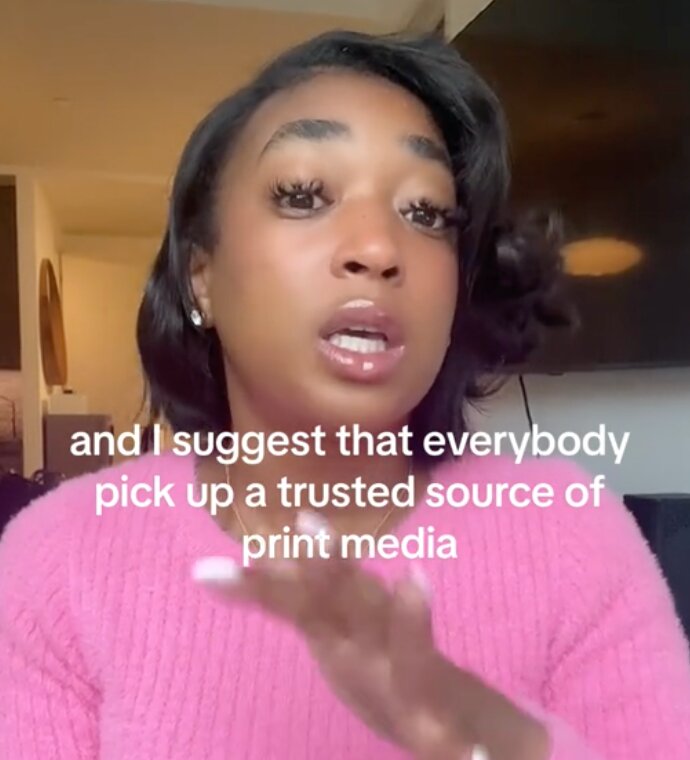
Meet TikTok’s “Print Princess,” Kelsey Russell, who leverages the platform to introduce her audience to news of the day; how to be critical about what they read; and how print can give us a break from screen time, as well as help us more meaningfully consider and retain information.
Among our news community, we frequently talk about “trust in news” and how it has eroded to dangerous levels. I’d suggest there are myriad reasons for that, including some that date back centuries. The press has always been a convenient punching bag. When people don’t like what they read, they naturally want to discount the information.
Some of the phenomenon is patently new, as we’ve seen with the increase in “lawfare” suits designed to chill journalists and shutter news organizations outright. There’s also the toxic political rhetoric, even shouted from the highest offices in the land, expressly to make people doubt watchdog and accountability reporting.
Now, we’re contending with Artificial Intelligence (AI), too, which is training people to doubt what they read and view.
Some of it is well-deserved. The press doesn’t always get the story right, especially in the rush to report first. Quality journalists among the American media are contrite when it happens, acknowledging their mistakes and offering corrections or retractions. Far too many outlets masquerading as trusted sources of news peddle misinformation and never acknowledge their failures to report accurately. That’s harmful, industry-wide.
I’d suggest the public also has a cynical view of how news is gathered and produced when they hear about strategic misdeeds, such as tabloid-style “catch and kill” stories — for example, when an adult film actress’ story about an affair with a politician never sees the light of day because the publisher and the porn star are paid to suppress it. It’s easy for the public to conflate that kind of “news” with what earnest, professional journalists produce day-in, day-out.
Indeed, there are many reasons — deserved and not — for the lack of trust in news today, but the important thing is that we’re thinking about it as an existential threat and doing our best to counter it. That’s why I’m bullish on The New York Times decision to convene a “trust team” that’s keenly focused on this issue.
At the link, read about my conversation with Edmund Lee, editor of The Times’ trust team and one of the ways they’ve built more transparency and familiarity into the display of news.
Ever wonder what it takes to produce Pulitzer Prize-winning journalism? I spoke with reporters and editors at three newsrooms that were awarded Pulitzers earlier this month. They spoke about the inspiration behind their award-winning series; the labors and resources the projects required; the dilemmas they faced during the news gathering; and ultimately, the impact.
I was talking to some Boomer-generation family members not long ago, who’d expressed frustration about the state of the world — not about big things, like war or the state of democracy, but about small, comparatively insignificant things. They complained about how nothing interested them on TV anymore, about the popularity of Taylor Swift, and how print menus had been replaced by QR codes. These grievances seemed petty to me, so I found myself imparting wisdom I gained far too late in life: “Not everything is made for you,” I told them.
It dawned on me that if you see things in the world in two categories — things you like = good; things you don’t like = bad — you’ll live your life in a state of perpetual frustration or agitation. It’s a far more pleasant existence to think, just because I don’t like something — just because it wasn’t produced with me as an audience or consumer in mind — doesn’t make something bad, unworthy, corrosive or a danger to society. Other people may like it, and they have a right to enjoy it and to exist, and it need not have any impact on you at all.
This same philosophy can — and should — be applied to people and lifestyles, too.
I thought about this as I read reporter Peggy Noonan’s account of attempting to interview protesters on Columbia University’s campus. She wrote about how they didn’t want to talk to her. “Friends, please come say hello and tell me what you think,” she implored them.
Frankly, if that’s how she approached the students, I wouldn’t be a bit surprised that they opted not to speak with her. “Friends …” does make it sound a bit disingenuous, like someone trying to draft you into a religious sect.
Journalist Peter Baker of The New York Times boosted Noonan’s remarks on X/Twitter, implying the students wouldn’t speak to her because they weren’t capable of articulating their reason for protesting.
Last week, when I spoke with several editors of school newspapers on campuses around the country, they all talked about students’ reluctance to speak to the press.
The editors explained to me that the student protesters — in fact their entire generation — is media savvy but also distrustful of the press. They worry of their remarks being misunderstood or intentionally misconstrued. They’ve grown up in an era in which “fake news” is a familiar concept and social media can make one inarticulate remark take on a life of its own.
Anish Vasudevan, the editor-in-chief of The Daily Orange at Syracuse University, explained how student protesters on campus have designated “media-trained” spokespersons expressly for these reasons.
As I spoke with these student journalists, it also confirmed how much newsroom “representation” matters today, especially among young people. They’re more inclined to feel seen, heard and understood when they’re talking to reporters who have some shared perspective, whether that’s ethnicity, gender, geography, race, language, education, a common campus, age or generation.
In many cases, student reporters were able to land the most meaningful interviews with their fellow students, because representation matters. It helps repair some of the deteriorated trust in news media when we see ourselves represented among the storytellers.
Maybe this story — this moment in history — isn’t for journalists like Noonan or Baker to chronicle. And that’s ok.
As with many other states today, Vermont is contending with a new cannabis economy. It has opened up a wellspring of opportunity for new businesses (dispensaries, growers and other cannabis-focused commercial organizations), associations, and for the state government to allocate and invest new tax revenue.
Building on a legacy news brand that dates back a century, Vermont News & Media saw its own opportunity to create a cannabis title, “Green Mountain Vermont Cannabis News,” to inform the public about cannabis laws and regulations, new businesses and jobs, and how to enjoy wider access to locally grown products. They’ve taken a different approach to the publication than other cannabis titles, choosing to reflect the state’s craft-cannabis culture.
E&P’s “Reporting On” series takes a look at what it’s like to be a journalist tasked with covering a national/international crisis, or an urgent public policy concern. This month, we spoke with journalists who report on the nation’s borders and ports. With as much national media—and particularly “cable news”—coverage as we have about the southern border, in particular, there is so much more to the story.
I learned a lot from these exceptional reporters, who take us to the border itself; share stories of what its like in communities like Chicago, where the border crisis has been brought to their doorsteps; who help sort through the politics and the realities; and turn our attention to the vulnerabilities of the nation’s ports, so critical to our economy and yet so rarely covered in the detail they deserve.
I set aside my own biases about immigration and allowed the reporters’ stories to stand tall here. But I’m perhaps not unlike so many other Americans who see that immigration is a many-layered complicated issue that’s just not being treated earnestly and effectively by our elected leaders. On radio and TV, we hear gripes about people not coming here “the right way,” but unlike the immigration channels of one or two generations ago, today’s path to citizenship is messy, long, prohibitive, frightening, expensive, and completely out of reach for so many immigrants. We’re failing in not exposing that story.
Having spent part of my childhood living in South America, I also know how dire and deadly life can be in nations to our south—measurably worse today than even in the 1970s. I can understand why people want to or are forced to leave their homes, their families, their livelihoods and their way of life. It’s not hyperbole to say it can be a life-or-death decision.
This is not to discount the serious and steady threat of bad actors coming across the border and exploiting desperate people, parents and their children. We need to stop them, and we often do. But surveillance technology, concertina wire, a big tall wall, and border enforcement alone won’t solve this crisis; it requires a retooling of foreign policy and thoughtful diplomacy rather than isolationism.
We are a champion nation. We broadcast to the world about our exceptionalism, what makes us special, what makes us wealthy, what makes us progressive, what makes us leaders, what makes us (comparatively) safe, what makes us free. To expect people from all over the world—especially poor nations plagued by crime and corruption—not to want to come here, in fact to risk their lives to become an American, is ill-considered.
When I was growing up, libraries seemed this quiet, unassuming certainty in everyday life. They were well-funded, accessible to everyone in the community, no matter why nor when you needed them. I saw librarians as all-knowing beings, who could find even the most obscure title on the stacks, without so much as a glance at a card catalog.
I worked for a while at my university library, in the periodical section. When students came in looking for references, I’d pull out newspapers and magazines from the bowels of the back or help them learn to use the microfiche machines — high-tech back then.
It may have been my paternal grandmother and her mother (Ida Locke, a librarian seen here) who encouraged my early reading.
Great-grandmother Locke lived with my grandparents, and I have fond memories of her seated on their sofa, a stack of books always present on the end table beside her. An insatiable reader, she could sail through a book in a single afternoon. She was a quiet, tiny mouse of a woman, always dressed for going out, even when there was no place to go. I can’t remember her voice, because she rarely offered even a hint of a smile nor a string of spoken words. But when I’d visit, she’d pat the sofa next to her, inviting me to sit and tell her what I was reading that week. Born to a German community in rural West Virginia, books were her way to rise above, to escape, to aspire — to work and have autonomy as a woman of that era.
Books didn’t change her nature — who she was or how she conducted her simple, frugal life — but they did broaden her perspective and informed her understanding of the world outside of her own.
I think about her a lot lately, as libraries are under attack from so many directions. Funding is imperiled. Politics has landed on their doorsteps. Shamefully, surreally, book bans — patently anti-liberty and anti-intellectual — are part of our national discourse. Librarians themselves are harassed and forced out of their jobs by politically motivated and dark money-funded mobs. Can democracy survive under these circumstances, I wonder? It feels symbolic of how we’ve lost our way.
We speak of polling in scientific terms — data, sample size, demographics. The goal is to be objective and fair, to randomly poll a lot of people across geography, ethnicity, income level, age, gender and more measurements that make the country so especially diverse.
Yet, polling is inherently subjective. After all, the responses pollsters elicit from respondents can largely depend on the questions they ask, how they’re worded, how consistently they’re asked, and whether they’re asked in the same way over a period of time.
There’s also the variable of sincerity and whether people answering polls are honest.
Perhaps it’s human nature to distrust polling data that doesn’t affirm our own opinions, even when presented with insight into how a poll is conducted. However, there are quality control measures that challenge the veracity of polls. And editors make decisions about what to publish based on those tests.
At E&P, we wanted to better understand polling methodologies and best practices, and how news media publishers can responsibly communicate polling data to the public. At the link, read about the work of polling organizations like Quinnipiac University, Gallup and The New York Times as they endeavor to gauge what matters to Americans.
Journalists in war zones navigate complexities, danger and how to make the story resonate with audiences far removed — geographically and emotionally — from the fighting
From the December 2023 Editor & Publisher magazine:
In the 1990s, I worked at a law firm while getting my grad degree. My job wasn’t clearly defined. I answered phones, paid the bills, and drafted correspondence and pleadings for the senior partners. One of the partners worked in criminal law, and working with his team allowed me insight into some horrific crimes — not the least of which was a compelling case against the Archdiocese for the alleged sexual abuse and rapes now made famous by the Netflix documentary, “The Keepers.”
That same attorney introduced me to a convicted murderer, for whom he was mounting a death penalty appeal. The man had been sentenced to death, along with a buddy, for murdering a Baltimore woman in her home. She was a single gal, a professional who lived alone. According to the defendants’ testimony, they’d gone to her home one evening, thinking she wasn’t there. Once inside, they scouted the first floor, looking for items of value to grab. They came to the kitchen and felt hunger pangs. They opened the refrigerator, took out some ingredients and began cooking up a snack on her stove.
But she was home.
Upstairs, she was sleeping in an early bed. The clanging sound of pots and pans and cooking utensils woke her. She stirred, and the sound jolted the intruders down below. One of the men grabbed a 10-inch chef’s knife — at trial, they’d pointed fingers at each other, accusing the other of wielding the knife — and they went upstairs.
They forced her back to the bed. To silence her screams, they put a pillow over her face. Then, the man holding the knife stabbed her dozens of times, including a final blow that penetrated the pillow and impaled her through the breastplate.
As I tell you this story, the hair on your arms might stand at attention. You might feel revulsion at the brutality of it. You might for just a fleeting moment consider what it was like for her in those final horrific moments. But you’ll never really understand the violence unless you saw the crime scene photos.
I had to sift through them one day, stacks upon stacks of black-and-white glossies taken by law enforcement and shown to jurors as evidence during the trial. To this day, I can remember how she looked, frail and tiny and limp. The simple furnishings around her defied why anyone would want to rob her. She had so little, just starting out in life.
Blood was everywhere — pooling on the sheets, seeping through the soft, worn pillowcase, where the knife was embedded in her body. It was splattered on the walls, the carpet, the nightstand.
I’m sure my heart fell out of rhythm when I noticed in one of the photos that she was wearing a nightgown with Ziggy, a cartoon character, childlike. I had the same nightgown when I was a teenager. I have a photo of me in it from one Christmas morning.
I cried for hours in our little law library. I still cry when I think about those images — when I think of her — today. They were hard to look at, certainly for the jurors who were deciding the defendants’ fate. But they needed to see them, to fully understand, to grapple with the violence, to make informed decisions and to act accordingly.
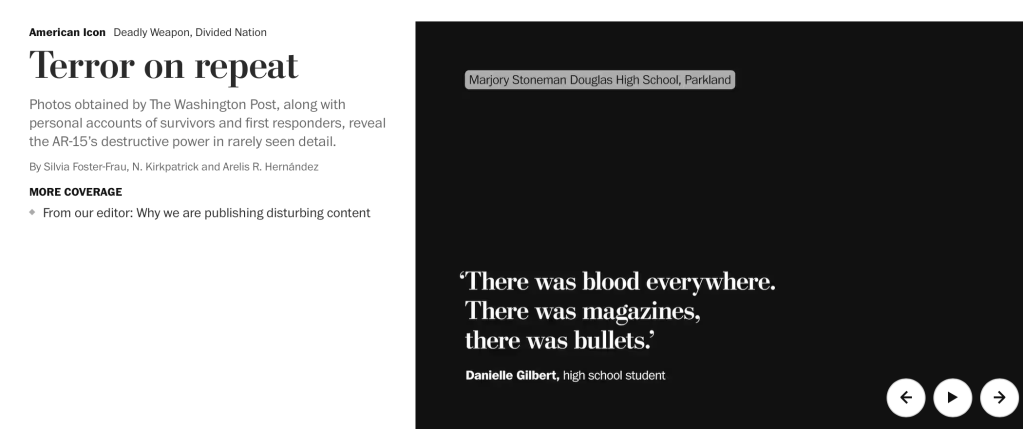
Yesterday, The Washington Post published a controversial investigative piece, “American Icon: Terror on Repeat, a rare look at the devastation caused by AR-15 shootings.”
The piece is controversial for its graphic photos, showing the horror, carnage and death inflicted by people with access to a weapon of war — a gruesome tool designed expressly for hunting human beings.
As long as I have worked in news, there has been fervent debates among journalists about graphic images and what is beyond the pale for the viewing public. This is not an easy professional nor moral call. And it’s often the case that new outlets are accused of exploitation and shock value for publishing violent imagery.
I spoke with a Pulitzer-awarded photojournalist this week, for whom I have the utmost respect. She’s been covering war for more than 23 years, and has paid witness to the very worst of humanity, the very worst violence, the absolute worst gore. Over the course of her career, she’s faced this dilemma an untold number of times, weighing which images to submit for publication and which ones are simply too grotesque to inflict on others.
She spoke thoughtfully about her worry that if a photograph is too distasteful to a person, they’ll simply turn the page or switch the channel and move along, negating all of the work and danger it took to capture it, negating the story of the victims.
If they can’t stand to look at the photo, they can’t care about the people, she explained to me.
We talked a little about the skills a journalist acquires on the war beat, and how they translate here in America for local news reporters who find themselves covering crises, like mass shootings. If you’re intrigued, I’ve written more about our conversation in the December issue of Editor & Publisher.
I implore you to look at the photos in WaPo’s important piece of journalism.
Fit yourself in the cowboy boots of young people running from rapid gunfire, when moments before they were singing along to country music.
Stand over the body bags lining an elementary school hallway, with the corpses and parts of children zippered inside, and imagine what it’s like to be their parents, their friends, the adults who failed to protect them.
Fight the urge to turn away from the picture of pews, soaked in blood, the walls of the church pockmarked and splintered by an AR-15s spray.
No narrative, no amount of pontificating, no amount of wrestling with the right adjectives can communicate the story more honestly and accurately than these videos and photos.
He’s right: Why should these images only haunt him and the victims’ families? We’re all responsible for gun violence in this country, because we turn away, we move on, we conscientiously — by choice — build up our tolerance to it.
I get tangled up on the question of whether it’s the press’s duty to somehow soften the blow, to make violence and murder more palatable to the public? Or is it a newsroom’s duty to depict the crime and its aftermath with unobscured clarity?