
Food, Travel, Culture, Health, Military Service, News & Publishing, Non-fiction, Politics & Public Policy, TV, Radio, Audio

Where have you gone, Bill Maher?

Bill Maher likes to say he hasn’t changed — that it’s his audience who changed.

But he certainly did evolve, and I can pinpoint the precise year that evolution began: 2014.

That was the year students at the University of California, Berkeley, protested Maher’s December commencement keynote. Though he ended up delivering the address, the incident chafed and bruised Maher’s thin skin. You see, some of the students didn’t like Maher’s take on Islam; they felt his comments had crossed a line from fair criticism to overt racism. Maher argued that the tolerance they were demanding was entirely lacking from the religion they were championing.

I am not debating either point here. My point is that the experience changed him. It soured him to liberalism. He hasn’t been the same since.

On Friday night, he began his show with a taunting, “Yeah, I did it again, bitches. … Fuck you. I like these dinners,” referring to a dinner he attended with the President, Kid Rock and Stephen A. Smith this week.

Maher spends a lot of each “Real Time” episode mocking the Left — while turning a blind eye to his dinner companion as he literally sets the world ablaze.

The contrast between Maher of the aughts and Maher of the 2020s is glaring.

It’s hard to overstate how impactful Maher’s show was as President George W. Bush took the country to war in the aftermath of 9/11. It was a time when anyone who spoke out against the President or the Iraq War was labeled a terrorist sympathizer, a traitor. And Maher, to his credit, had people on his program like Michael Moore, who rightfully questioned the administration and the justification for war.

Maher asked the tough questions at a time when it was wildly unpopular to break free of the groupthink — a sort of stupor the nation had collectively fallen into. He threaded the needle between humor and earnest, probing curiosity — a comedian who could actually do journalism.

He could be self-deprecating. He could express empathy. He still had a sense of humility and could admit when he didn’t know something, or when he’d been wrong about a topic. He was genuinely funny. Even in the darkest times, he made us laugh, and it felt like a release, a long-awaited exhale when we did.

All of that is gone.

Once, an unapologetic atheist who highlighted atrocities made in the names of all religions, Maher now wholly sides with Israel in the Israel-Palestinian war, portraying the millennia-old conflict as black and white — the good guys versus the bad guys. It’s hard to square that with the Maher of 20 years ago, who could’ve objectively looked at the war to see atrocities on both sides. He could’ve held two truths in his mind: That Hamas is a terrorist organization and committed horrific acts on October 7, which must be punished, and that Israel’s response was relentless, indiscriminate and arguably criminal.

That Maher is gone, too. This Maher routinely dismisses pro-Palestinian protesters as anti-Semitic, immature and ignorant. He nitpicks the definition of genocide.

The past few years, Maher has dedicated a lot of his show to rants about a woke bogeyman, elevating the lore and amplifying the fear.

He frequently smack talks Democrats, insisting there’s a big contingent in the party that espouses anarchy and seeks to abolish the police. But there is not a single candidate running for election this year whose platform includes defunding the police. Granted, there are TWO candidates who came under fire for previously shitposting about cops.

Maher may forget that he was once a fierce critic of militarizing local police departments. Not a peep about that now.

There are 23 U.S. House and Senate candidates who won their primaries based on a platform that includes abolishing ICE. But ICE is a whole other animal, and of course, Maher knows that.

Politicians on the Right, many of whom can’t define the distinctions between the economic models of Capitalism, Communism and Socialism, have followed the President’s lead, choosing a blanket term: communists! And Maher’s fallen in lockstep with them.

Outlets like the Associated Press, PolitiFact and FactCheck.org have all done investigations into communist sympathies among this season’s candidates. The Associated Press even interviewed Joe Sims, the co-chair of the Communist Party USA, who said there are no — none, zero — candidates for either congressional chamber who are communists, nor anyone who subscribes to its Marxist ideologies.

On the matter of Socialism, across the entire country, there are 10 Democratic Socialists of America-endorsed congressional candidates this midterm cycle. They represent just 2.3% of the Democrat’s House candidates. It would be interesting to put Bernie Sanders (an Independent and avowed Democratic Socialist) in front of Maher again — a politician he used to respect if not revere — and see if he suddenly remembers what it means to be a Democratic Socialist, or if he’d conflate it with communism and call Sanders a communist to his face.

On this week’s show, Maher strangely pressed guest Gov. Andy Beshear (D-KY) to renounce communism, like some modern-day Joe McCarthy, but with a TV show and a stoner podcast.

Meanwhile, Maher and his writers largely ignore the hugely consequential democracy-destabilizing things like voter suppression, the politicization of the Justice Department, the destruction of allied relationships around the world, the Trump administration’s egregious attack on the free speech and the free press, growing Christian Nationalist influence over the federal government, and the unbridled, rampant corruption committed by the President, his family and his cronies.

There is so much he could sink his teeth into. But what we get, instead, is another bit about Sydney Sweeney’s breasts and Maher advocating for the President’s vanity ballroom.

You may have noticed that, like the current President, Maher is easily seduced by flattery, celebrity and awards. For as long as he’s been on TV, he’s been a shameless name-dropper. Count how many times he refers to guests on his show as friends. He wants you to know he has access to celebrities and people in power. I’d argue that’s what he likes most about Trump — that he has access to the President of the United States, and he doesn’t want to lose it.

So, every show feels like appeasement now — like he’s playing to an audience of one.

Or maybe the “Real Time” viewership only comes from producing MAGA clickbait now? Have all the liberals, progressives — and those scary communists and socialists — tuned out?

I mourn the Bill Maher of 20 years ago. Back then, I paid for an HBO subscription when I “didn’t have two nickels to rub together,” because I valued the conversations he moderated, the thoughtfulness of the guest bookings. The show felt serious, timely — in fact, urgent — and impactful. I was such a fan of the show that my family would tease me that I had to be home at 10 p.m. on Friday nights to watch my “boyfriend’s” show, a standing weekly date.

It’s probably too wishful to think “Real Time” will return to that format — accessible, conversational, earnest, LIVE journalism. It suited Maher as a host, and it was exponentially more constructive for the audience. He might also ponder a tip from this old reporter: Consider your sources. When you give a guest like Karoline Leavitt that coveted first chair and your one-on-one attention, it signals to the audience that honesty, integrity and truth are no longer of consequence to you.

Military Service, News & Publishing, Non-fiction, photography, Politics & Public Policy, TV, Radio, Audio

Reporting on the war in the Middle East: Reporters contend with lack of access, harassment, censorship, arrests and danger to bring the front lines to readers worldwide

In late summer, I spoke with two journalists — Julian Borger, world affairs editor for The Guardian, and Nabih Bulos, who is the Los Angeles Times’ Middle East bureau chief — tasked with telling the story of the broadening war in Gaza. We spoke about the challenges of war coverage — about safety, working with local fixers and other journalists on the ground, about reporting on a region that it was nearly impossible to gain access to, and about the unpredictable nature of the work itself. For foreign correspondents, war means perpetual motion, a never-ending chase for anecdotes and atrocities, and meaningful context in sea of gray. 

The only certainty, it seemed to me, was the volatility and the potential for the war to entrap or entice other nations and other terrorist groups to join the fight. And that’s precisely how it’s playing out. With just a few days of my discussions with Bulos and Borger, Hezbollah fired rockets into northern Israel. 

Since, Israel retaliated by detonating pagers and mobile devices they believed to be in the hands of Hezbollah operatives. Iran-launched missiles rained down on Israel, and now the world holds its collective breath for Israel’s inevitable response to Iran’s assault. The one-year anniversary of the war passed. 

The statistics I cited in the story are already obsolete. Since October 7, 2023, the war has now claimed the lives of 1,706 Israelis, 42,409 Palestinians, and 2,448 in Lebanon. 

It is also one of the deadliest wars in the modern era for journalists. 128 have died. 40 have been wounded. At least 2 remain missing, according to the Committee to Protect Journalists. Please consider their sacrifices as you read this latest installment in our “Reporting On” series: 

https://www.editorandpublisher.com/stories/reporting-on-the-war-in-the-middle-east,252455

Military Service, News & Publishing, Politics & Public Policy

Reporting on war and conflict

Journalists in war zones navigate complexities, danger and how to make the story resonate with audiences far removed — geographically and emotionally — from the fighting

From the December 2023 Editor & Publisher magazine:

https://www.editorandpublisher.com/stories/reporting-on-war-and-conflict,247155

Military Service, News & Publishing, Politics & Public Policy, Uncategorized

History Repeats

A pilgrimage back to the battlefields of Gettysburg

By Gretchen A. Peck

Growing up in a then-small town in mid-state Maryland, the Commonwealth of Pennsylvania always beckoned from the north. As 5th-graders, we’d travel to Camp Round Top for a standard-curriculum introduction to cabin life and campfire songs. Those who could afford it trekked up to places like Seven Springs for high-school ski trips. Towns like York and Reading appealed to our parents for stuff like farm-fresh canned goods and outlet shopping. It was rare to venture far enough east or west to get a taste of the big cities in Pennsylvania. I didn’t see Pittsburgh until I was well into my 40s, and Philadelphia eluded me until I was in college and in control of my own journeys. 

Though it felt like an epic adventure back then—through the wide-eyed but impatient eyes of a child — Gettysburg was an easy day-trip destination for parents and teachers who wanted to leverage some pretty remarkable local history. As a kid, I went there twice. Both times are etched in my memory still — one a fond trip; the other, a not-so-fond trip involving a banana-seated bicycle and a flashy Mercedes-Benz. 

The fonder of those two trips was with my main pal, my great-grandmother, Ruth. She was always rather independent and still felt comfortable behind the wheel of one those iron-horse American-made cars and station wagons she used to drive. I can’t be certain if she pitched the idea of a day trip to Gettysburg because she was intrigued by the history herself, or if she was just looking for a way to keep a precocious kid occupied for a span of time, but northward we went to the battlefields of Gettysburg. 

Gettysburg

I knew about Gettysburg’s history, probably because I’d read about it independently. I was a voracious, above-grade reader with an affinity for history and historic fiction. I don’t know what I expected of the battlefields there, which I knew to have claimed the lives of thousands of men, but as we drove Gettysburg’s rolling hills and past its stacked stone walls, I found them to be just pretty countryside, but otherwise unremarkable. It was hard to imagine them littered with the bodies of dead and dying soldiers. Then again, it was hard to imagine fellow countrymen turning on one another at all. It didn’t sit well with me then, as a child, and doesn’t now.

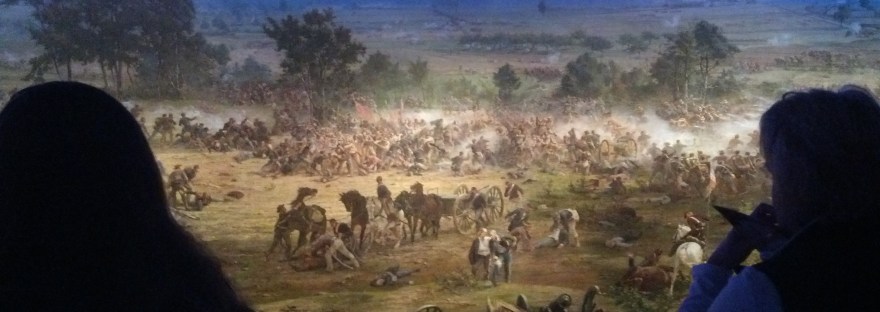
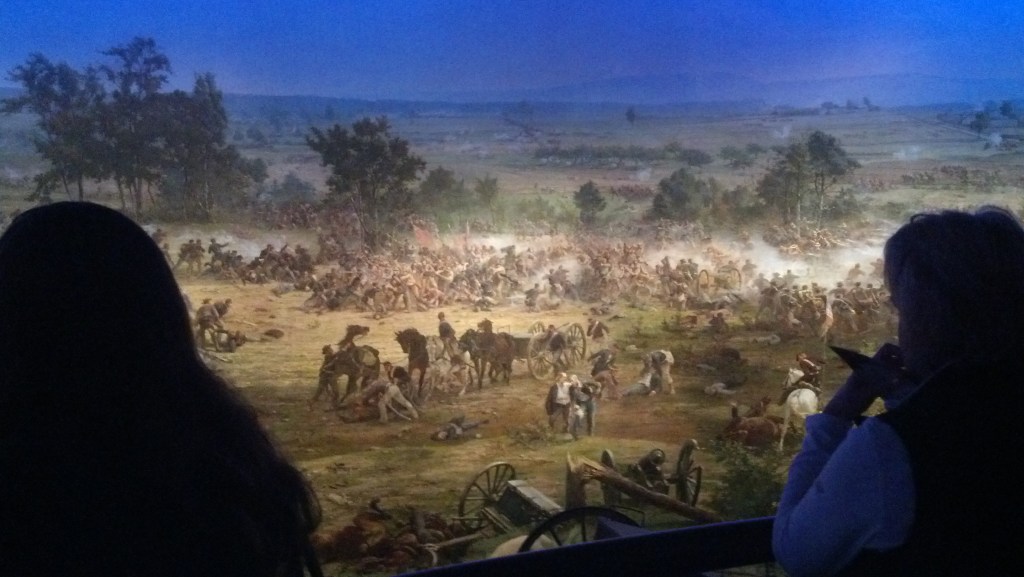
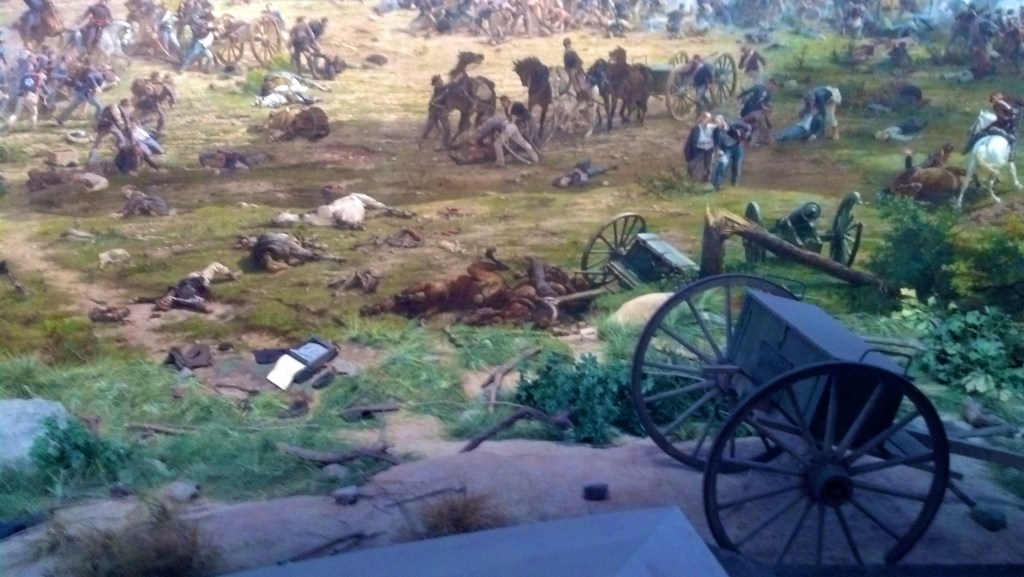
At the museum commemorating the pivotal battle, there was an interactive display — what they refer to as a cyclorama — a painting by French artist Paul Philippoteaux that offers a 360-degree depiction of the battleground’s horrors and the spoils of war. The artist shied not away from the gore, and viewing the battlefield like that helped me to imagine what those bucolic fields looked like in July 1863. I spun around, taking it all in, aghast at the blood and carnage. 

Cyclorama depicting the Battle of Gettysburg
Cyclorama (detail)

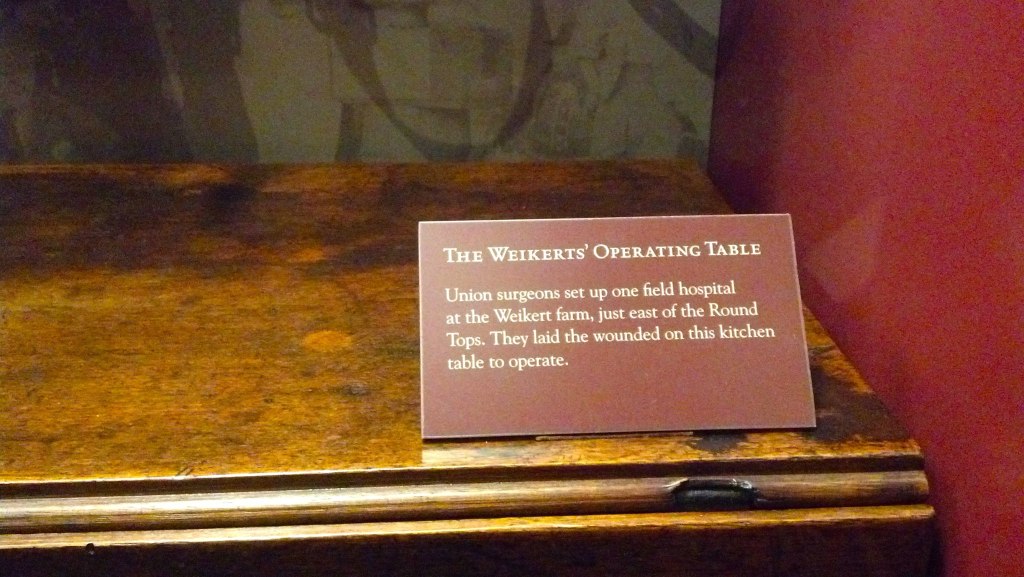
There was another artifact from the museum that I thought I remembered so vividly—an old wooden table used as a makeshift operating table. As a child, I stared in horror at the rough-blade saws they used for amputation with little to soothe the wounded soldiers. The table had what appeared to be a stain, and I gasped at the thought that no one had thought to wipe away the blood before putting it on display. 

Before we headed for home, my great-grandmother bought me a fold-out miniature depiction of the cyclorama, on glossy postcard stock. I unfolded it on my lap and studied it the whole way home. 

I was in my 40s when I went back to Gettysburg on a cold misty-mountain day, the end of a brief but cathartic pilgrimage back to where I began. Decidedly middle-aged by then, I had new perspective on childhood homes and places of significance around my hometown. I toured it with my parents, and we spoke of memories, avoiding the hardest ones. After the visit, I packed my truck and headed north toward home in Pennsylvania. I toyed with the idea of stopping in Gettysburg, but it was threatening to rain and I kept that in the back of my mind as an excuse not to make the pitstop. 

But something compelled me to retrace the steps my great-grandmother and I had walked together decades before. 

I thought of her as I bought my ticket, and wandered through the exhibits. She felt beside me as I ascended the long escalator to the theater-in-the-round where they cyclorama painting is on display. I could practically hear her laughter when I walked up to the display of the operating table to see that the “stain” I’d remembered was most likely just the natural grain of the wood and some wear and tear — the blood I’d conjured were just a child’s imagination run amok. 

Kitchen table/Operating table

I brushed by families and stood by myself reading the plaques and watching the video clips throughout the exhibit. I thought about the toxicity of politics, how it inherently divides up the nation into neat little categories, largely based on where and to whom we’re born. I thought of the barbarism of the war, the hand-to-hand, eye-to-eye combat, an intimate, personal war waged among neighbors and families and fellow countrymen. 

What would the weapons of Civil War be today?

It seemed to me then, even as a child, a wholly absurd notion. I felt men were to blame and women had to suffer their consequences. Now that members of Congress like Rep. Marjorie Taylor Greene (R-GA) openly flirt with the idea of civil war, like it’s the stuff of romantic nostalgia, I can no longer blame the barbarism on men alone. I do imagine that the civil war the Congresswoman pines for will not be so “fairly” fought, with men in uniforms on rural battlefields, but instead through cowardly acts of terror.

By the time I found my middle-aged self in Gettysburg back on that misty day, the nation’s politics had once again turned toxic, like a sepsis from a wound that never really healed. It’s exponentially worse now — in 2022, as we sit — so much more vitriolic, hateful, and steeped in a scourge of misinformation. 

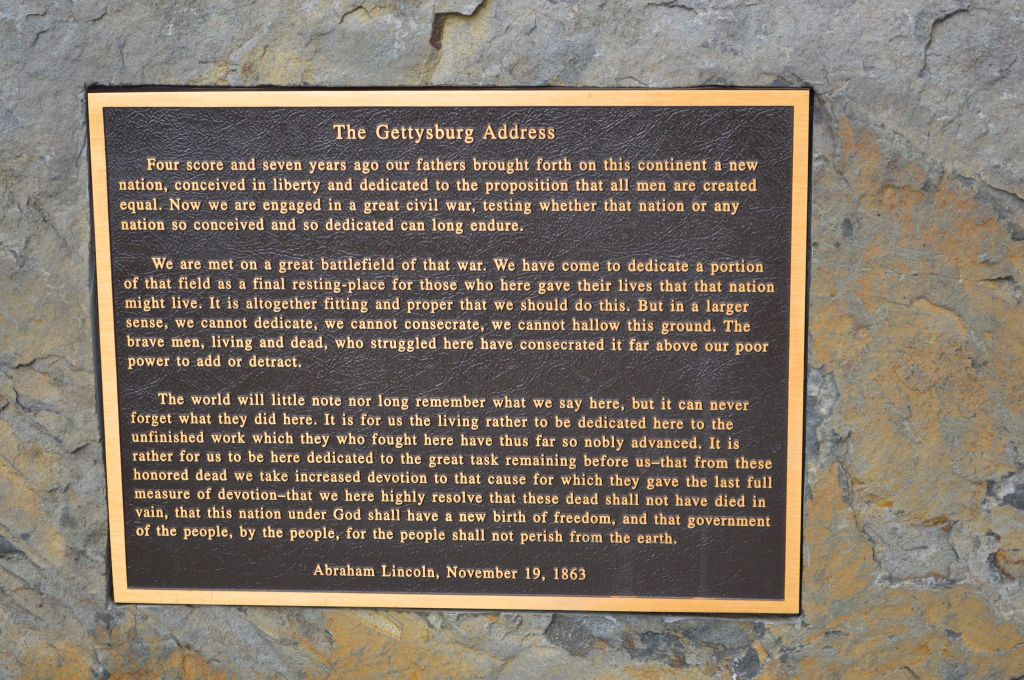
Before I left Gettysburg in my wake for that third time in my life, I stopped in the gift shop — now, a gift shop on steroids — and bought water for the ride home, a soldier bag for my husband (he’d hate it if I called it a murse, which it is), and a mug depicting the Gettysburg address for me. Just outside the gift shop sat a table where visitors could “Send a Message to the Troops” via postcard. I filled one out, and hoped it found someone out in some far-off “battlefield” and makes her or him feel thought-of and important.

I stopped to snap a selfie with a bronze statue of President Abraham Lincoln before getting on the road, just long enough to hear a strange conversation unfold between a father and son coming up the path to see the museum. “Lincoln,” the child exclaimed when he saw the statue where I was taking my selfie. “Take a picture of me, Daddy,” the little boy pleaded. There was an awkward pause before the father said, “Nah. Nah. Not now. Besides, he was on the other side.”

I thought of my great-grandmother again in that moment, by all accounts a church-going, southern, conservative Republican woman to her core. There was never any question how she came down on such matters. Slavery was immoral, a sin, and a war fought on slavery’s behalf — pitting neighbor against neighbor, countryman against countryman, brother versus brother — was, too. This was not up for debate.

She’d brought me to that hallowed battlefield to instill that in me. 

“War is cruelty.”

It felt tragic, almost surreal, to see a child brought to that solemn place and taught otherwise — its lessons not just missed but mistaken, misrepresented, warped.  Once again it feels surreal to see members of Congress masticating the possibility of bloodshed, or to read articles by pundits pondering whether Civil War in the United States is inevitable or has already begun. 

Perish the thought. 

Military Service, Politics & Public Policy, Uncategorized

On Memorial Day

My father-in-law died just two springtime’s ago. Not a day goes by when I don’t think of him—often, fondly and expressed with laughter. Sometimes, it’s with regret. 

We’d come north to be closer to him after my mother-in-law passed away. We knew he’d need our attention and care as the years compounded. These were bonus years, we felt, when got to know him, when we spoke of meaningful things, including his reflections on life, people, history, politics, and even war. He’d tell us his catalog of stories, as if he’d never told them before, as if we hadn’t heard them dozens of times. We knew that one day, we’d miss hearing him tell them. 

That day didn’t come until he was 95 years old, after he’d led a full life, equal parts remarkable and ordinary. 

There are days when we feel the deep, profound loss, a black hole that cannot be sated, always threatening to suck you into its mysterious depths. 

Those are the days when I think of all the questions we neglected to ask, all the memories he never got to share or didn’t want to.

Through his eyes, we’d seen the world in a different way. He could change your way of thinking with his perspective. He did that for me on numerous occasions, about things that I already thought I’d had all figured out—poverty and frugality, simplicity, curiosity, race, charity, death, religion, friendship, family, humor, war. 

What a privilege to have had the time with him, I know, and I’m especially aware of it today, when so many families gather to mourn their loved ones who never came home from war. I think of their generations of loved ones deprived of the simple moments strung together to make a complicated, fulfilled life. I think of those who never got to say goodbye, left with medals, mementoes and incessant, gnawing what-could-have-beens.

My father-in-law and all four of his brothers served in WWII, and they each came home to their family—perhaps not whole and unscathed, but alive. I’m sure not a day passed for any of them when they didn’t think of their fellow Americans, their brothers and sisters in the Army, Navy and Marine Corps, who perished.

One of the stories my father-in-law used to tell was how he’d come back home from his “island-hopping” tour of the South Pacific and made a pitstop in San Francisco before making the cross-continental trek home to New Haven, Connecticut. He called home right away. His father answered in an impatient bark: Who the hell is this?

It’s me, his third eldest son said into the receiver, explaining his current location.

His father softened, but pointed out that it was the middle of the night in New Haven, Connecticut, and that he’d been awoken from a sound sleep by the phone call.

When my father-in-law told this story, he’d chuckle at the memory. Who the hell is this, he’d say, imitating his father’s gruff-Yankee tone.

Of course, his parents, siblings, and community must’ve been relieved. One son was on his way home—news worth a sleepless night, which is why we’d all laugh along during his retelling.

Today, I think of all those families who didn’t get a call like that, who received entirely different, generationally devastating news, instead. May we take today to be still and reflect on their profound loss and sacrifice.