Journalists in war zones navigate complexities, danger and how to make the story resonate with audiences far removed — geographically and emotionally — from the fighting
From the December 2023 Editor & Publisher magazine:
In the 1990s, I worked at a law firm while getting my grad degree. My job wasn’t clearly defined. I answered phones, paid the bills, and drafted correspondence and pleadings for the senior partners. One of the partners worked in criminal law, and working with his team allowed me insight into some horrific crimes — not the least of which was a compelling case against the Archdiocese for the alleged sexual abuse and rapes now made famous by the Netflix documentary, “The Keepers.”
That same attorney introduced me to a convicted murderer, for whom he was mounting a death penalty appeal. The man had been sentenced to death, along with a buddy, for murdering a Baltimore woman in her home. She was a single gal, a professional who lived alone. According to the defendants’ testimony, they’d gone to her home one evening, thinking she wasn’t there. Once inside, they scouted the first floor, looking for items of value to grab. They came to the kitchen and felt hunger pangs. They opened the refrigerator, took out some ingredients and began cooking up a snack on her stove.
But she was home.
Upstairs, she was sleeping in an early bed. The clanging sound of pots and pans and cooking utensils woke her. She stirred, and the sound jolted the intruders down below. One of the men grabbed a 10-inch chef’s knife — at trial, they’d pointed fingers at each other, accusing the other of wielding the knife — and they went upstairs.
They forced her back to the bed. To silence her screams, they put a pillow over her face. Then, the man holding the knife stabbed her dozens of times, including a final blow that penetrated the pillow and impaled her through the breastplate.
As I tell you this story, the hair on your arms might stand at attention. You might feel revulsion at the brutality of it. You might for just a fleeting moment consider what it was like for her in those final horrific moments. But you’ll never really understand the violence unless you saw the crime scene photos.
I had to sift through them one day, stacks upon stacks of black-and-white glossies taken by law enforcement and shown to jurors as evidence during the trial. To this day, I can remember how she looked, frail and tiny and limp. The simple furnishings around her defied why anyone would want to rob her. She had so little, just starting out in life.
Blood was everywhere — pooling on the sheets, seeping through the soft, worn pillowcase, where the knife was embedded in her body. It was splattered on the walls, the carpet, the nightstand.
I’m sure my heart fell out of rhythm when I noticed in one of the photos that she was wearing a nightgown with Ziggy, a cartoon character, childlike. I had the same nightgown when I was a teenager. I have a photo of me in it from one Christmas morning.
I cried for hours in our little law library. I still cry when I think about those images — when I think of her — today. They were hard to look at, certainly for the jurors who were deciding the defendants’ fate. But they needed to see them, to fully understand, to grapple with the violence, to make informed decisions and to act accordingly.
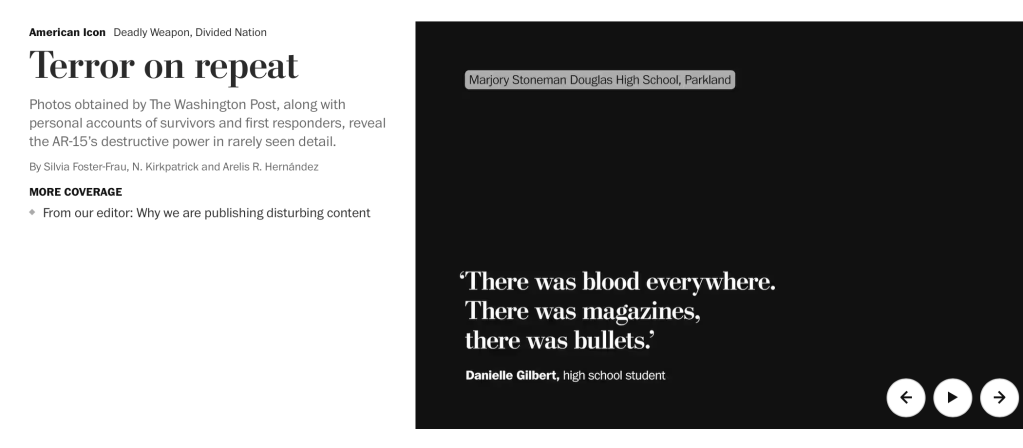
Yesterday, The Washington Post published a controversial investigative piece, “American Icon: Terror on Repeat, a rare look at the devastation caused by AR-15 shootings.”
The piece is controversial for its graphic photos, showing the horror, carnage and death inflicted by people with access to a weapon of war — a gruesome tool designed expressly for hunting human beings.
As long as I have worked in news, there has been fervent debates among journalists about graphic images and what is beyond the pale for the viewing public. This is not an easy professional nor moral call. And it’s often the case that new outlets are accused of exploitation and shock value for publishing violent imagery.
I spoke with a Pulitzer-awarded photojournalist this week, for whom I have the utmost respect. She’s been covering war for more than 23 years, and has paid witness to the very worst of humanity, the very worst violence, the absolute worst gore. Over the course of her career, she’s faced this dilemma an untold number of times, weighing which images to submit for publication and which ones are simply too grotesque to inflict on others.
She spoke thoughtfully about her worry that if a photograph is too distasteful to a person, they’ll simply turn the page or switch the channel and move along, negating all of the work and danger it took to capture it, negating the story of the victims.
If they can’t stand to look at the photo, they can’t care about the people, she explained to me.
We talked a little about the skills a journalist acquires on the war beat, and how they translate here in America for local news reporters who find themselves covering crises, like mass shootings. If you’re intrigued, I’ve written more about our conversation in the December issue of Editor & Publisher.
I implore you to look at the photos in WaPo’s important piece of journalism.
Fit yourself in the cowboy boots of young people running from rapid gunfire, when moments before they were singing along to country music.
Stand over the body bags lining an elementary school hallway, with the corpses and parts of children zippered inside, and imagine what it’s like to be their parents, their friends, the adults who failed to protect them.
Fight the urge to turn away from the picture of pews, soaked in blood, the walls of the church pockmarked and splintered by an AR-15s spray.
No narrative, no amount of pontificating, no amount of wrestling with the right adjectives can communicate the story more honestly and accurately than these videos and photos.
He’s right: Why should these images only haunt him and the victims’ families? We’re all responsible for gun violence in this country, because we turn away, we move on, we conscientiously — by choice — build up our tolerance to it.
I get tangled up on the question of whether it’s the press’s duty to somehow soften the blow, to make violence and murder more palatable to the public? Or is it a newsroom’s duty to depict the crime and its aftermath with unobscured clarity?
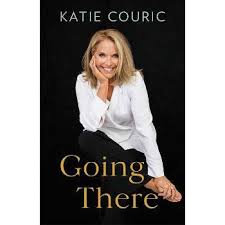
Katie Couric’s 2021 memoir is perfectly titled: Going There
It’s clever, because it relates to so many facets of her story—the places she went (physically and emotionally) over the course of her decades-long career in news; the torment of recalling profound loss and grief; or how she took a chance at love again.
Whether you’ve been a fan or a casual observer, Couric’s familiar voice comes through in the text.
Full disclosure, I once felt full-on fangirl when Couric retweeted me during the pandemic—both of us grateful for journalists who were covering “the front lines” of COVID.
As far as women in news go, Couric is legendary. And her memoir could’ve easily gone down a chest-thumping path, boasting of her myriad hard-news features and epic longevity on TV screens. Instead, there’s a raw, earnest quality to her retelling of the story that’s genuine and approachable, like Couric herself, as we come to see.
She shares with us what it was like to grieve her husband, her sister, her parents. She speaks honestly about loss, motherhood, exhaustion, but also about love, redemption and gratitude.
I’ve always felt the most effective memoirs are those that demonstrate a change and a maturation of the autobiographer: what you learn, who you come, what you overcome.
Life isn’t Instagram.
Going There is deeply introspective, particularly when Couric recounts her regrets and miscalculations along the way—missing signs that her beloved first-husband Jay was ill; unwisely choosing partners after his death; anecdotally putting career ahead of family; and a slew of professional missteps that make her (and us) cringe today.
Most of all, it’s a tome about journalism and TV news, from a woman’s point of view during a transformative time, spanning the age of overt misogyny and sexual misconduct to the post-#MeToo modern day.
Couric peels back the curtain on what it was like to navigate network politics, sexism and fierce competition, not just between the TV networks, but sometimes among your own network team. I’ll think about “60 Minutes”—a staple Sunday-night show in our home growing up—a little differently after learning how Couric was treated by the producers and fellow journalists.
Recently, in conversation with someone else in news, I used the term “working sources,” and I was met with silence on the other end of the line; then, a question: What do you mean by ‘working sources?’ More condemnation than question. And I explained what I feel it’s like to land an important interview, particularly with someone who may be initially reluctant to go on record, let alone on camera. I spoke of building trust, of having conversations, perhaps meeting in person, explaining my process, being fully transparent and honest—but, in effect, working to get the interview.
Couric gives us a no-holds-barred account of “working sources,” crediting her bookers and producers for contortionist-like moves to woo them. In the print world that I know, there are clearly defined ethics on such matters, and one of them is that we don’t accept gifts from them, and they shouldn’t expect from us in return. It seems TV news is a bit more cut-throat competitive, and that there are gray areas on such matters.
I (and I’m sure a lot of women readers) also appreciated how Couric spoke about trying to balance the two sides of her professional personality—serious, right-toned journalist versus the quirkier, fun, silly, sometimes smart-ass side of her personality. The TODAY Show gave her the perfect platform for that balancing act.
“Katherine or Katie, the serious journalist or the smiley cutup … the tension between those two sides of my nature would run like a fault line through my career,” she reflects.
Couric writes about Jeff Zucker and Matt Lauer, men with whom she’d had as close a professional relationship as you might have; both proved grave disappointments in the end.
Couric took a lot of heat when Going There first came out, particularly about her recounting of an interview with SCOTUS Justice Ruth Bader Ginsburg. Couric asked Justice Ginsburg about Colin Kaepernick’s protests. The Justice expressed how she found it disgraceful—not what you might expect from a liberal-leaning, First Amendment-affirming judge. Couric revealed how she wrestled with the editorial decision about whether to keep the exchange in the interview, or to cut it out. Critics decried that it was Couric’s duty to broadcast her remarks, that it was journalistic malpractice not to. She’s not objective, they said, citing Couric’s admission that she greatly admired Ginsburg.
But that’s journalism. You bring personal perspective to your reporting. How can you not? You are a person, a citizen, with lived experiences like anyone else. You learn things, and those things inform you as you move through life and, professionally, into others’ lives. These editorial dilemmas come up in nearly every interview or reporting assignment, especially in hard news and investigative journalism.
“I know I’m being fair when everybody’s mad at me,” Walter Kronkite once told Couric.
If all this sounds intriguing, I hope you’ll read the book, and check out Couric’s Instagram for more of her “smiley cutup” side.
Within the past five years — and certainly during the height of the pandemic — I began to notice the term “building community” come up in conversation a lot, particularly with local news publishers and journalists. It’s certainly not a new concept — the idea that a local newspaper (or news site) doesn’t just inform the community; it also provides a thread that runs through the community, creating a sense of belonging and a reminder of shared vested interests.
Every local news outlet does this in some way. It’s inherent. But E&P went in search of stories of news media publishers striving to meaningfully connect with the community and to foster community engagement in positive ways. At the link, you’ll read about two of them — The Lansing Journal and The Spokesman-Review.
The past few years have been remarkable for news media publishers, which have enjoyed some particularly public and powerful support. In the U.S. Congress, representatives and senators from both sides of the aisle sponsored legislative proposals that would secure press protections (the PRESS Act), get news agencies a seat at the table in negotiations with Big Tech (Journalism Competition & Preservation Act, the JCPA), and a proposal that would provide financial relief to local news businesses (the Local Journalism Sustainability Act, or LJSA).
Under Founder Steve Waldman’s direction, Rebuild Local News has been lobbying statehouse legislators to adopt bills that would provide tax credits to small businesses that advertise in local news media, to newsrooms that retain or hire more journalists and to individuals who subscribe or donate to a local news outlet.
While these champions for local news have been hard at work, powerful forces have been running a counteroffensive — undermining the press, impeding access and making it easier for members of the public and political class to sue news organizations.
A pilgrimage back to the battlefields of Gettysburg
By Gretchen A. Peck
Growing up in a then-small town in mid-state Maryland, the Commonwealth of Pennsylvania always beckoned from the north. As 5th-graders, we’d travel to Camp Round Top for a standard-curriculum introduction to cabin life and campfire songs. Those who could afford it trekked up to places like Seven Springs for high-school ski trips. Towns like York and Reading appealed to our parents for stuff like farm-fresh canned goods and outlet shopping. It was rare to venture far enough east or west to get a taste of the big cities in Pennsylvania. I didn’t see Pittsburgh until I was well into my 40s, and Philadelphia eluded me until I was in college and in control of my own journeys.
Though it felt like an epic adventure back then—through the wide-eyed but impatient eyes of a child — Gettysburg was an easy day-trip destination for parents and teachers who wanted to leverage some pretty remarkable local history. As a kid, I went there twice. Both times are etched in my memory still — one a fond trip; the other, a not-so-fond trip involving a banana-seated bicycle and a flashy Mercedes-Benz.
The fonder of those two trips was with my main pal, my great-grandmother, Ruth. She was always rather independent and still felt comfortable behind the wheel of one those iron-horse American-made cars and station wagons she used to drive. I can’t be certain if she pitched the idea of a day trip to Gettysburg because she was intrigued by the history herself, or if she was just looking for a way to keep a precocious kid occupied for a span of time, but northward we went to the battlefields of Gettysburg.
Gettysburg
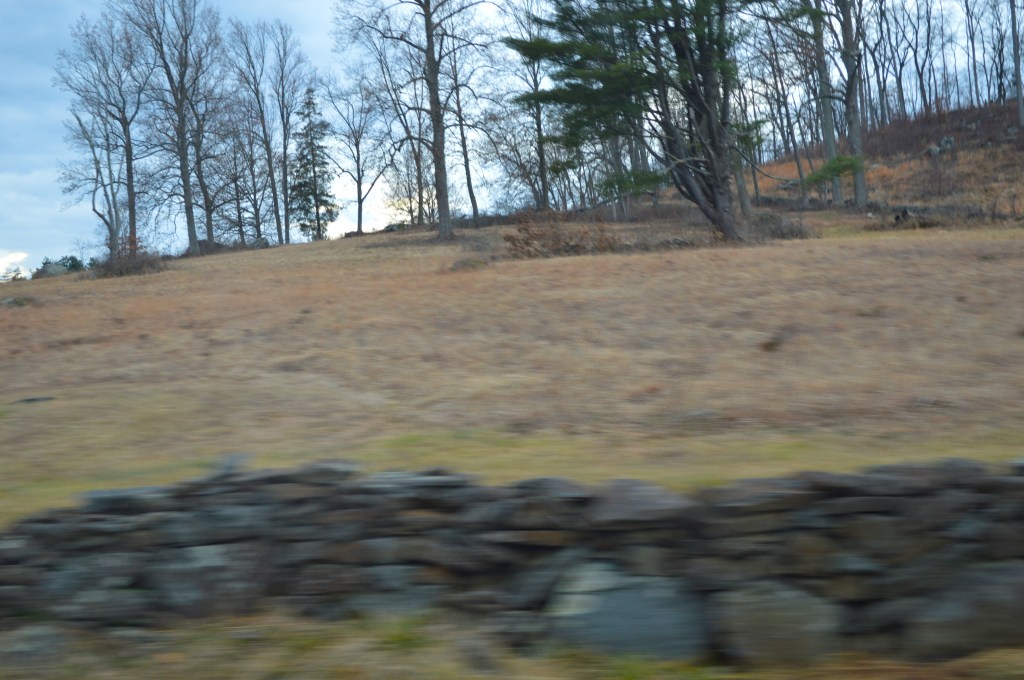
I knew about Gettysburg’s history, probably because I’d read about it independently. I was a voracious, above-grade reader with an affinity for history and historic fiction. I don’t know what I expected of the battlefields there, which I knew to have claimed the lives of thousands of men, but as we drove Gettysburg’s rolling hills and past its stacked stone walls, I found them to be just pretty countryside, but otherwise unremarkable. It was hard to imagine them littered with the bodies of dead and dying soldiers. Then again, it was hard to imagine fellow countrymen turning on one another at all. It didn’t sit well with me then, as a child, and doesn’t now.
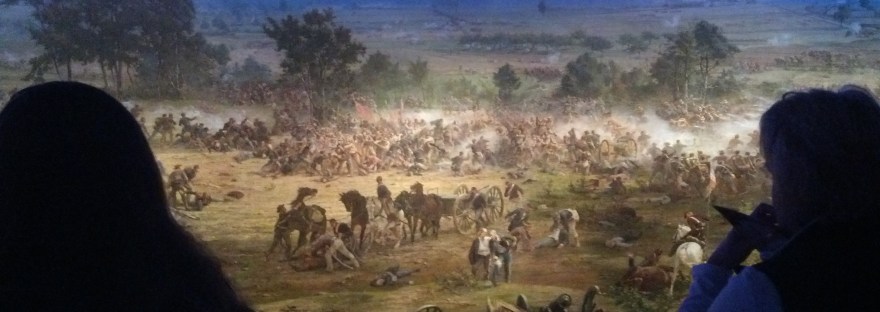
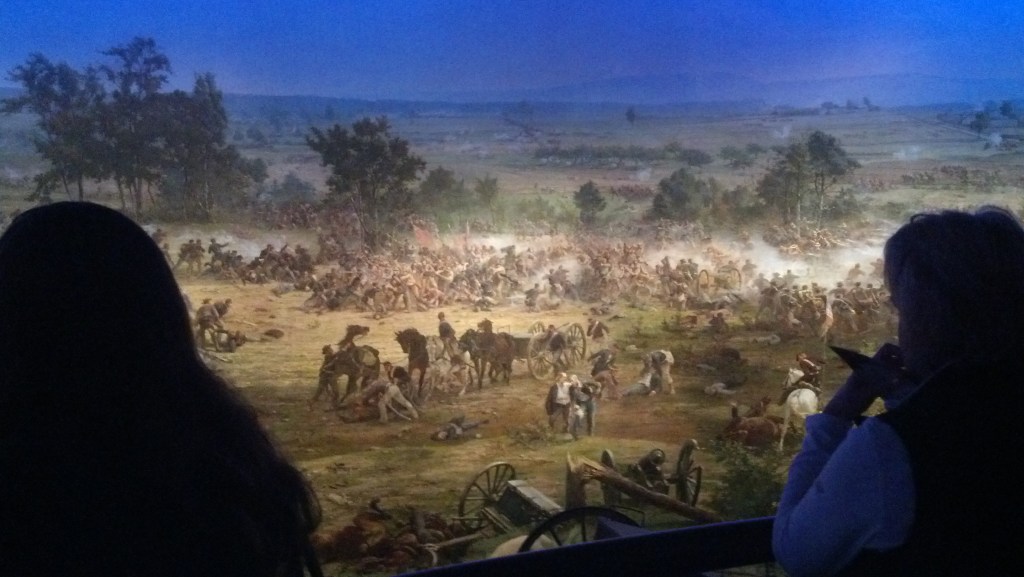
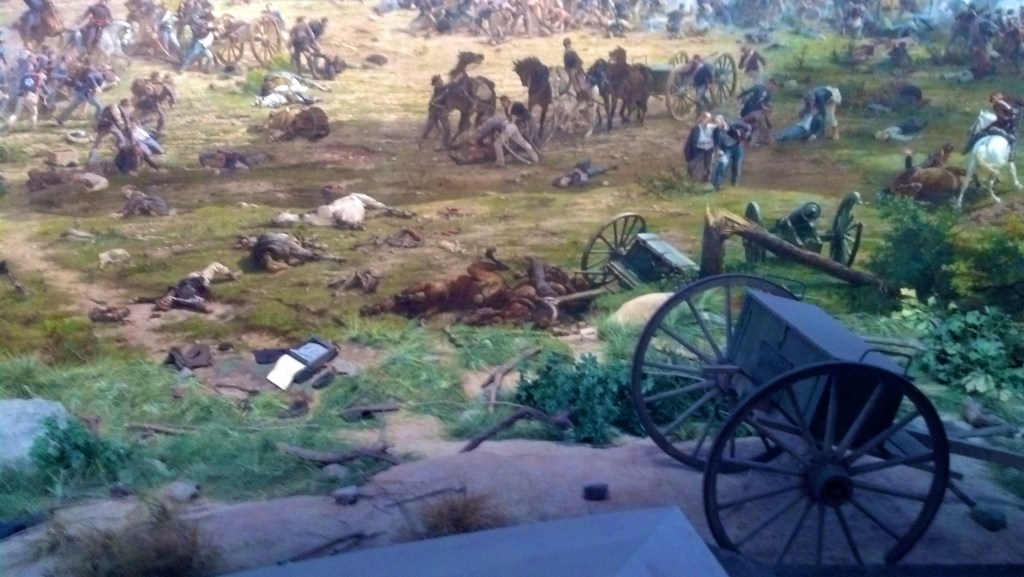
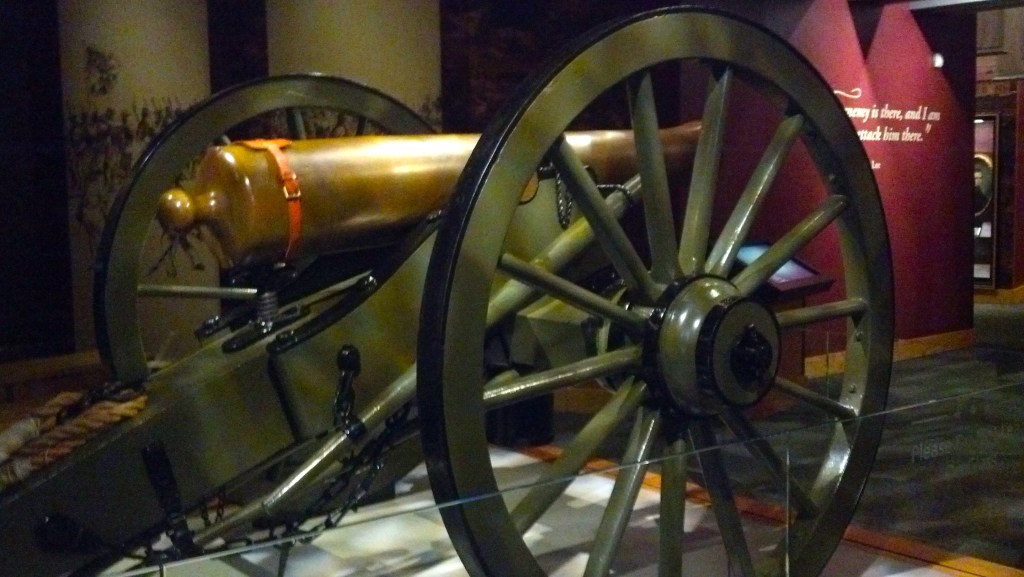
At the museum commemorating the pivotal battle, there was an interactive display — what they refer to as a cyclorama — a painting by French artist Paul Philippoteaux that offers a 360-degree depiction of the battleground’s horrors and the spoils of war. The artist shied not away from the gore, and viewing the battlefield like that helped me to imagine what those bucolic fields looked like in July 1863. I spun around, taking it all in, aghast at the blood and carnage.
Cyclorama depicting the Battle of GettysburgCyclorama (detail)
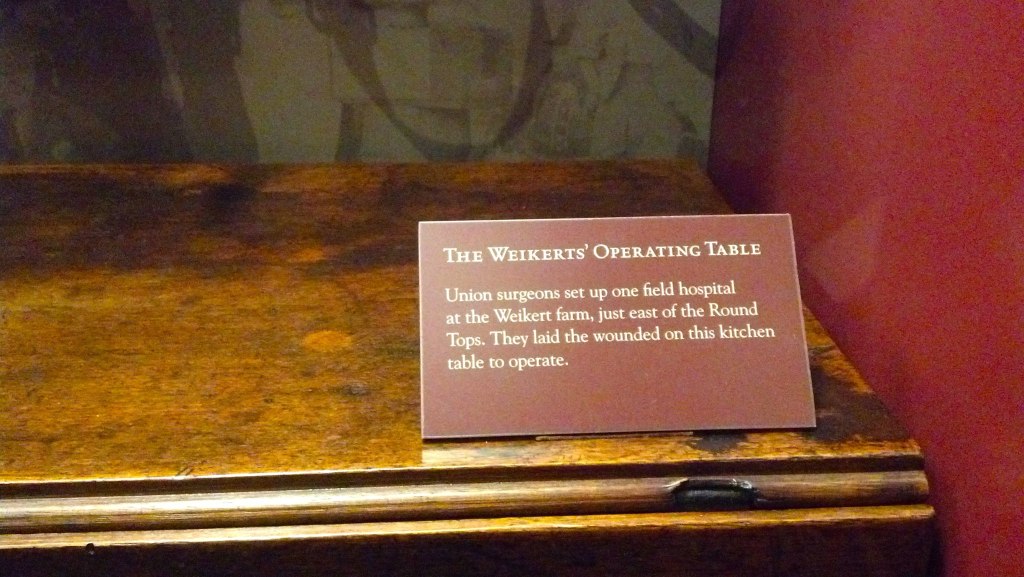
There was another artifact from the museum that I thought I remembered so vividly—an old wooden table used as a makeshift operating table. As a child, I stared in horror at the rough-blade saws they used for amputation with little to soothe the wounded soldiers. The table had what appeared to be a stain, and I gasped at the thought that no one had thought to wipe away the blood before putting it on display.
Before we headed for home, my great-grandmother bought me a fold-out miniature depiction of the cyclorama, on glossy postcard stock. I unfolded it on my lap and studied it the whole way home.
I was in my 40s when I went back to Gettysburg on a cold misty-mountain day, the end of a brief but cathartic pilgrimage back to where I began. Decidedly middle-aged by then, I had new perspective on childhood homes and places of significance around my hometown. I toured it with my parents, and we spoke of memories, avoiding the hardest ones. After the visit, I packed my truck and headed north toward home in Pennsylvania. I toyed with the idea of stopping in Gettysburg, but it was threatening to rain and I kept that in the back of my mind as an excuse not to make the pitstop.
But something compelled me to retrace the steps my great-grandmother and I had walked together decades before.
I thought of her as I bought my ticket, and wandered through the exhibits. She felt beside me as I ascended the long escalator to the theater-in-the-round where they cyclorama painting is on display. I could practically hear her laughter when I walked up to the display of the operating table to see that the “stain” I’d remembered was most likely just the natural grain of the wood and some wear and tear — the blood I’d conjured were just a child’s imagination run amok.
Kitchen table/Operating table
I brushed by families and stood by myself reading the plaques and watching the video clips throughout the exhibit. I thought about the toxicity of politics, how it inherently divides up the nation into neat little categories, largely based on where and to whom we’re born. I thought of the barbarism of the war, the hand-to-hand, eye-to-eye combat, an intimate, personal war waged among neighbors and families and fellow countrymen.
What would the weapons of Civil War be today?
It seemed to me then, even as a child, a wholly absurd notion. I felt men were to blame and women had to suffer their consequences. Now that members of Congress like Rep. Marjorie Taylor Greene (R-GA) openly flirt with the idea of civil war, like it’s the stuff of romantic nostalgia, I can no longer blame the barbarism on men alone. I do imagine that the civil war the Congresswoman pines for will not be so “fairly” fought, with men in uniforms on rural battlefields, but instead through cowardly acts of terror.
By the time I found my middle-aged self in Gettysburg back on that misty day, the nation’s politics had once again turned toxic, like a sepsis from a wound that never really healed. It’s exponentially worse now — in 2022, as we sit — so much more vitriolic, hateful, and steeped in a scourge of misinformation.
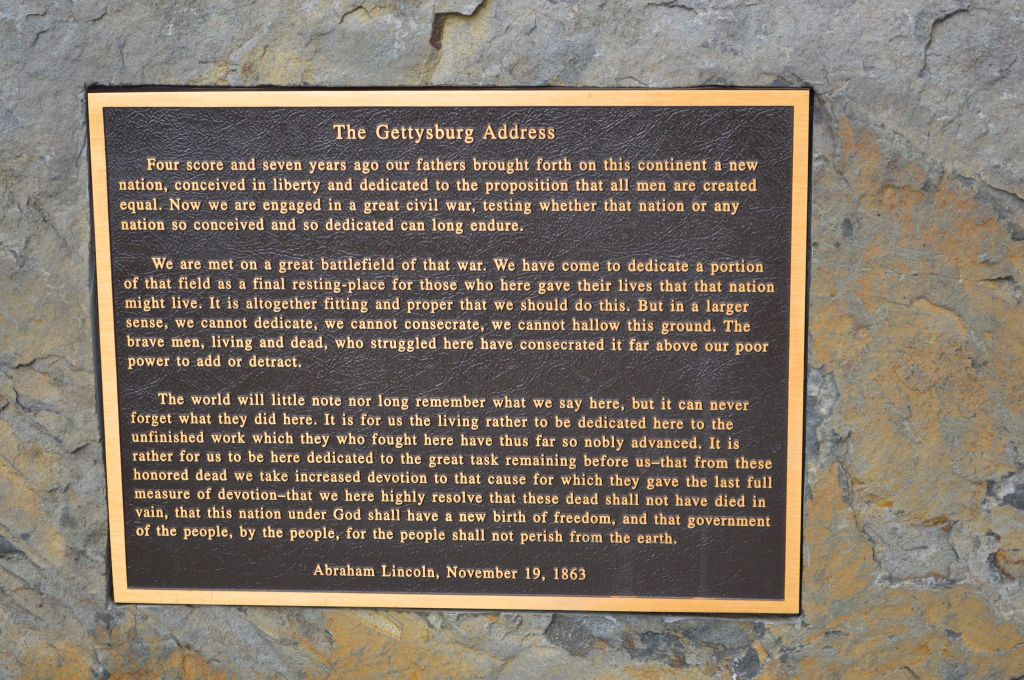
Before I left Gettysburg in my wake for that third time in my life, I stopped in the gift shop — now, a gift shop on steroids — and bought water for the ride home, a soldier bag for my husband (he’d hate it if I called it a murse, which it is), and a mug depicting the Gettysburg address for me. Just outside the gift shop sat a table where visitors could “Send a Message to the Troops” via postcard. I filled one out, and hoped it found someone out in some far-off “battlefield” and makes her or him feel thought-of and important.
I stopped to snap a selfie with a bronze statue of President Abraham Lincoln before getting on the road, just long enough to hear a strange conversation unfold between a father and son coming up the path to see the museum. “Lincoln,” the child exclaimed when he saw the statue where I was taking my selfie. “Take a picture of me, Daddy,” the little boy pleaded. There was an awkward pause before the father said, “Nah. Nah. Not now. Besides, he was on the other side.”
I thought of my great-grandmother again in that moment, by all accounts a church-going, southern, conservative Republican woman to her core. There was never any question how she came down on such matters. Slavery was immoral, a sin, and a war fought on slavery’s behalf — pitting neighbor against neighbor, countryman against countryman, brother versus brother — was, too. This was not up for debate.
She’d brought me to that hallowed battlefield to instill that in me.
“War is cruelty.”
It felt tragic, almost surreal, to see a child brought to that solemn place and taught otherwise — its lessons not just missed but mistaken, misrepresented, warped. Once again it feels surreal to see members of Congress masticating the possibility of bloodshed, or to read articles by pundits pondering whether Civil War in the United States is inevitable or has already begun.
Relationships with sources are more scrutinized and more complicated than ever
By Gretchen A. Peck
Access journalism. Follow threads about the press or conversations among journalists and it’s bound to come up in discussion. Fundamentally, access journalism occurs when reporters value landing a source more than the information gleaned from that source.
But what do readers, viewers, or other members of the public mean when they use the term as criticism? Is it simply expedient and pithy, just a new way to disparage the press?
More importantly, what does the practice or appearance of access journalism mean to the trust audiences and the public place in their news sources? And how should we prepare new journalists coming into the field for navigating the access minefield?
My father-in-law died just two springtime’s ago. Not a day goes by when I don’t think of him—often, fondly and expressed with laughter. Sometimes, it’s with regret.
We’d come north to be closer to him after my mother-in-law passed away. We knew he’d need our attention and care as the years compounded. These were bonus years, we felt, when got to know him, when we spoke of meaningful things, including his reflections on life, people, history, politics, and even war. He’d tell us his catalog of stories, as if he’d never told them before, as if we hadn’t heard them dozens of times. We knew that one day, we’d miss hearing him tell them.
That day didn’t come until he was 95 years old, after he’d led a full life, equal parts remarkable and ordinary.
There are days when we feel the deep, profound loss, a black hole that cannot be sated, always threatening to suck you into its mysterious depths.
Those are the days when I think of all the questions we neglected to ask, all the memories he never got to share or didn’t want to.
Through his eyes, we’d seen the world in a different way. He could change your way of thinking with his perspective. He did that for me on numerous occasions, about things that I already thought I’d had all figured out—poverty and frugality, simplicity, curiosity, race, charity, death, religion, friendship, family, humor, war.
What a privilege to have had the time with him, I know, and I’m especially aware of it today, when so many families gather to mourn their loved ones who never came home from war. I think of their generations of loved ones deprived of the simple moments strung together to make a complicated, fulfilled life. I think of those who never got to say goodbye, left with medals, mementoes and incessant, gnawing what-could-have-beens.
My father-in-law and all four of his brothers served in WWII, and they each came home to their family—perhaps not whole and unscathed, but alive. I’m sure not a day passed for any of them when they didn’t think of their fellow Americans, their brothers and sisters in the Army, Navy and Marine Corps, who perished.
One of the stories my father-in-law used to tell was how he’d come back home from his “island-hopping” tour of the South Pacific and made a pitstop in San Francisco before making the cross-continental trek home to New Haven, Connecticut. He called home right away. His father answered in an impatient bark: Who the hell is this?
It’s me, his third eldest son said into the receiver, explaining his current location.
His father softened, but pointed out that it was the middle of the night in New Haven, Connecticut, and that he’d been awoken from a sound sleep by the phone call.
When my father-in-law told this story, he’d chuckle at the memory. Who the hell is this, he’d say, imitating his father’s gruff-Yankee tone.
Of course, his parents, siblings, and community must’ve been relieved. One son was on his way home—news worth a sleepless night, which is why we’d all laugh along during his retelling.
Today, I think of all those families who didn’t get a call like that, who received entirely different, generationally devastating news, instead. May we take today to be still and reflect on their profound loss and sacrifice.
In this month’s Editor & Publisher magazine, check out the cover story. I spoke with news organizations about the past pandemic-challenged year and how they’ve managed through the tumult.
With a federal antitrust suit against Google and Facebook, a single newspaper publisher seeks to level the playing field
By Gretchen A. Peck
Tech giants Google and Facebook aren’t strangers to antitrust litigation and Congressional scrutiny, but in a first-of-its-kind case, the two companies have been named as defendants in a federal antitrust lawsuit filed by a newspaper publisher.
The plaintiff, HD Media Co., LLC, is the West Virginia-based publisher of seven titles, including the Pulitzer Prize-winning Charleston Gazette-Mail and the Herald-Dispatch, a historically significant newspaper that dates back to 1871.
On Jan. 29, the publisher filed its lawsuit in the Southern District of West Virginia. To small community and regional newspaper publishers across the nation, the action may seem like David squaring off against a two-headed Goliath.