Looking back over four decades I’ve spent in publishing, I have found that the most successful newsrooms I’ve worked in or consulted for have had a cooperative organizational culture. It’s typical for editors to lead daily or weekly newsroom staff meetings to discuss reporting projects in the works, accomplishments and obstacles to work around. But what I’ve observed is the benefit of broader team cooperation, too.
In one newsroom where I served as the editor, I regularly brought together not only the newsroom team, but also periodically welcomed the publisher and members of the staff representing production, marketing, IT, audience, data and art/creative to join us. While traditionally these roles are distinguished and separate, it became apparent to me early in my career that they are each a critical gear in the publishing machine. They literally have to work in tandem to make the engine run. Routine interaction allowed for every member of the team to have a voice and an opportunity to express their observations, challenges and ideas. They felt valued and empowered.
That’s not just a feel-good byproduct, it had practical benefits, too. Together, we created great things—compelling brand messaging, newsletter and special supplements, interactive storytelling, fresh design for our covers and pages, powerful impact reports, and live events, including three conferences that brought together thousands of attendees. It strengthened our magazine’s brand and galvanized our team.
If you are operating as silos, you’re missing opportunities for innovation—and, in this climate, growth and the potential for long-term sustainability.
I spend many of my days telling the stories of local newsrooms around the country doing exemplary work, serving their communities with practical information, uplifting perspectives — building community, as we say. Over the decades I’ve been on this “beat,” it’s been thoroughly rewarding work. Not only do I enjoy turning the spotlight on these storytellers, it’s fortified my long-standing belief that journalism is foundational to democracy. Without the First Amendment, nothing that becomes before or after it in the U.S. Constitution really matters. Without it, a nation spirals into autocracy, theocracy, despotism. Without it, corruption runs unbridled.
And I still believe this with every cell and synapse of my being.
But I’ve grown weary. The constant onslaught of anti-press rhetoric, endorsed by the highest offices in the land has admittedly weakened my resolve in recent years. The nation’s slide toward authoritarianism — our inability to even argue from a baseline of facts — is such a profound disappointment. At times, it makes me wonder if all the hard work of my colleagues in the media is worth it when it increasingly feels like screaming into a void.
I felt at the lowest point when I read the news that ABC News had settled a lawsuit brought by the President elect for comments made by anchor George Stephanopoulos during a “This Week” interview with Rep. Nancy Mace (R-SC). During the interview, the news anchor pressed Mace on her endorsement of the then candidate, considering Mace herself has spoken openly about being raped when she was a teenager. During his query, the anchor said that Donald J. Trump had been found liable for rape in the civil defamation suit E. Jean Carroll brought and won — with the jury awarding her $83.3 million.
Trump took issue with the word “rape” and filed suit against the network. Keep in mind that even the judge in the case described the initiating offense in this way: “The jury’s finding of sexual abuse therefore necessarily implies that it found that Mr. Trump forcibly penetrated her vagina.”
If forcibly penetrating a woman’s vagina – whether with a penis, an object or a hand — isn’t “rape,” then once again, it feels as if we’re not operating from a baseline of facts. It feels like arguing semantics in Atwood’s Gilead.
Before the case could advance further to the discovery phase, ABC News and George Stephanopoulos agreed to a settlement that required an escrowed $15 million to fund a future Donald J. Trump Presidential museum, another $1 million for Trump’s legal fees, and a public apology by the journalist – in other words, an admission of defamation.
Tim Miller and William Kristol — notably former Republicans — had a conversation about the perils of criticizing Trump. They wrote on thebulwark.com, “ABC News and George Stephanopoulos have joined the preemptive capitulation parade by settling Trump’s defamation suit—and by conspicuously paying out protection money ahead of the inauguration. The potential chilling effect on a key First Amendment issue is breathtaking.”
Northeastern Professor Dan Kennedy opined in his newsletter: “What Stephanopoulos said arguably wasn’t even false, and surely it didn’t amount to actual malice. A deep-pockets defendant like Disney ought to stand up for the First Amendment lest its cowardly capitulation to Trump harm other media outlets without the wherewithal to fight back.”
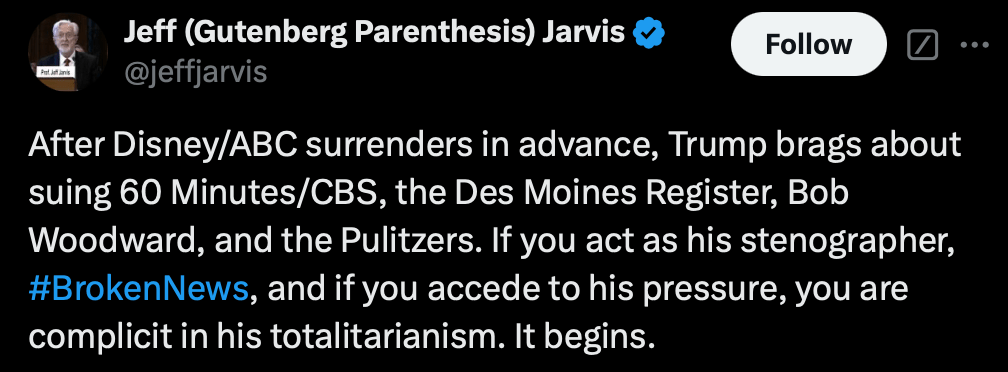
On Twitter/X, Jeff Jarvis, author and journalist, issued a warning:
Of course, none of us had a seat at the conference table surrounded by high-hourly-rate lawyers, so it’s purely speculation as to why the news media publisher agreed to settle. Some say the legal definition of rape in New York is a higher benchmark than this form of sexual assault. Others said the network didn’t want to be forced into protracted and expensive discovery, during which the President’s legal team could request all sorts of documentation, from producers’ correspondence to business strategy, personal calendars and diaries, footage from every show that mentioned Trump, social media posts, you name it.
Discovery is long and hard fought, typically with the Plaintiff asking for everything under the sun, and the Defendant having to go to court to argue against each non-related or protected journalist-source item.
Still others speculated that the $15 million settlement was such an insignificant amount for the parent organization, the Walt Disney Company, that it just made sense to pay it and get it over and done with. After all, an ongoing legal battle would’ve further impeded the network’s ability to gain access or fairly report on the incoming Administration. All of these reasons could simultaneously be true, too.
But the impact of the settlement has ripples — no, asphyxiating currents — that will reach far beyond the parties. It’s ammunition for a President and party that has continued to portray the press as “the enemy of the people.” It may not further embolden Trump himself to bring lawsuits against news outlets — he’s done that, usually unsuccessfully, for decades and long before he fatefully descended down the Trump Tower escalator to declare his first candidacy. And there’s no sign that he plans to slow down. Last week, he filed suit against the Gannett-owned Des Moines Register and pollster Ann Selzer over an unfavorable poll they published prior to election, alleging the poll — a poll, for goodness sakes — was akin to “election interference.”
But it will embolden others, particularly the political and powerful classes, to wield lawfare as a weapon to intimidate the press, to send a chill through the media, and in some cases, to kill off news outlets entirely — destroyed by the weight of defending protracted legal battles. Death by billable hour.
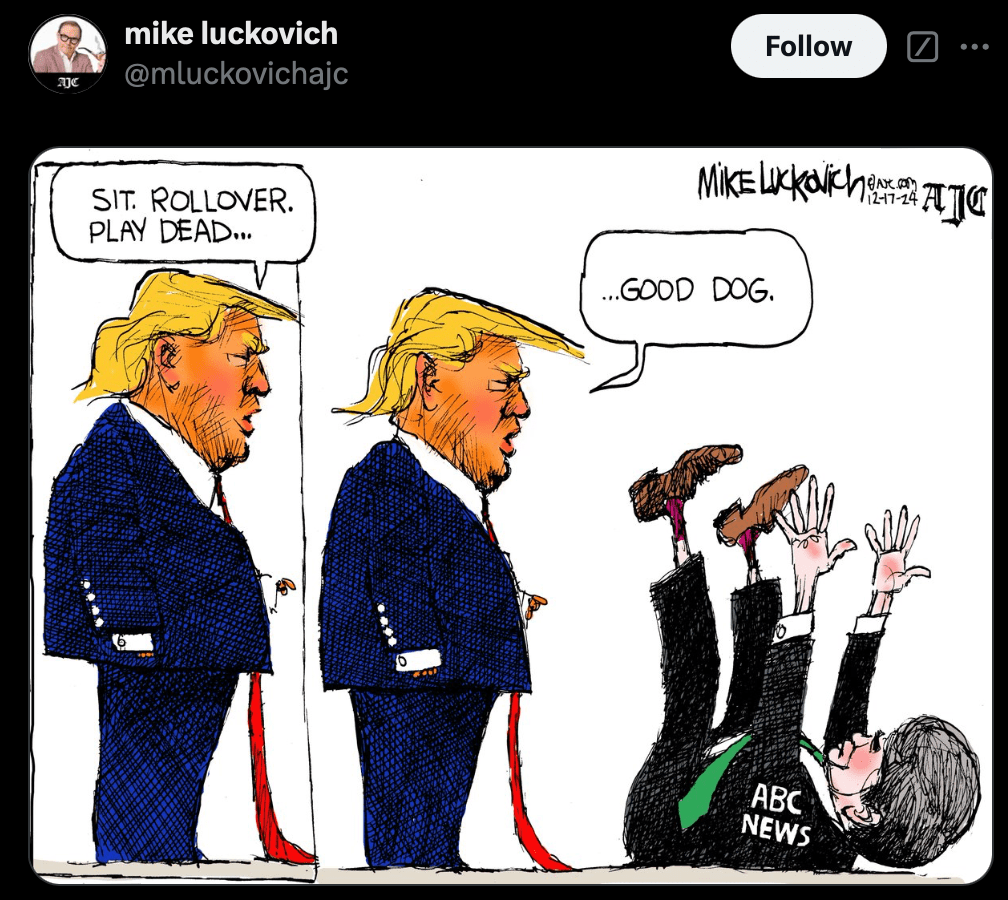
Atlanta Journal-Constitution Cartoonist Mike Luckovich so perfectly memorialized the settlement, shared on Twitter/X:
In E&P’s January issue, Columnist Rob Tornoe shares a conversation with Luckovich about being a political cartoonist in the era of Trump. You’ll want to read it.
And let’s be clear, lawfare is not just a threat to large media conglomerates. It oozes down to regional and local newsrooms, as well.
“I fear the federal attack on the press will trickle down locally, and it will be harder to get information through normal channels and freedom of the press requests,” Katie Honan, reporter for THE CITY, observed in Nieman Lab’s “Predictions for Journalism, 2025” series.
The other way it corrodes our profession is by signaling to journalists that your company, your superiors, may not have your back. They may, in fact, sell you out, make you pay, make you grovel. As a journalist there is little that’s more demoralizing than feeling as though your superiors would throw you under the bus rather than stand in solidarity with you.
Jonathan V. Last at The Bulwark wrote that “Disney has cut off ABC News at the knees and put everyone in its news division on notice that they will not be supported by corporate if they make enemies with Trump world.”
But I’m feeling a little better, a little stronger, more resolved for a couple of reasons. This Des Moines Register case is so petty, so meritless, it’ll surely be tossed out, right?
Right?
And I spent the past few weeks learning about the journalism program at the University of Oregon, where the curricula, the practical experiences and skills the students learn, and the remarkable faculty who guide them have sent some welcome breezes from the west to lift my wings. Asked about the aspirations and temperament of the new class of journalists coming into the profession, one member of the faculty described them generally as motivated, inspired, idealistic, energetic.
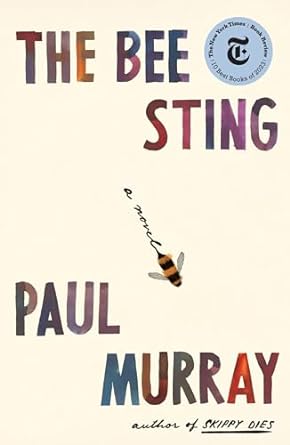
Paul Murray’s The Bee Sting is the most compelling work of fiction I’ve read in years. It’s a tale about a contemporary Irish family, told through each of its four members’ perspectives—father, mother, daughter and son. Murray’s use of first-person narrative, sentence structure and punctuation (or lack thereof) ensures each voice is distinctive.
Though the story unfolds over more than 600 pages, for the reader, there’s never a sense that even a paragraph is ancillary or unnecessary. It’s a story that conveys raw human emotions: grief, fear, disappointment, yearning, joy, duty and desire.
Murray cleverly, almost stealthily, explores some grand themes, such as one’s desire to be purely authentic, while the forces of life and societal conventions push back. He expertly captures how the past imprints on a person. Hardship, envy, violence, poverty, happiness, fleeting moments of awe, passion—memories that bind to us like DNA strands.
The author keenly explores the friction of a life that doesn’t follow the path you’ve plotted. Does it ever?
If you’re looking for a book that sucks you in and holds you captive until the final sentencee, this is that book.
This headline may not be entirely true, and yet, it was in this pre-Middle School era of my life when I first began to fully “understand the value of a dollar.”
I find that’s a popular phrase passed down through generations, an invaluable life lesson or a rite of passage. For two sixth-grade classes in the 1970s, their introduction to commerce and capitalism began that week.
That was the year that the number of students had outgrown the school, and some lucky contractor got the local school system bid for providing pop-up classrooms made out of stitched-together double-wide trailers. Two sixth-grade classes shared the one we’d been sentenced to, with a sliding partition between the two groups, each with its own teacher.
The partition was an insufficient barrier that mostly rendered us distracted by what was happening with the kids on the other side. When they laughed, our heads swiveled. When we acted up, they’d go silent and giggle as they listened to our punishment being levied. One teacher would have to raise her voice to keep the attention of her class whenever the sounds of the other teacher seemed more interesting.
And vice versa, and so it went.
Imagine the delight in our little hearts when one day the partition was folded in on itself, the two classrooms of kids facing off at last. The once competitive teachers joined forces and announced that we were going to learn about running a business and paying bills. They went on to explain that for a period of one week, there would be no traditional classroom lessons and that our trailer would be transformed into a microcosmic town.
Each of us had a role to play in the town. They asked for a show of hands when assigning roles like bankers, retailers, landlords, food purveyors, even insurance carriers.
I was the only one who wanted to run the town’s newspaper.
The town also needed governance, and so a show of hands indicated which of my classmates aspired to political life – managing their day-to-day duties while also running for a handful of offices, including mayor and sheriff.
We spent a day or two planning and building the town. Creative cardboard cutouts became our storefronts. Logos were designed, and signs went up over our storefronts. My classmates got right to work. The banker “handprinted” money and distributed a precisely equal amount of cash to each of the town’s residents, so everyone had a level playing field – a comparatively endearing socialist start to what would end in survival-of-the-fittest capitalistic carnage.
The most popular business, by far, was the town baker, who sold decadent treats to a classroom of kids given the freedom to make their own nutritional and expenditure decisions.
We didn’t speak of food allergies back then.
I got right to work wearing all the hats at the newspaper – a lot like things are today.
I reported and designed the layout. I “printed” the paper on the front office’s mimeograph. Printing is a big cost for actual newspapers, but I’d managed to get the paper and “press” for free. This would be seen as an ethical breach for actual newspapers.
I had to hock the paper, selling single copies to passersby. I sold advertising and wrote ad copy. I had to distribute the paper when it was hot off the press.
And though everyone wanted to read the paper – mostly to see if they were in it – few wanted to buy the paper. It was hard to compete with Mom-baked brownies.
I spent the week walking around the perimeter of the trailer, interviewing my classmates about the health of their businesses or who they liked in the pending election. I wrote trends pieces about how the town’s residents thought the rent was too damned high and how they wanted to be able to spend more of their money on luxury items, like those chocolately brownies. I vaguely remember writing an expose on the insurance carrier in town, who I saw as a huckster selling vapor.
“People give you money, but what do they really get in return,” I grilled him like I was Woodward or Bernstein.
One by one, the small businesses fell, exiling their owners from town, to a corner of the trailer-classroom to watch an episode of “Free to be You and Me” or to throw a sixth-grade temper tantrum, perhaps.
Naturally, the bank endured; it thrived off of the interest. The insurance carrier – who had minimal overhead costs and a contained, safe environment that put odds in his favor – stayed afloat. The baker had fistfuls of colorful cash by week’s end. And the newspaper endured, though I, too, was pretty busted. By the time I’d covered my own costs – rent, insurance, crayons – I didn’t have enough currency for much else.
I’d spent days coveting my classmates’ disposable income and how they frivolously, happily spent it on baked goods and insurance policies.
Somehow, I’d managed to get the news out, but it wasn’t easy, and it wasn’t lucrative.
Criticism of the Press is sometimes warranted. Let’s begin this observation about news with that fundamental agreement. Bias is “a thing” – inherent in language’s DNA, in every single word choice – and it is the publisher’s, editor’s and journalist’s job to choose: Manage bias, or give it free rein?
There’s a niche phenomenon in news criticism that feels fledgling this year: Puritanical headline outrage, I’ll call it.
While it has been the legacy of newspapers to incorporate quotations into headlines, today’s arm-chair news critics declare war with titles over quotations or paraphrases without context – for example, when The New York Times ran this outrage-stoking headline: “Trump Urges Unity vs. Racism.”
In fact, in the aftermath of yet another mass shooting, the President gave a statement in which he did just that. Of course, anyone who hasn’t lived the hermit life for the past three decades of Trump – the man and the brand – knows that this message is counter to what the President has “advocated for” in the past and present.
A segment of readers seethed over the headline, suggesting that it was biased, and that it provided the President with a megaphone to perpetuate a disingenuous message, by way of the big-font top-of-the-fold headline. Even members of the media said that headline – on top of other such grievances with the newspaper – inspired them to cancel their subscriptions and call for others to do the same.
Today’s (self-appointed) Headline Editors, working from their homes and phone displays, expect news publishers to give broad context in headlines, to tell the full story to readers, in order to remove any ambiguity about the content from the outset.
Could The New York Times’ headline writer have chosen any number of other headline options with 30 characters or fewer?
Certainly.
But when nearing the witching hour of an on-press deadline, sometimes we choose what is expeditious and relevant. Sometimes the moment – the horror of a mass shooting, arguably – calls for an aspirational approach, the common denominator, the sliver of hope, a message that transcends the politics and the politician.
Critics decried that this particular headline was by design, that it was an editorial choice to somehow show favoritism to the President of the United States. This is a theory fundamentally at odds with the very mission of news people and newspapers.
I have to believe that some of this “headline outrage” has more to do with the way people read and process information they read online today. We are a nation of headline surfers. We’ve studied this data.
Today, we viscerally react to headlines and often comment about the content before ever reading beyond it. Naturally, readers who rely so heavily – even entirely – on headlines would want them to tell the whole story. It’s a lofty expectation fueled by illiterate laziness.
To its credit, The New York Times took the criticism to heart and even offered an explanation and apology to readers. It showed that the newspaper was listening, at least.
Let’s use this example – of a newspaper “managing” bias – in contrast to what occurred on FOX News on the morning of Friday, November 22, 2019.
It is true that the FOX & Friends hosts tried to haplessly interject, but the President steamrolled, and the producers were AWOL.
But they had to see it coming at FOX News, right? This Tasmanian Devil of an interview couldn’t have taken anyone by surprise in the planning meetings or during the live broadcast. They had to expect that the President would behave in this manner. His rally riffs are notorious, and he has a pattern of doing this on past call-ins to the network.
Still, the producers – and to a certain extent those talking heads who had to endure it through gritted teeth and earnest expressions – collectively made an “editorial” decision to give bias “free reign.”
One of the foundational tenets of journalism: Consider your source.
Days like this call for sentences using “bloviating,” “preening,” and “grandstanding.”
Also, “obscuring,” “omitting,” and “lying.”
I am cognizant how words are received, digested, shared, and manipulated in digital space. They catch on and quickly become part of the news-cycle vernacular, thanks to personality and platform megaphones.
Some media colleague, or perhaps it was the White House, today bandied about the term “Soviet-style impeachment,” and now every other caller into C-SPAN’s “Republican call-line” references it, even though “Russian impeachment” is an oxymoron. Just ask Yeltsin.
That’s a poor joke, because Yeltsin is dead, and three attempts to impeach him failed. In fact, no Russian President was ever successfully impeached.
I know; shocking, right?
Putin probably has a lock on that, too.
So it’s a strange comparison that would seemingly be a happy ending for Trump loyalists, except it requires equating Trump to a Soviet dictator who “gets away with it.”
In writing about the impeachment of Donald J. Trump, Shakespearean and Biblical parallels are low-hanging fruit, yet effective, relatable to the highly literate and a 10th-grade English class alike.
It can be maddening trying to chronicle history when it comes at you fast. The past can feel like the only perspective and guidepost.
Print news cycles, measured in days and weeks are now brutally, digitally compressed — into hours, minutes, seconds, and Tweet characters. There’s much less time to agonize over word choice. Still, we aim to tell the story with equal parts veracity and verve.
In Oregon, newspaper publishers have recognized the need to provide their communities with better and deeper coverage of state government and politics. Their answer was the creation of the Oregon Capital Bureau.
Under the editorial leadership of veteran investigative reporter Les Zaitz, the Bureau leverages the newsroom talent of three local news organizations: the Pamplin Media Group, publisher of the Portland Tribune and 24 other weekly, twice-weekly and monthly titles; EO Media Group, publisher of the East Oregonian, Daily Astorian and nine other titles; and the Salem Reporter, a digital news service that Zaitz heads up as editor. The Salem Reporter—co-founded by Zaitz and real estate developer Larry Tokarski—recently launched in September.
For the penultimate segment on “Hardball with Chris Matthews” each weeknight, Matthews queries his panel of journalists and pundits—often with at least one reporter representing a major-market newspaper—challenging them, “Tell me something I don’t know.”
His branded phrase not only introduces the segment, it exemplifies one of the benefits of having journalists appear as guests on broadcast news programs. Reporters remain excellent sources themselves of researched, vetted and well-sourced information. Their appearances and expertise on the topics of discussion lend both content and credibility to broadcast news programs.
And there are obvious professional gains for the journalist—who has a brand and a byline to protect—and to the newspaper’s brand, which benefits from audience reach and an opportunity to evangelize its reporting.
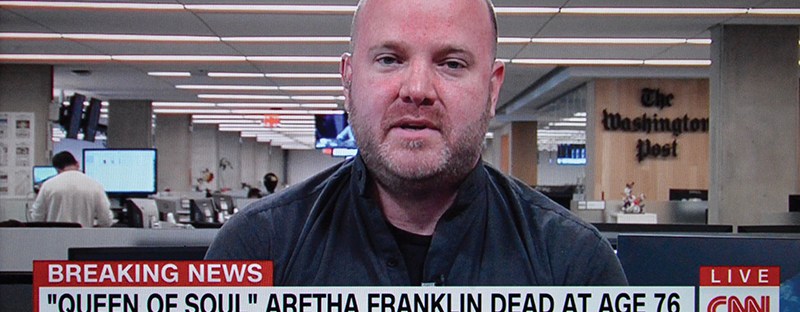
Still, as some newspaper journalists have learned, appearing on broadcast news programs can occasionally come with some unwanted attention too.
If newspaper design had a motto, it might be: “Stick to the format. The design and layout is the brand.”
And that remains true today with iconic titles of newspapers rendered in familiar fonts and layouts that are distinctive in their own right. Think of how familiar and distinctive a title like USA Today is when you flip through the pages. The color, the layout, the way the headlines grab your attention—all part of the brand.
Newspaper publishers, by and large, have always understood this. But the notion that printed newspapers’ design should never deviate from the template is being challenged, and it’s because of digital and mobile publishing and the rising cost to paper. Still, that hasn’t stopped publishers from experimenting with their print product.
I recently discovered the Pew Research Center’s Journalism Project has partially compiled some of my bylines with Editor & Publisher magazine — and other great resources from other journalists.





 Gretchen A. Peck