Among our news community, we frequently talk about “trust in news” and how it has eroded to dangerous levels. I’d suggest there are myriad reasons for that, including some that date back centuries. The press has always been a convenient punching bag. When people don’t like what they read, they naturally want to discount the information.
Some of the phenomenon is patently new, as we’ve seen with the increase in “lawfare” suits designed to chill journalists and shutter news organizations outright. There’s also the toxic political rhetoric, even shouted from the highest offices in the land, expressly to make people doubt watchdog and accountability reporting.
Now, we’re contending with Artificial Intelligence (AI), too, which is training people to doubt what they read and view.
Some of it is well-deserved. The press doesn’t always get the story right, especially in the rush to report first. Quality journalists among the American media are contrite when it happens, acknowledging their mistakes and offering corrections or retractions. Far too many outlets masquerading as trusted sources of news peddle misinformation and never acknowledge their failures to report accurately. That’s harmful, industry-wide.
I’d suggest the public also has a cynical view of how news is gathered and produced when they hear about strategic misdeeds, such as tabloid-style “catch and kill” stories — for example, when an adult film actress’ story about an affair with a politician never sees the light of day because the publisher and the porn star are paid to suppress it. It’s easy for the public to conflate that kind of “news” with what earnest, professional journalists produce day-in, day-out.
Indeed, there are many reasons — deserved and not — for the lack of trust in news today, but the important thing is that we’re thinking about it as an existential threat and doing our best to counter it. That’s why I’m bullish on The New York Times decision to convene a “trust team” that’s keenly focused on this issue.
At the link, read about my conversation with Edmund Lee, editor of The Times’ trust team and one of the ways they’ve built more transparency and familiarity into the display of news.
I was talking to some Boomer-generation family members not long ago, who’d expressed frustration about the state of the world — not about big things, like war or the state of democracy, but about small, comparatively insignificant things. They complained about how nothing interested them on TV anymore, about the popularity of Taylor Swift, and how print menus had been replaced by QR codes. These grievances seemed petty to me, so I found myself imparting wisdom I gained far too late in life: “Not everything is made for you,” I told them.
It dawned on me that if you see things in the world in two categories — things you like = good; things you don’t like = bad — you’ll live your life in a state of perpetual frustration or agitation. It’s a far more pleasant existence to think, just because I don’t like something — just because it wasn’t produced with me as an audience or consumer in mind — doesn’t make something bad, unworthy, corrosive or a danger to society. Other people may like it, and they have a right to enjoy it and to exist, and it need not have any impact on you at all.
This same philosophy can — and should — be applied to people and lifestyles, too.
I thought about this as I read reporter Peggy Noonan’s account of attempting to interview protesters on Columbia University’s campus. She wrote about how they didn’t want to talk to her. “Friends, please come say hello and tell me what you think,” she implored them.
Frankly, if that’s how she approached the students, I wouldn’t be a bit surprised that they opted not to speak with her. “Friends …” does make it sound a bit disingenuous, like someone trying to draft you into a religious sect.
Journalist Peter Baker of The New York Times boosted Noonan’s remarks on X/Twitter, implying the students wouldn’t speak to her because they weren’t capable of articulating their reason for protesting.
Last week, when I spoke with several editors of school newspapers on campuses around the country, they all talked about students’ reluctance to speak to the press.
The editors explained to me that the student protesters — in fact their entire generation — is media savvy but also distrustful of the press. They worry of their remarks being misunderstood or intentionally misconstrued. They’ve grown up in an era in which “fake news” is a familiar concept and social media can make one inarticulate remark take on a life of its own.
Anish Vasudevan, the editor-in-chief of The Daily Orange at Syracuse University, explained how student protesters on campus have designated “media-trained” spokespersons expressly for these reasons.
As I spoke with these student journalists, it also confirmed how much newsroom “representation” matters today, especially among young people. They’re more inclined to feel seen, heard and understood when they’re talking to reporters who have some shared perspective, whether that’s ethnicity, gender, geography, race, language, education, a common campus, age or generation.
In many cases, student reporters were able to land the most meaningful interviews with their fellow students, because representation matters. It helps repair some of the deteriorated trust in news media when we see ourselves represented among the storytellers.
Maybe this story — this moment in history — isn’t for journalists like Noonan or Baker to chronicle. And that’s ok.
E&P’s “Reporting On” series takes a look at what it’s like to be a journalist tasked with covering a national/international crisis, or an urgent public policy concern. This month, we spoke with journalists who report on the nation’s borders and ports. With as much national media—and particularly “cable news”—coverage as we have about the southern border, in particular, there is so much more to the story.
I learned a lot from these exceptional reporters, who take us to the border itself; share stories of what its like in communities like Chicago, where the border crisis has been brought to their doorsteps; who help sort through the politics and the realities; and turn our attention to the vulnerabilities of the nation’s ports, so critical to our economy and yet so rarely covered in the detail they deserve.
I set aside my own biases about immigration and allowed the reporters’ stories to stand tall here. But I’m perhaps not unlike so many other Americans who see that immigration is a many-layered complicated issue that’s just not being treated earnestly and effectively by our elected leaders. On radio and TV, we hear gripes about people not coming here “the right way,” but unlike the immigration channels of one or two generations ago, today’s path to citizenship is messy, long, prohibitive, frightening, expensive, and completely out of reach for so many immigrants. We’re failing in not exposing that story.
Having spent part of my childhood living in South America, I also know how dire and deadly life can be in nations to our south—measurably worse today than even in the 1970s. I can understand why people want to or are forced to leave their homes, their families, their livelihoods and their way of life. It’s not hyperbole to say it can be a life-or-death decision.
This is not to discount the serious and steady threat of bad actors coming across the border and exploiting desperate people, parents and their children. We need to stop them, and we often do. But surveillance technology, concertina wire, a big tall wall, and border enforcement alone won’t solve this crisis; it requires a retooling of foreign policy and thoughtful diplomacy rather than isolationism.
We are a champion nation. We broadcast to the world about our exceptionalism, what makes us special, what makes us wealthy, what makes us progressive, what makes us leaders, what makes us (comparatively) safe, what makes us free. To expect people from all over the world—especially poor nations plagued by crime and corruption—not to want to come here, in fact to risk their lives to become an American, is ill-considered.
When I was growing up, libraries seemed this quiet, unassuming certainty in everyday life. They were well-funded, accessible to everyone in the community, no matter why nor when you needed them. I saw librarians as all-knowing beings, who could find even the most obscure title on the stacks, without so much as a glance at a card catalog.
I worked for a while at my university library, in the periodical section. When students came in looking for references, I’d pull out newspapers and magazines from the bowels of the back or help them learn to use the microfiche machines — high-tech back then.
It may have been my paternal grandmother and her mother (Ida Locke, a librarian seen here) who encouraged my early reading.
Great-grandmother Locke lived with my grandparents, and I have fond memories of her seated on their sofa, a stack of books always present on the end table beside her. An insatiable reader, she could sail through a book in a single afternoon. She was a quiet, tiny mouse of a woman, always dressed for going out, even when there was no place to go. I can’t remember her voice, because she rarely offered even a hint of a smile nor a string of spoken words. But when I’d visit, she’d pat the sofa next to her, inviting me to sit and tell her what I was reading that week. Born to a German community in rural West Virginia, books were her way to rise above, to escape, to aspire — to work and have autonomy as a woman of that era.
Books didn’t change her nature — who she was or how she conducted her simple, frugal life — but they did broaden her perspective and informed her understanding of the world outside of her own.
I think about her a lot lately, as libraries are under attack from so many directions. Funding is imperiled. Politics has landed on their doorsteps. Shamefully, surreally, book bans — patently anti-liberty and anti-intellectual — are part of our national discourse. Librarians themselves are harassed and forced out of their jobs by politically motivated and dark money-funded mobs. Can democracy survive under these circumstances, I wonder? It feels symbolic of how we’ve lost our way.
Journalists in war zones navigate complexities, danger and how to make the story resonate with audiences far removed — geographically and emotionally — from the fighting
From the December 2023 Editor & Publisher magazine:
A pilgrimage back to the battlefields of Gettysburg
By Gretchen A. Peck
Growing up in a then-small town in mid-state Maryland, the Commonwealth of Pennsylvania always beckoned from the north. As 5th-graders, we’d travel to Camp Round Top for a standard-curriculum introduction to cabin life and campfire songs. Those who could afford it trekked up to places like Seven Springs for high-school ski trips. Towns like York and Reading appealed to our parents for stuff like farm-fresh canned goods and outlet shopping. It was rare to venture far enough east or west to get a taste of the big cities in Pennsylvania. I didn’t see Pittsburgh until I was well into my 40s, and Philadelphia eluded me until I was in college and in control of my own journeys.
Though it felt like an epic adventure back then—through the wide-eyed but impatient eyes of a child — Gettysburg was an easy day-trip destination for parents and teachers who wanted to leverage some pretty remarkable local history. As a kid, I went there twice. Both times are etched in my memory still — one a fond trip; the other, a not-so-fond trip involving a banana-seated bicycle and a flashy Mercedes-Benz.
The fonder of those two trips was with my main pal, my great-grandmother, Ruth. She was always rather independent and still felt comfortable behind the wheel of one those iron-horse American-made cars and station wagons she used to drive. I can’t be certain if she pitched the idea of a day trip to Gettysburg because she was intrigued by the history herself, or if she was just looking for a way to keep a precocious kid occupied for a span of time, but northward we went to the battlefields of Gettysburg.
Gettysburg
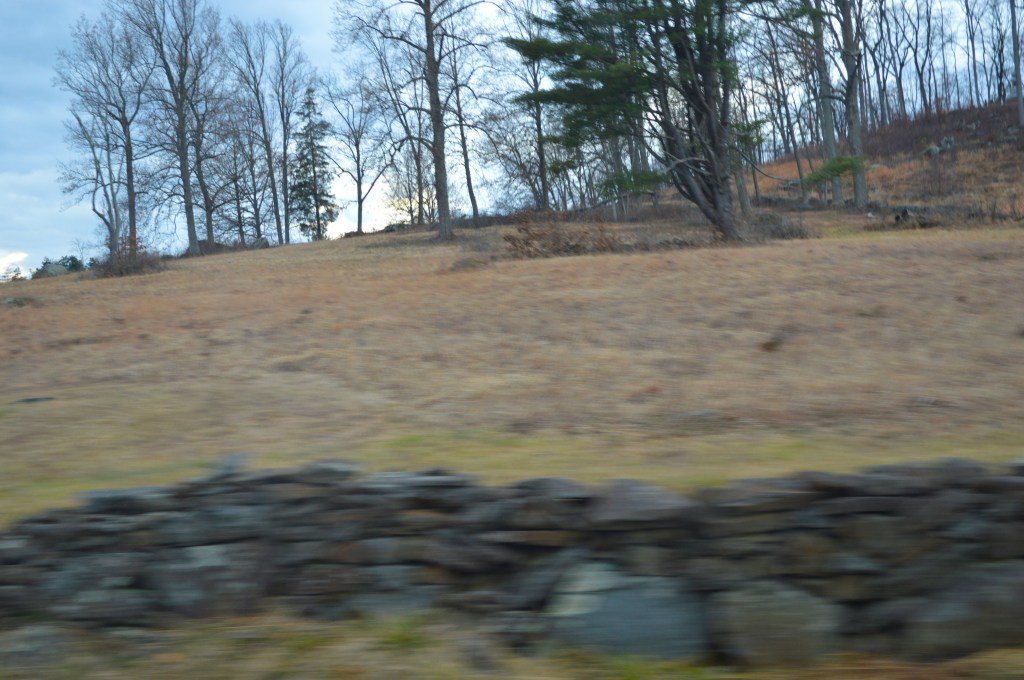
I knew about Gettysburg’s history, probably because I’d read about it independently. I was a voracious, above-grade reader with an affinity for history and historic fiction. I don’t know what I expected of the battlefields there, which I knew to have claimed the lives of thousands of men, but as we drove Gettysburg’s rolling hills and past its stacked stone walls, I found them to be just pretty countryside, but otherwise unremarkable. It was hard to imagine them littered with the bodies of dead and dying soldiers. Then again, it was hard to imagine fellow countrymen turning on one another at all. It didn’t sit well with me then, as a child, and doesn’t now.
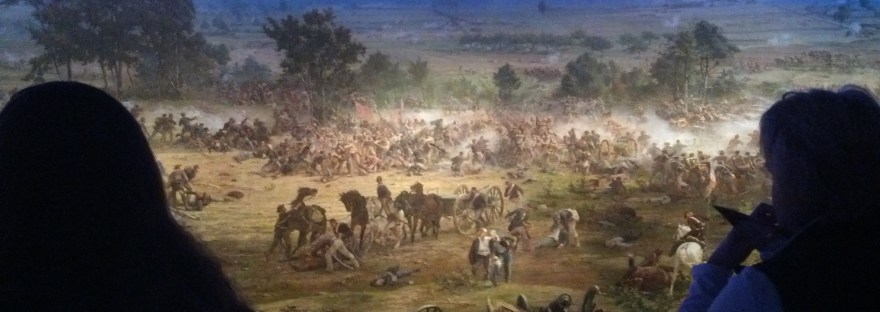
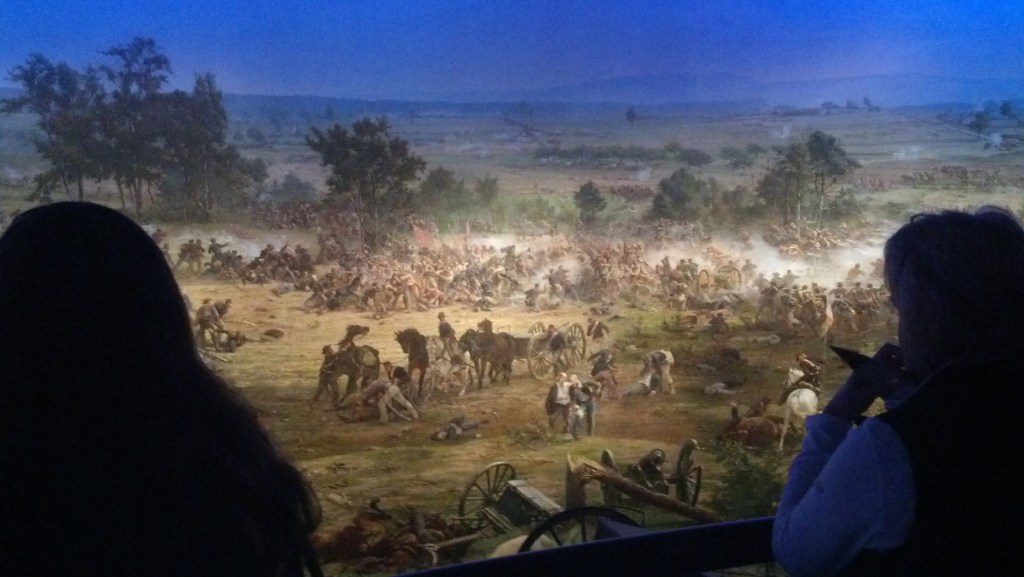
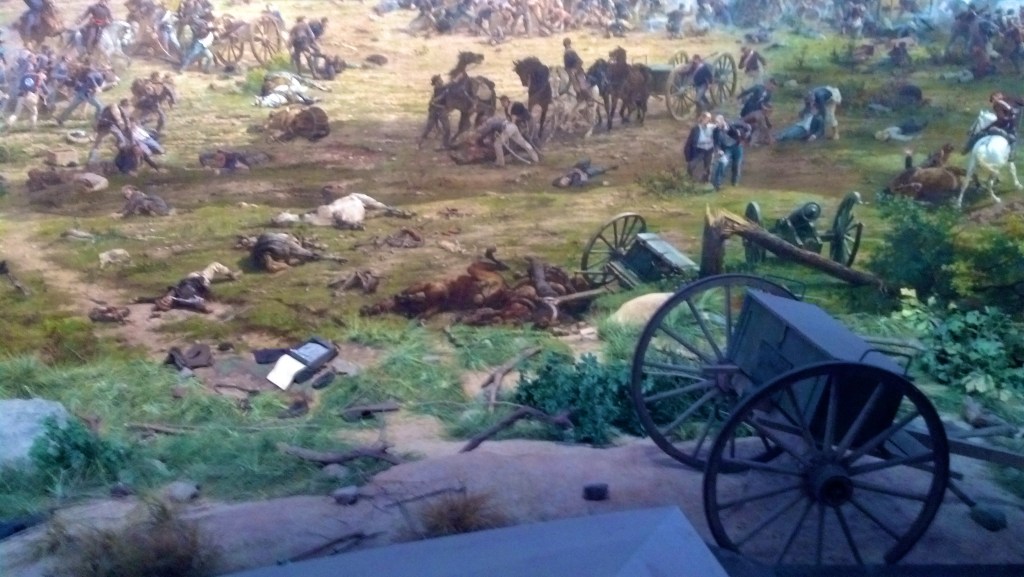
At the museum commemorating the pivotal battle, there was an interactive display — what they refer to as a cyclorama — a painting by French artist Paul Philippoteaux that offers a 360-degree depiction of the battleground’s horrors and the spoils of war. The artist shied not away from the gore, and viewing the battlefield like that helped me to imagine what those bucolic fields looked like in July 1863. I spun around, taking it all in, aghast at the blood and carnage.
Cyclorama depicting the Battle of GettysburgCyclorama (detail)
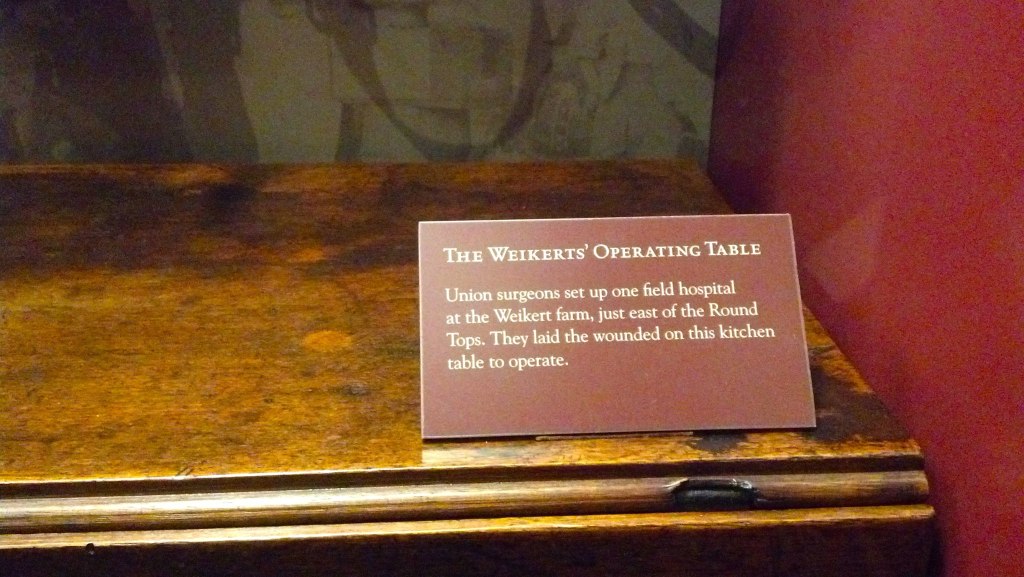
There was another artifact from the museum that I thought I remembered so vividly—an old wooden table used as a makeshift operating table. As a child, I stared in horror at the rough-blade saws they used for amputation with little to soothe the wounded soldiers. The table had what appeared to be a stain, and I gasped at the thought that no one had thought to wipe away the blood before putting it on display.
Before we headed for home, my great-grandmother bought me a fold-out miniature depiction of the cyclorama, on glossy postcard stock. I unfolded it on my lap and studied it the whole way home.
I was in my 40s when I went back to Gettysburg on a cold misty-mountain day, the end of a brief but cathartic pilgrimage back to where I began. Decidedly middle-aged by then, I had new perspective on childhood homes and places of significance around my hometown. I toured it with my parents, and we spoke of memories, avoiding the hardest ones. After the visit, I packed my truck and headed north toward home in Pennsylvania. I toyed with the idea of stopping in Gettysburg, but it was threatening to rain and I kept that in the back of my mind as an excuse not to make the pitstop.
But something compelled me to retrace the steps my great-grandmother and I had walked together decades before.
I thought of her as I bought my ticket, and wandered through the exhibits. She felt beside me as I ascended the long escalator to the theater-in-the-round where they cyclorama painting is on display. I could practically hear her laughter when I walked up to the display of the operating table to see that the “stain” I’d remembered was most likely just the natural grain of the wood and some wear and tear — the blood I’d conjured were just a child’s imagination run amok.
Kitchen table/Operating table
I brushed by families and stood by myself reading the plaques and watching the video clips throughout the exhibit. I thought about the toxicity of politics, how it inherently divides up the nation into neat little categories, largely based on where and to whom we’re born. I thought of the barbarism of the war, the hand-to-hand, eye-to-eye combat, an intimate, personal war waged among neighbors and families and fellow countrymen.
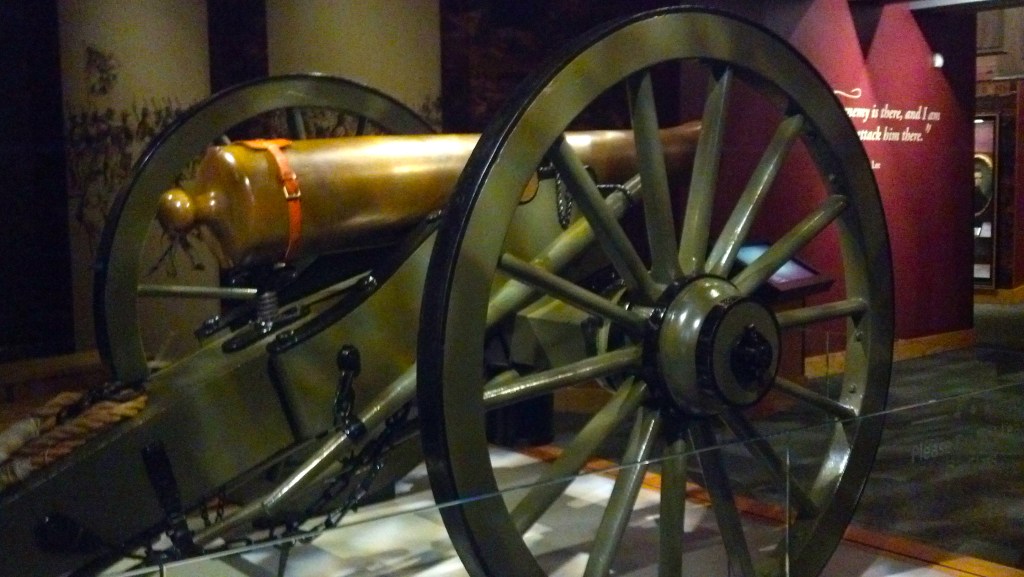
What would the weapons of Civil War be today?
It seemed to me then, even as a child, a wholly absurd notion. I felt men were to blame and women had to suffer their consequences. Now that members of Congress like Rep. Marjorie Taylor Greene (R-GA) openly flirt with the idea of civil war, like it’s the stuff of romantic nostalgia, I can no longer blame the barbarism on men alone. I do imagine that the civil war the Congresswoman pines for will not be so “fairly” fought, with men in uniforms on rural battlefields, but instead through cowardly acts of terror.
By the time I found my middle-aged self in Gettysburg back on that misty day, the nation’s politics had once again turned toxic, like a sepsis from a wound that never really healed. It’s exponentially worse now — in 2022, as we sit — so much more vitriolic, hateful, and steeped in a scourge of misinformation.
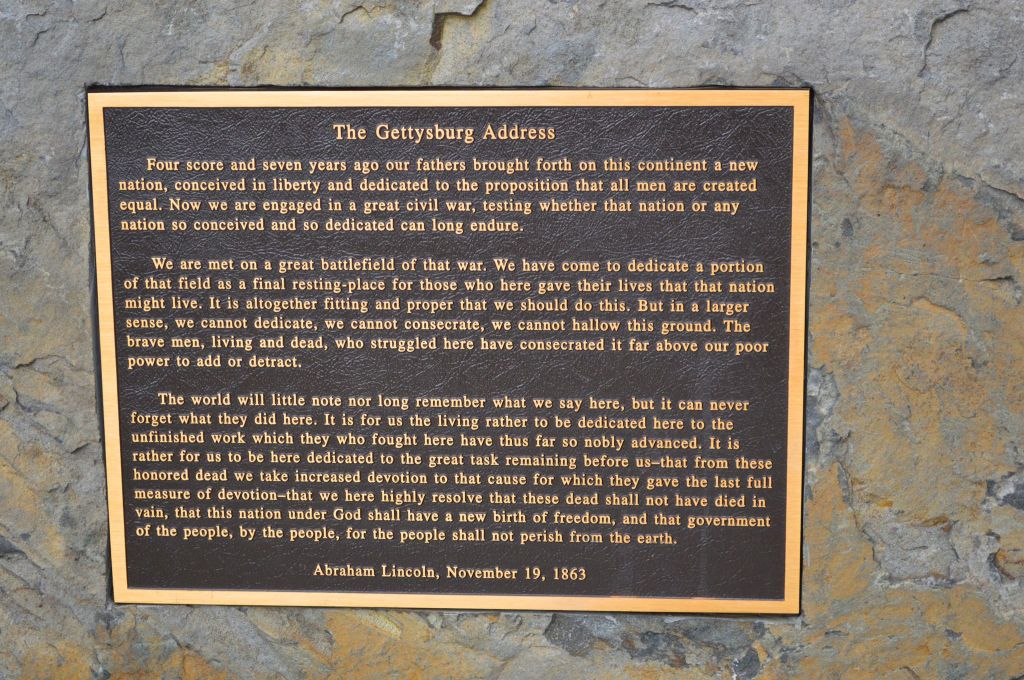
Before I left Gettysburg in my wake for that third time in my life, I stopped in the gift shop — now, a gift shop on steroids — and bought water for the ride home, a soldier bag for my husband (he’d hate it if I called it a murse, which it is), and a mug depicting the Gettysburg address for me. Just outside the gift shop sat a table where visitors could “Send a Message to the Troops” via postcard. I filled one out, and hoped it found someone out in some far-off “battlefield” and makes her or him feel thought-of and important.
I stopped to snap a selfie with a bronze statue of President Abraham Lincoln before getting on the road, just long enough to hear a strange conversation unfold between a father and son coming up the path to see the museum. “Lincoln,” the child exclaimed when he saw the statue where I was taking my selfie. “Take a picture of me, Daddy,” the little boy pleaded. There was an awkward pause before the father said, “Nah. Nah. Not now. Besides, he was on the other side.”
I thought of my great-grandmother again in that moment, by all accounts a church-going, southern, conservative Republican woman to her core. There was never any question how she came down on such matters. Slavery was immoral, a sin, and a war fought on slavery’s behalf — pitting neighbor against neighbor, countryman against countryman, brother versus brother — was, too. This was not up for debate.
She’d brought me to that hallowed battlefield to instill that in me.
“War is cruelty.”
It felt tragic, almost surreal, to see a child brought to that solemn place and taught otherwise — its lessons not just missed but mistaken, misrepresented, warped. Once again it feels surreal to see members of Congress masticating the possibility of bloodshed, or to read articles by pundits pondering whether Civil War in the United States is inevitable or has already begun.
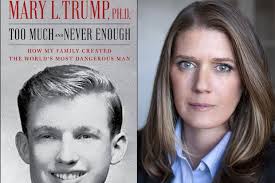
I bought Mary L. Trump, PhD’s book, “Too Much and Never Enough” not so much because I was interested in the family dynamics of the Trump clan, but because I have an (confessed) staunch disdain for men who try to silence women, and for Presidents who make people around them sign NDAs and file frivolous lawsuits to delay and degrade every publication or opinion about him. So, when I heard that the Trump family had tied the book up in court, I pre-ordered it.
It’s a thin hardback and an easy read.
In the early chapters, she struggles with voice.
At times, Trump reminds the reader that she is a clinician, highly educated in and informed about mental health and mental disease. Occasionally, she breaks from that serious tone, injecting editorial that is biting or snarky. I’m not sure those work in her favor.
A few chapters in, she hits her stride, and the book transitions into what it wanted to be from the beginning: A highly personal memoir, with decades worth of cringe-inducing memories of sadism and cruelty that runs like sap in the Trump family tree. Knowing that, you might tend to believe that this is purely “a hit piece,” written for retribution or revenge. She is wounded – and who wouldn’t be – but it becomes evident that malice isn’t her motivation. Rather, the narrative seems to indicate a patently private person’s strange sense of duty to the public, to correct the record on her family’s biography and image, including the curated and fabricated story of her Uncle’s business acumen.
The stories of family “black sheeps,” of dramatic dis-ownings, or siblings who turn against one another for their parents’ affection or post-mortem spoils, are nothing new. But the story of the Trump family is particularly tragic, because the repercussions of their greed, cruelty, and tumult have trickled down to all of us now. They’re global.
The saddest part of this story, it seems to me, is the acknowledgement that family can be so easily fractured, and that sometimes a person can spend a lifetime thinking they play a certain role in the family – thinking they are (if not well liked, then) well-loved by other members of the family. They can carry on blindly under those assumptions for years, decades even, until one day they come to realize that they didn’t have that firm standing at all, that the affection they felt for others was not reciprocated – the unsteadying realization that “I am on my own.”
I think that must’ve been how it felt in the moment Mary Trump recounts near the end of the book – a fateful phone conversation with her grandmother, the President’s mother. It’s a gut punch.
By the end, I was surprised at how viciously the President’s immediate family and inner circle denounced his niece’s recounting of her life to date. Donald, his siblings, their children? They were raised in a culture of abuse. You’ll close this book and think, “That explains so much.” It almost makes a person feel pity for the President, for the man he came to be. Almost.
I read and hear a lot about “cancel culture,” Most recently, it came up in tweet conversations about the proposed boycott of GOYA foods after the company’s CEO said something nice about the President.
As far as I can tell, the term is a colloquialism turned political bone over which to fight. I see how politicians toss it into the ring and stand back, interjecting screams from time to time about its evils and why you should fear it, condemn it. I see how they compare people — citizens, constituents — to a “mob.”
I see how the ploy works, pitting fellow Americans further against one another — viciously so — not for those Americans’ own benefit, but for the politicians’ sake.
Unless I’m wrong — and please tell me if I am — the de facto definition for “cancel culture” is the idea of withdrawling support for, undermining, or even “defunding” a company, an organization, a person, an idea, a practice, a phrase, even a sculptural rendering of a person.
The goal is, in effect, to diminish that entity’s popularity, privilege, and financial stability.
Do I have that right?
If so, I wonder how this is any different than the strangely apolitical idea of the “power of the purse strings?” In other words, the act of putting your money — the greatest, most inherently capitalistic tool that any American has in their quivers — toward quashing something they find distasteful, disappointing, or unconscionable.
There’s an entire “street” in Washington DC — that begins and ends with the letter K — established so all its tenants can spend their days and nights asking our Representatives to fund this, or withhold funds from that.
Doesn’t it seem like, when they do it, it’s called governance, but when you do it, it’s labeled something less … palatable?
It seems to me that this is not a novel idea at all — giving your hard-fought earnings to things you’d like to affirm, and withholding them from entities you do not wish to support.
Everyone has a right to do that, and we already do, on all sides of the political landscape. Our purses — or wallets, or checkbooks, or ApplePay apps — are how we lobby our way through American life.
Naturally, “the power of the purse strings” isn’t nearly as sexy a rhetorical trick for politicians. The sounds-more-scary “cancel culture” rhetoric is far more effective and manipulative.
I’m not a fan of memes. Too often the social-media populace relies on memes as a substitute for journalistically sound news.
But I recently saw a meme that so beautifully represented the absurdity of politicizing virus mitigation. It contrasted the enormity of the sacrifices made by the Greatest Generation during WWII — the pitch-in, can-do spirit of the war-time era — with the politically obstinate Americans who refuse to wear a mask today. After all, a mask is a small, finite sacrifice proven to reduce the spread of the virus, and as a byproduct will get us all back to work, to recreation, to communing, to fully living again.
A true patriot doesn’t champion personal liberty at the very expense of the nation.
I lived in Pennsylvania at the dawn of the fracking boom, which ravaged the State in so many ways. I became interested in fracking because of personal experience with groundwater contamination back in my home state of Maryland – malfeasance that caused most of my family to be sick or to die of cancer. I learned about cancer clusters by being a member of one.
I anxiously watched what was happening in Pennsylvania, as gas-drilling leases were dangled before landowners and farmers as a way to sustain their properties when the local economy had fizzled. I noticed as landowners who’d leased reported obvious well contamination – hazardous materials that you could see and those that you couldn’t see. Pennsylvania’s waterways were suddenly contaminated with nasty things that were meant to stay deep in the ground and by chemicals used in the fracking process, which the industry wasn’t required to disclose to the public.
I chronicled how the gas companies made grandiose vows to communities about a commercial boom that would happen if only municipalities would welcome in their trucks and drills and legions of personnel, only to frack the town and then pack up and move along to the next dupes. I shook with rage as communities were terrorized by armed mercenaries for hire who’d shut down public roads and seal off private lands to prevent citizens from getting a closer look at drilling sites and well pads. I knowingly nodded when landowners who’d leased their properties began reporting that the gas companies were shirking them, using small-print loopholes so they didn’t have to pay landowners what they were rightfully owed.
Fracking wasn’t getting a lot of press coverage then, unless you counted some of the local small-town papers in the northern and western parts of the State, which seemingly were so enamored by the promise of commerce they missed the opportunity to protect their communities. Josh Fox’s Gasland helped ensure “fracking” became part of the public’s vernacular, in Pennsylvania and around the world.
Tom Corbett was Pennsylvania’s governor at the time, and to say he was pro-fracking would be understatement. He wasn’t just in the industry’s pockets, he banked his entire first term and a potential future term on the fracking economy.
I wasn’t on any kind of energy beat then, but I worked Corbett’s office as if I was, placing calls to the Governor’s office nearly daily, which he dodged. I attended every anti-fracking rally and protest I could – reporting on and photographing them. And I took to social media with what I found and the questions I had, including to Tom Corbett’s Facebook page, where I would plead with the Governor to address topics he clearly didn’t want to talk about.
I never name-called. I was never anything other than polite, but I did ask tough questions that I believed were critical to the public’s health and safety. I carved out at least a few minutes of my day to “touch base” with the Governor there.
I took a lot of heat from the gas-company reps who showed up there, too, and from laypeople who still believed that fracking would help Pennsylvania rise from its industrially ravaged ruins, like a fiscal phoenix. I received an onslaught of public and private threats, including on my life.
And one day, the Governor blocked me. Soon thereafter, he lost his bid for re-election. Pennsylvania installed a Democrat to the Office, who was still rather pro-fracking, but managed to straddle the middle by suggesting he’d tax the crap out of the gas companies while still allowing them to wreck the land and sicken the population.
I learned an important journalistic lesson during my time on Tom Corbett’s Facebook page: That sometimes it’s not the answer to our questions that matter; rather, that we have the tenacity to ask the questions.
Today, I often take to Twitter to question politicians and public officials, including the President of the United States, who has chosen Twitter as his bully pulpit. I model my questions there like I would if I were sitting in a Press briefing, or if I had the ear of the politician. With limited characters, I try my best to give context to the questions I ask, so they don’t come off as petty, biased or snarky, which is a common pitfall with truncated communications of this kind.
I do my best to be polite, but my questions are purposeful and pointed, and often formed because I’ve observed the politician being misleading, misinformed, or just unabashedly lying to the American people.
As you may expect, the barrage of clap-backs I get there are sometimes upsetting. Even though I haven’t attempted to be a verified “somebody” on Twitter, I – like so many other journalists, especially women journalists – get lots of attention in the form of harassment, getting doxxed, and threatened. I wish people weren’t so quick to condemn others just asking questions, but that’s the political, polarized nature of our world today. Even the most innocuous topics seem to inspire people to take to their corners and come out swinging.
Sometimes, it gets me down. I’m not going to pretend that it doesn’t take its toll on one’s psyche, but when it does, I remind myself: If someone took the time to comment, even with a visceral, nasty response, at least they’ve read the question. At least they now know there is a question, a dilemma, something to substantively debate.
At least that seed has been planted.
I’ve had fellow journalists question this approach. Some have reached out to me privately and asked, “Why do you bother? It’s not as if so-and-so is going to respond to your question on Twitter.”
I’ve explained that I have no delusions that when I tweet @ the President, for example, that he’ll respond or even notice – though if a comment trends, I suspect a lot of these politicians do take note. I explain that it was more important to put the question out there, to the benefit of the public. Twitter and other social media platforms tend to be echo chambers. Algorithms and personal settings make it far too easy for us to narrow the information that comes our way – usually, information that’s palatable to us, that supports our own established beliefs, rather than challenging them. A simple question posted to a politician’s feed breaks through that echo chamber.
Of course, tweeting at people – politicians or otherwise – doesn’t supplant traditional means of journalism. You still need to work your sources; you still need to dodge layers of blockers – press secretaries, comms pros, and PR folks – to get to them and to get them on record. None of that has changed.
Some days, Twitter feels as if it’s nothing but bots, pols, and journos swirling the drain together. But if the politicians and public officials are going to be there; if the bots and political operatives are going to be there, blasting misinformation and disinformation, we need to be there as well.
Checks and balances in the digital age. It’s our duty.









 Gretchen A. Peck