Food, Travel, Culture, Non-fiction, photography, Real Estate, Architecture, Interior Design and Landscaping

Philadelphia’s City Hall — a closer look, after all these years

For 20+ years, I walked and drove by Philadelphia’s iconic City Hall. I had one of my most memorable occasions in its heart — an open-air courtyard you can access from north, south, east and west. It was the day before Christmas Eve, and I’d gone to happy hour with some friends from work before we all took a few days off to celebrate the holiday. 

We’d congregated at McGlinchey’s (RIP), a favorite dive bar on South 15th, and spent hours nursing beers and smoking, in defiance of the new rules prohibiting smoking in bars and restaurants. McGlinchey’s was like that, rebellious in spirit, old and dingy in décor. We shared laughs about office antics, and as the evening wore on, we turned our conversation to more serious topics, like religion and philosophy, the meaning of life. 

It came time to head home. My best friend from work and I linked arms with another coworker and strolled through Center City, into City Hall’s south entrance and headed toward the courtyard. In its center, stood Philly’s version of the Rockefeller Center Christmas tree. It was towering and glorious. Its magnificence brought our trio to a halt, and we stood there, silent, arm-in-arm staring up at it. 

“What time is it,” someone asked, breaking the silence and the spell. 

“Almost midnight,” came a reply. 

Just then, it started to snow the most perfect, fluffy, big-flaked snow imaginable. We stood there a little longer, looking up, catching the snow on our knit hats and eyelashes. It felt … quintessentially Philadelphia. 
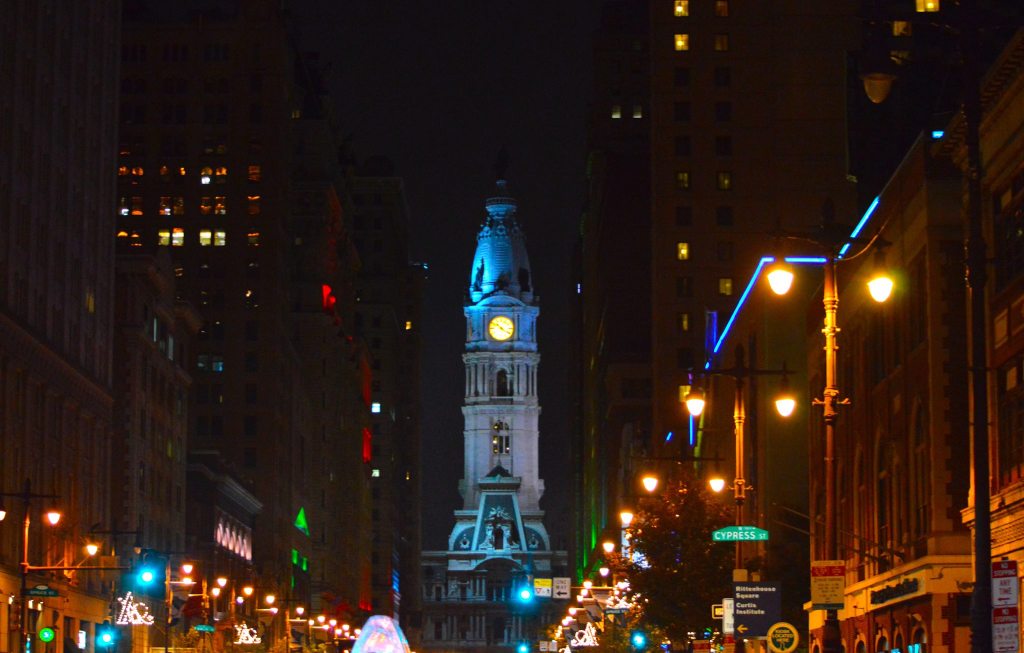
City Hall at night. Photo: G.A. Peck

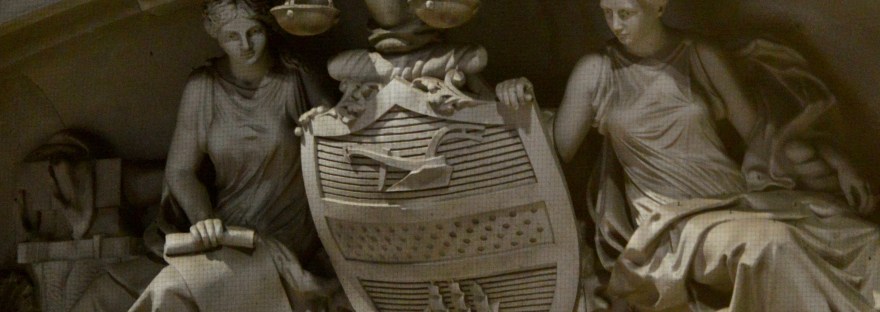
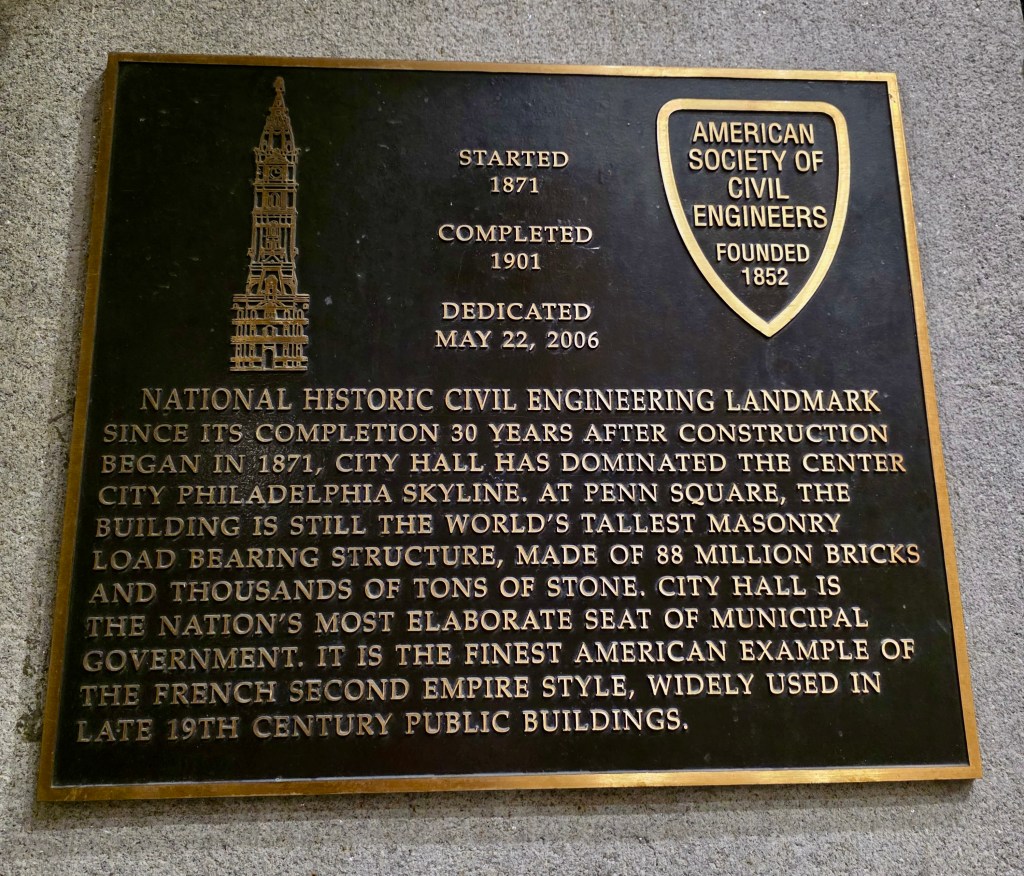
So, I’ve long been an admirer and frequent passerby, but I’ve never gotten a keen look at the building’s remarkable detail. Recently, I returned to Philadelphia and had a bird’s eye view of the east side of the building from my high-rise hotel room — close enough to get a long-lens view of some of the remarkable sculptures adorning its façade. There are 250 statues, reliefs and caryatids created by sculptor Alexander Milne Calder, adding intrigue and storyline to the historic building.  
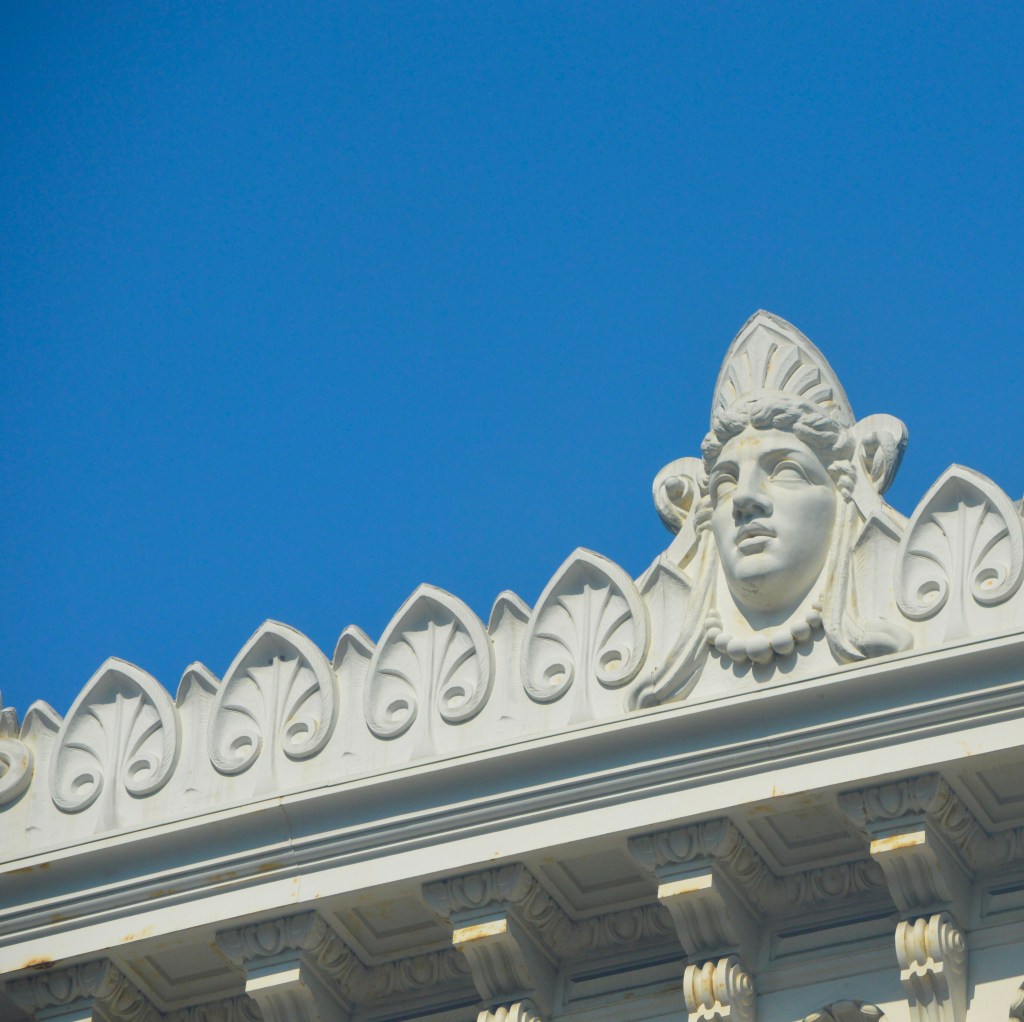
City Hall, Philadelphia, detail of ornate Second Empire architecture. Photo: G.A. Peck

The statue of William Penn that tops the highest tower is made of bronze and is itself 37 feet tall and a formidable 53,000 lbs. I’ll never forget seeing it sporting a Philadelphia Flyers sweater in 1997. Until 1987, when One Liberty Place debuted on the scene, “Billy Penn” was the tallest point in all of the city. These days, Comcast’s imposing towers dwarf City Hall. 
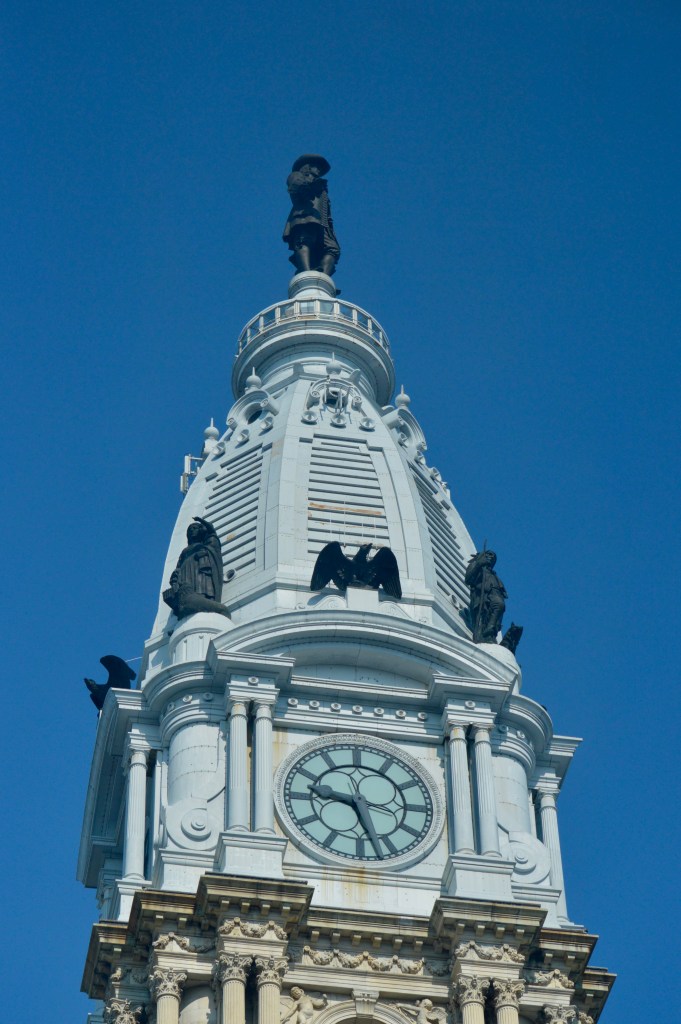
The clock tower at Philadelphia’s City Hall is made of cast iron. The statue of William Penn was made of bronze by Alexander Milne Calder, sculptor. Photo: G.A. Peck

In the 1990s, scaffolding surrounded the clock tower and Penn’s statue. The City had invested in a multimillion-dollar cleaning project. When the scaffolding came down, the tower was a completely different color than the rest of the building, nearly white next to the building’s stone and its sooty patina. I mistakenly wondered if the city had run out of money for power washing the rest of the building, content to keep the two-toned look. But that’s not at all what happened. 

While the rest of the building is constructed in granite and marble, the tower is made of cast iron. It had rusted, necessitating the restoration. Naturally, it would be a different color than the stone. As you can see from the daytime photos, rust is starting to return. 

Knowing how heavy cast iron is, imagine the feat of hoisting it into place in 1894!
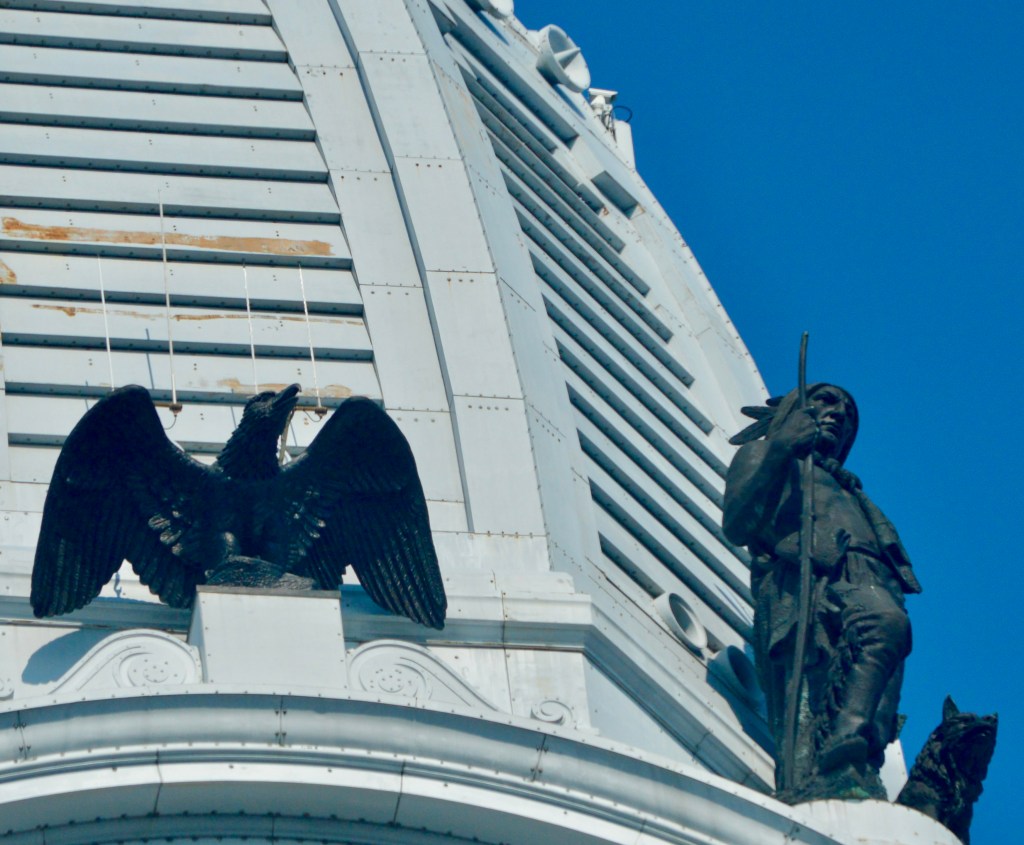
The clock tower has four eagles, facing north, south, east and west. The statue to the right depicts a Lenape Native American man with his hunting dog. Photo: G.A. Peck

The clock tower surrounded by eight bronze statues, including a Lenape man and his hunting dog, and four bronze eagles facing north, south, east and west. 

Calder’s statues depict people of different races — immigrants practicing new trades and professions in their new land. 
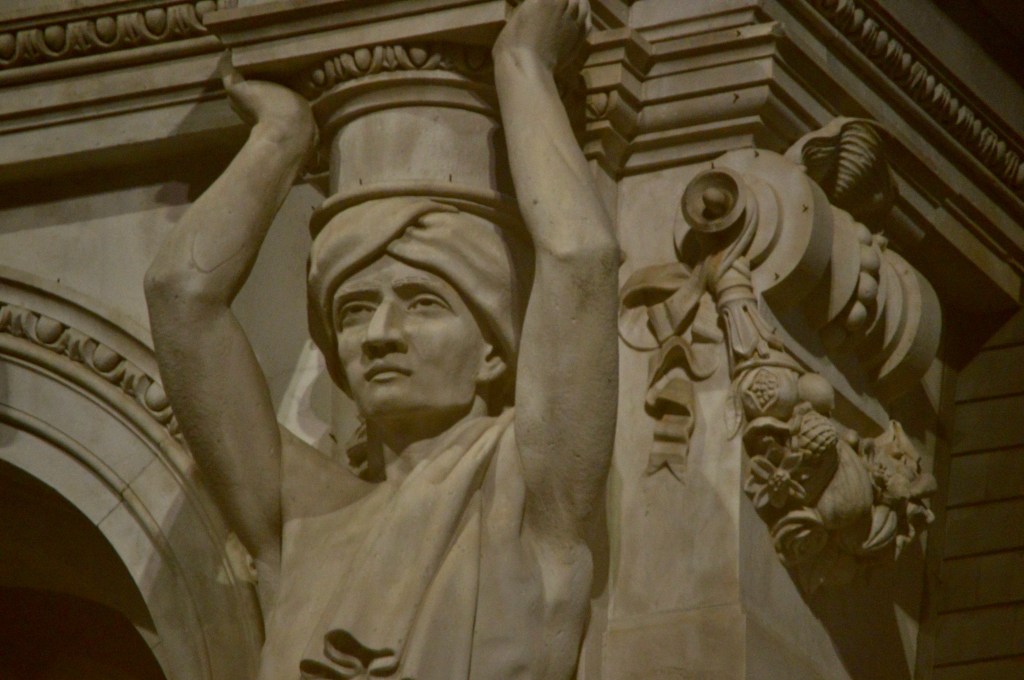
Philadelphia City Hall, Juniper Street. Photo: G.A. Peck
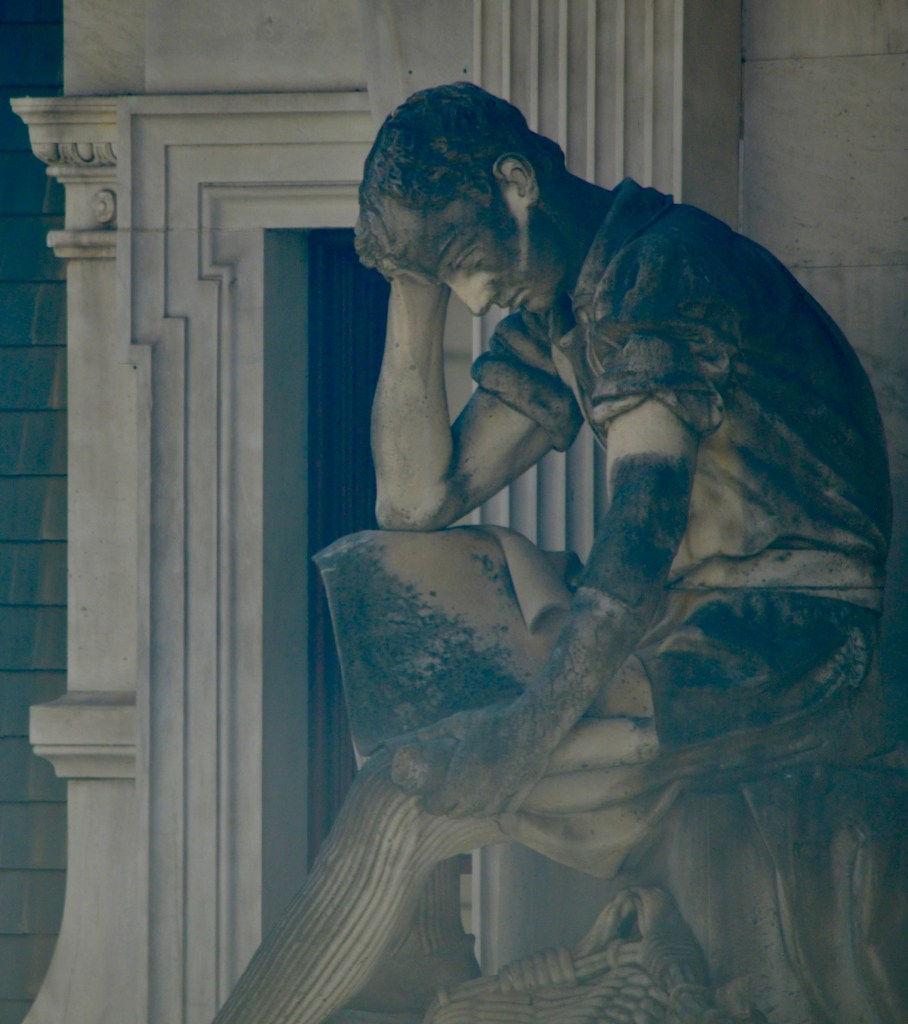
Calder incorporated statues of men and women of many ethnicities, countries of origin, vocation or profession. Perhaps he intended this one to depict a scholar or a printer.
The marble’s patina mimics the stained limbs and attire of a pressman. Photo: G.A. Peck

Besides statues of people, Calder also incorporated animals into his designs. This elephant looks out over Juniper Street, and you’ll also find a tiger, camel, bison, bull, horse, and a group of cats chasing a mouse among the sculptures.
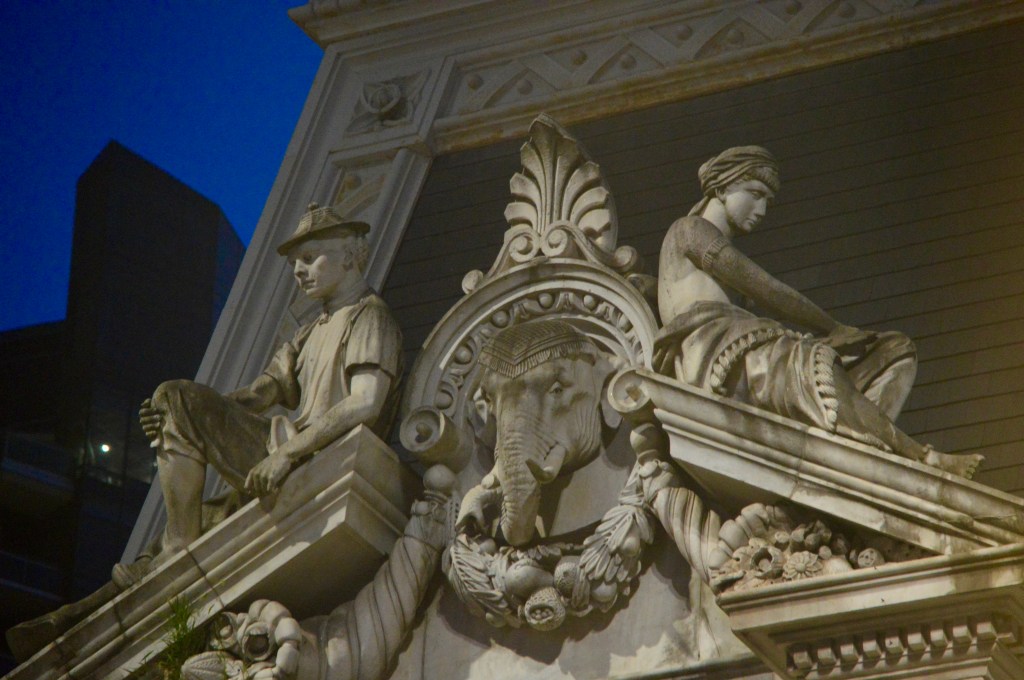
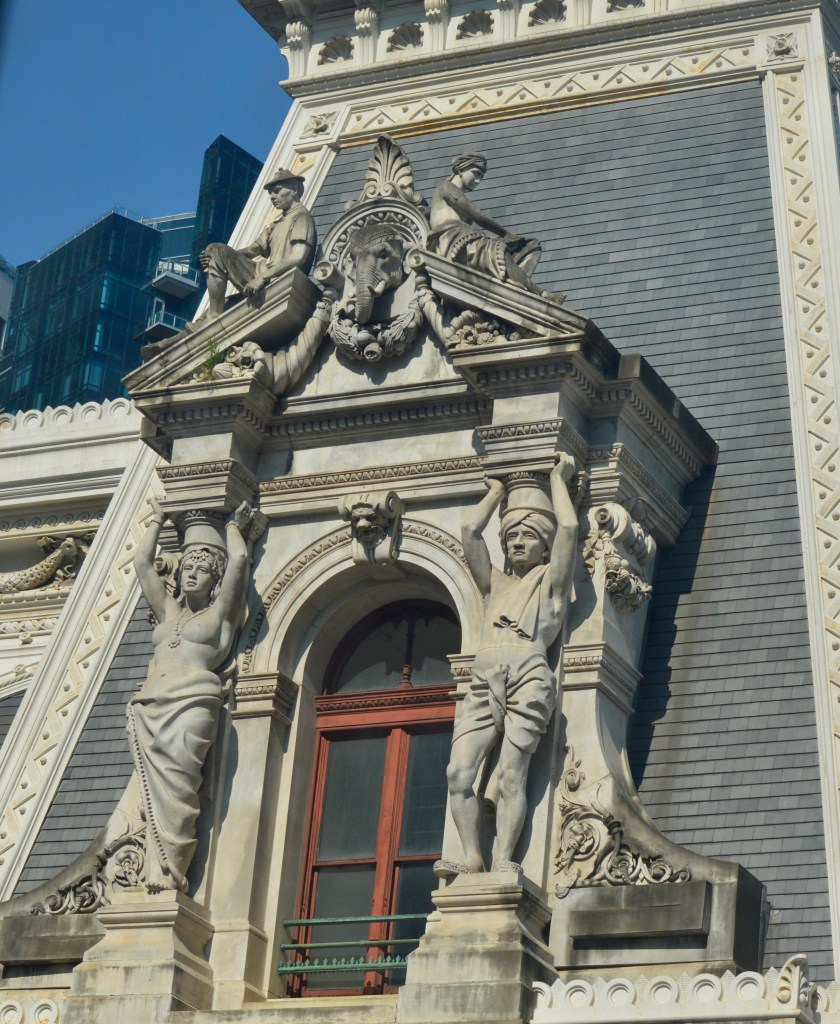
An elephant gazes down upon Juniper Street from its high perch on City Hall. Photo: G.A. Peck
Philadelphia’s skyline is a study in architectural-period contrasts. Photo: G.A. Peck

The building takes on a different quality at night, its angles and curves accented against dark sky. To keep the structure unencumbered by lights and hardware, City Hall is illuminated at night by 222 color-programmable LED spotlights mounted on 10 neighboring buildings. 
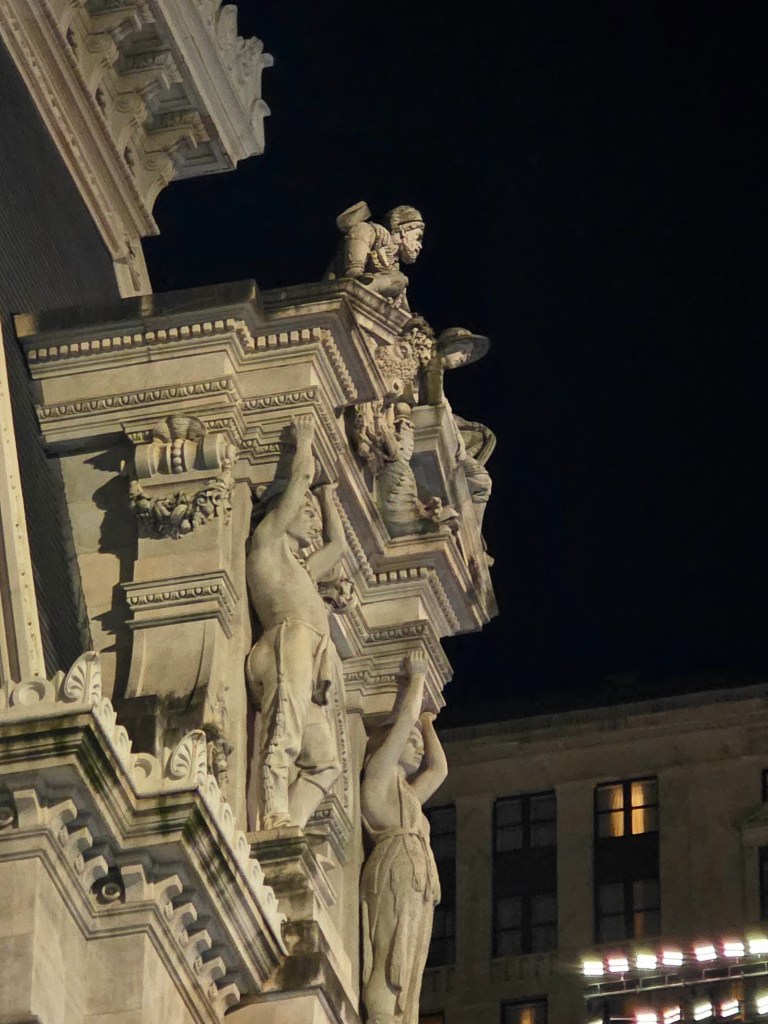
City Hall takes on a different quality at night; it is illuminated by LED spotlights mounted on neighboring buildings. Photo: G.A. Peck
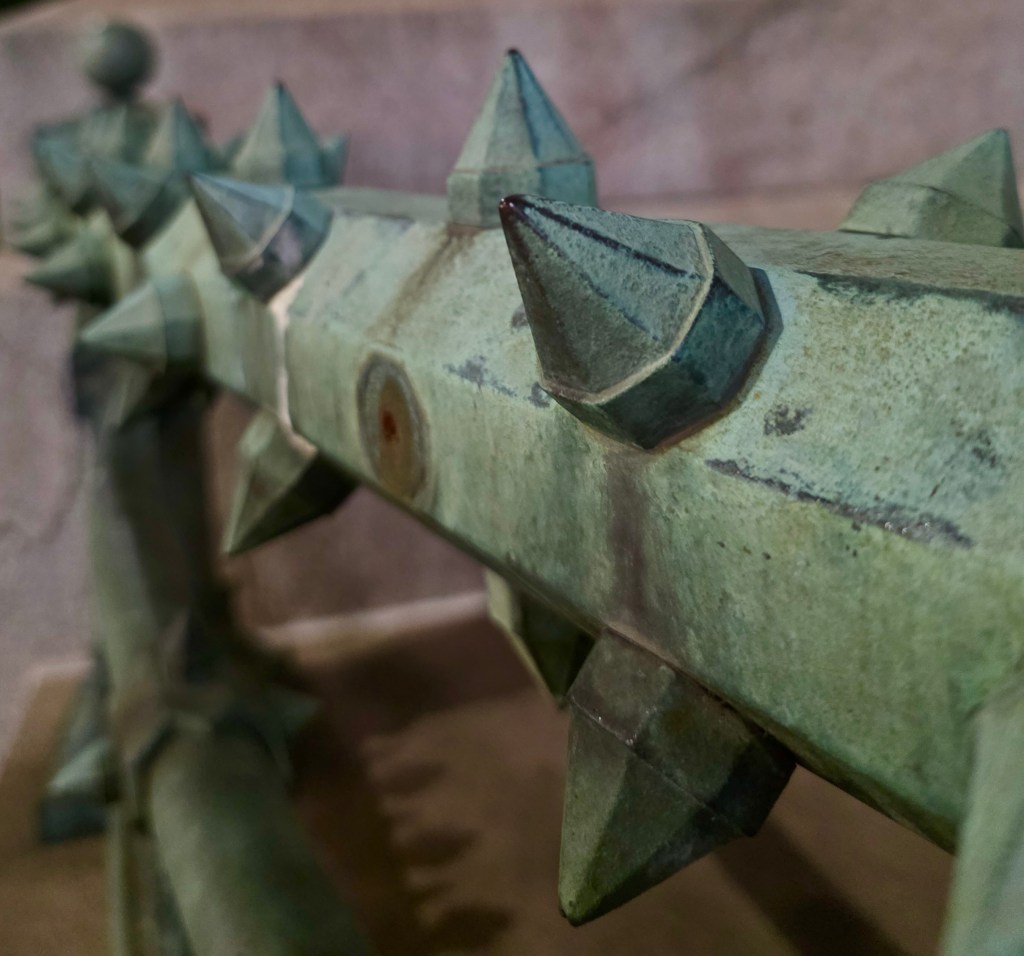
Railing detail, Philadelphia’s City Hall. Photo: G.A. Peck
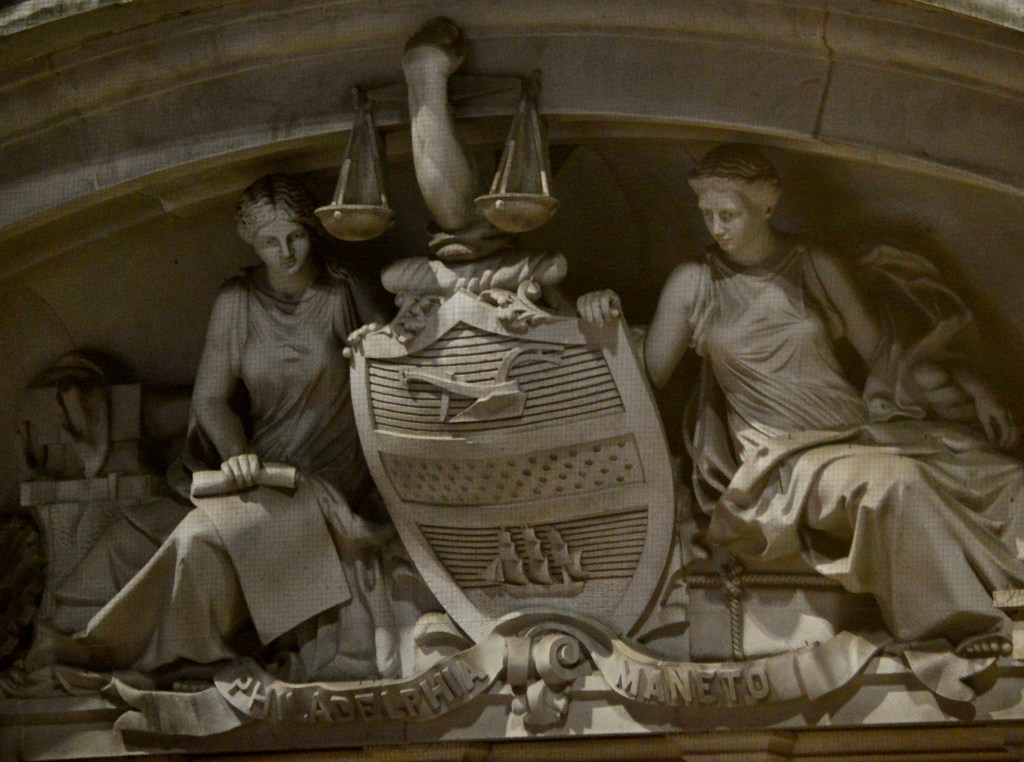
“Philadelphia Maneto” loosely translates to “Let brotherly love continue.”
The country could use more of that spirit today. Photo: G.A. Peck
Military Service, News & Publishing, Politics & Public Policy, Uncategorized

History Repeats

A pilgrimage back to the battlefields of Gettysburg

By Gretchen A. Peck

Growing up in a then-small town in mid-state Maryland, the Commonwealth of Pennsylvania always beckoned from the north. As 5th-graders, we’d travel to Camp Round Top for a standard-curriculum introduction to cabin life and campfire songs. Those who could afford it trekked up to places like Seven Springs for high-school ski trips. Towns like York and Reading appealed to our parents for stuff like farm-fresh canned goods and outlet shopping. It was rare to venture far enough east or west to get a taste of the big cities in Pennsylvania. I didn’t see Pittsburgh until I was well into my 40s, and Philadelphia eluded me until I was in college and in control of my own journeys. 

Though it felt like an epic adventure back then—through the wide-eyed but impatient eyes of a child — Gettysburg was an easy day-trip destination for parents and teachers who wanted to leverage some pretty remarkable local history. As a kid, I went there twice. Both times are etched in my memory still — one a fond trip; the other, a not-so-fond trip involving a banana-seated bicycle and a flashy Mercedes-Benz. 

The fonder of those two trips was with my main pal, my great-grandmother, Ruth. She was always rather independent and still felt comfortable behind the wheel of one those iron-horse American-made cars and station wagons she used to drive. I can’t be certain if she pitched the idea of a day trip to Gettysburg because she was intrigued by the history herself, or if she was just looking for a way to keep a precocious kid occupied for a span of time, but northward we went to the battlefields of Gettysburg. 

Gettysburg

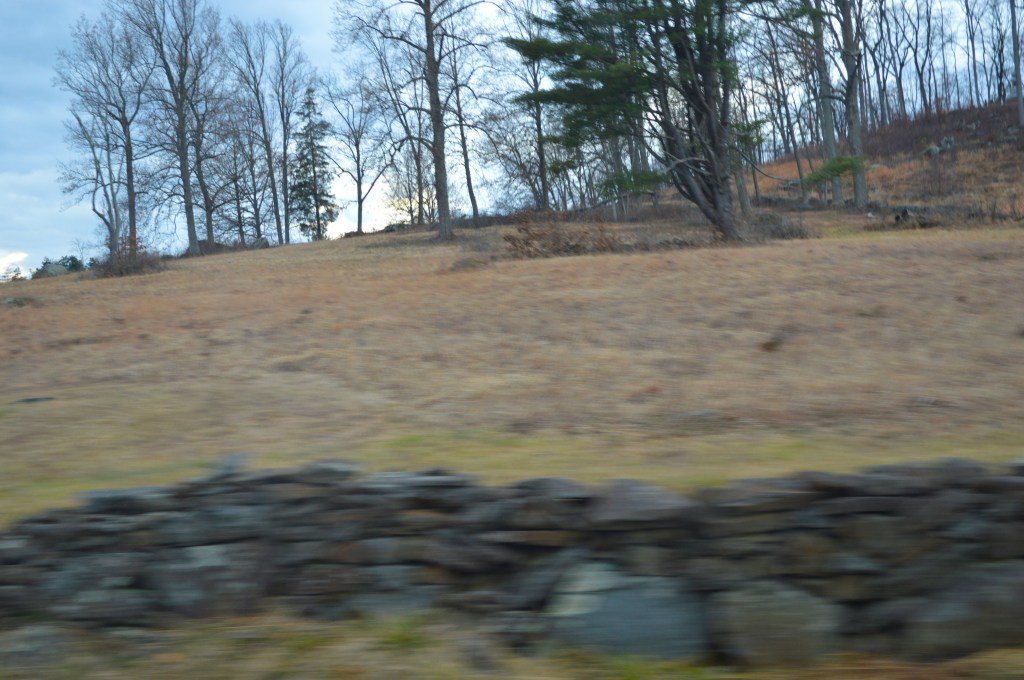
I knew about Gettysburg’s history, probably because I’d read about it independently. I was a voracious, above-grade reader with an affinity for history and historic fiction. I don’t know what I expected of the battlefields there, which I knew to have claimed the lives of thousands of men, but as we drove Gettysburg’s rolling hills and past its stacked stone walls, I found them to be just pretty countryside, but otherwise unremarkable. It was hard to imagine them littered with the bodies of dead and dying soldiers. Then again, it was hard to imagine fellow countrymen turning on one another at all. It didn’t sit well with me then, as a child, and doesn’t now.

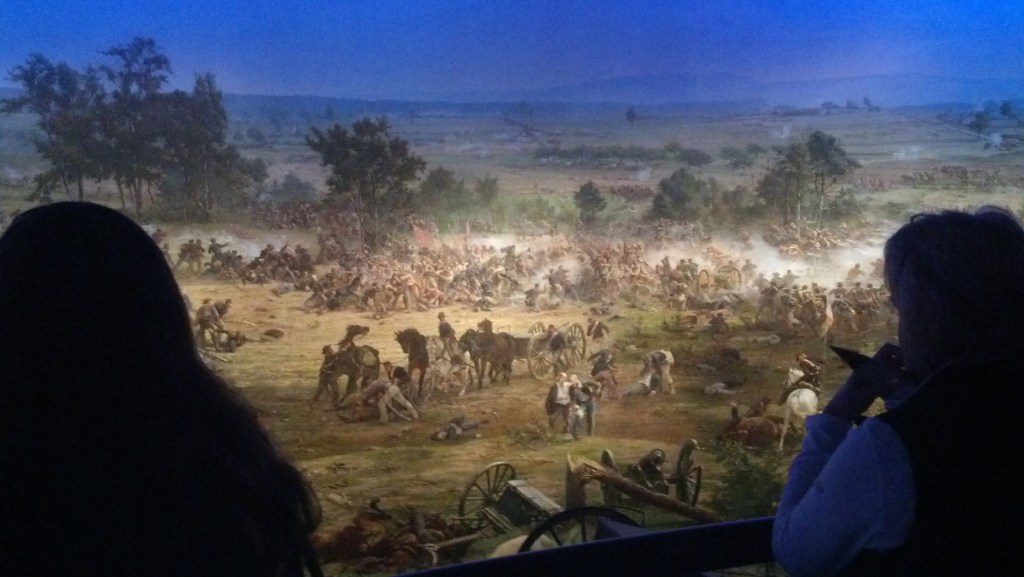
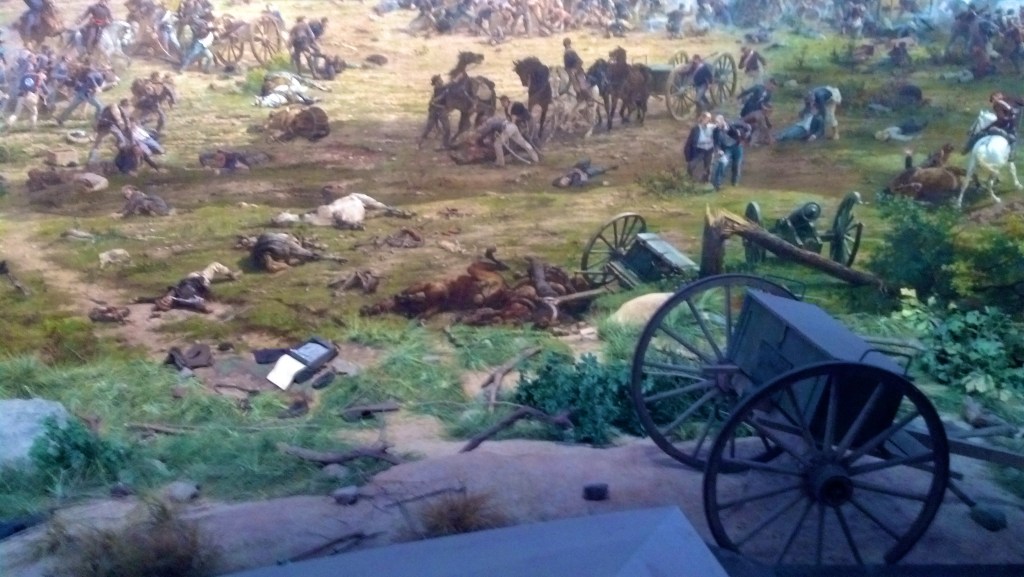
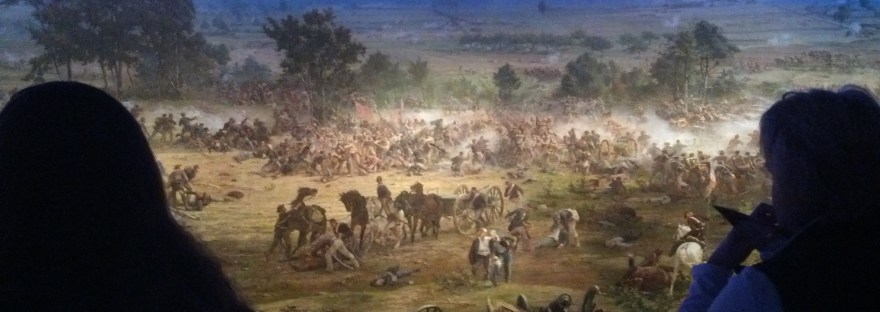
At the museum commemorating the pivotal battle, there was an interactive display — what they refer to as a cyclorama — a painting by French artist Paul Philippoteaux that offers a 360-degree depiction of the battleground’s horrors and the spoils of war. The artist shied not away from the gore, and viewing the battlefield like that helped me to imagine what those bucolic fields looked like in July 1863. I spun around, taking it all in, aghast at the blood and carnage. 

Cyclorama depicting the Battle of Gettysburg
Cyclorama (detail)

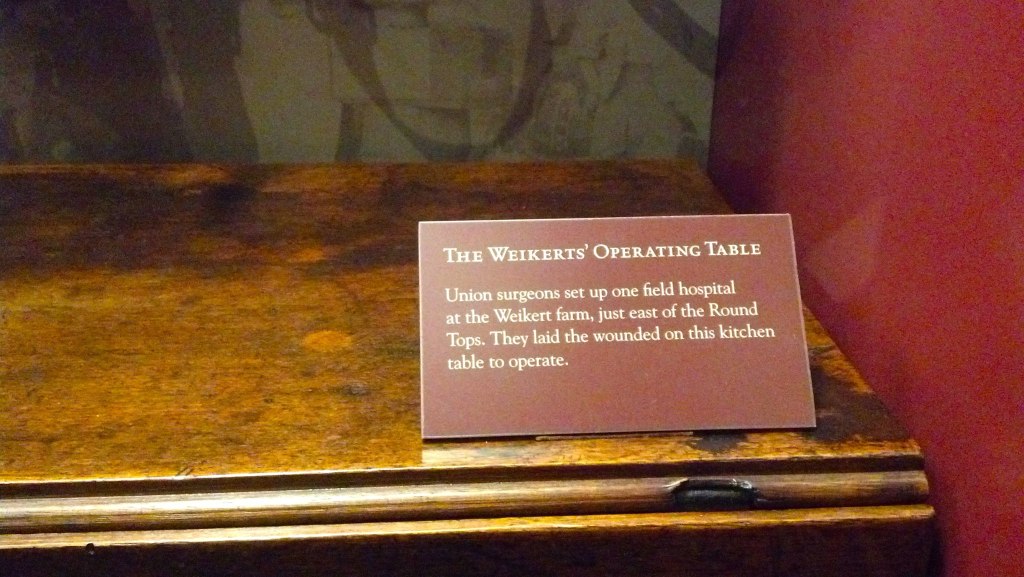
There was another artifact from the museum that I thought I remembered so vividly—an old wooden table used as a makeshift operating table. As a child, I stared in horror at the rough-blade saws they used for amputation with little to soothe the wounded soldiers. The table had what appeared to be a stain, and I gasped at the thought that no one had thought to wipe away the blood before putting it on display. 

Before we headed for home, my great-grandmother bought me a fold-out miniature depiction of the cyclorama, on glossy postcard stock. I unfolded it on my lap and studied it the whole way home. 

I was in my 40s when I went back to Gettysburg on a cold misty-mountain day, the end of a brief but cathartic pilgrimage back to where I began. Decidedly middle-aged by then, I had new perspective on childhood homes and places of significance around my hometown. I toured it with my parents, and we spoke of memories, avoiding the hardest ones. After the visit, I packed my truck and headed north toward home in Pennsylvania. I toyed with the idea of stopping in Gettysburg, but it was threatening to rain and I kept that in the back of my mind as an excuse not to make the pitstop. 

But something compelled me to retrace the steps my great-grandmother and I had walked together decades before. 

I thought of her as I bought my ticket, and wandered through the exhibits. She felt beside me as I ascended the long escalator to the theater-in-the-round where they cyclorama painting is on display. I could practically hear her laughter when I walked up to the display of the operating table to see that the “stain” I’d remembered was most likely just the natural grain of the wood and some wear and tear — the blood I’d conjured were just a child’s imagination run amok. 

Kitchen table/Operating table

I brushed by families and stood by myself reading the plaques and watching the video clips throughout the exhibit. I thought about the toxicity of politics, how it inherently divides up the nation into neat little categories, largely based on where and to whom we’re born. I thought of the barbarism of the war, the hand-to-hand, eye-to-eye combat, an intimate, personal war waged among neighbors and families and fellow countrymen. 

What would the weapons of Civil War be today?

It seemed to me then, even as a child, a wholly absurd notion. I felt men were to blame and women had to suffer their consequences. Now that members of Congress like Rep. Marjorie Taylor Greene (R-GA) openly flirt with the idea of civil war, like it’s the stuff of romantic nostalgia, I can no longer blame the barbarism on men alone. I do imagine that the civil war the Congresswoman pines for will not be so “fairly” fought, with men in uniforms on rural battlefields, but instead through cowardly acts of terror.

By the time I found my middle-aged self in Gettysburg back on that misty day, the nation’s politics had once again turned toxic, like a sepsis from a wound that never really healed. It’s exponentially worse now — in 2022, as we sit — so much more vitriolic, hateful, and steeped in a scourge of misinformation. 

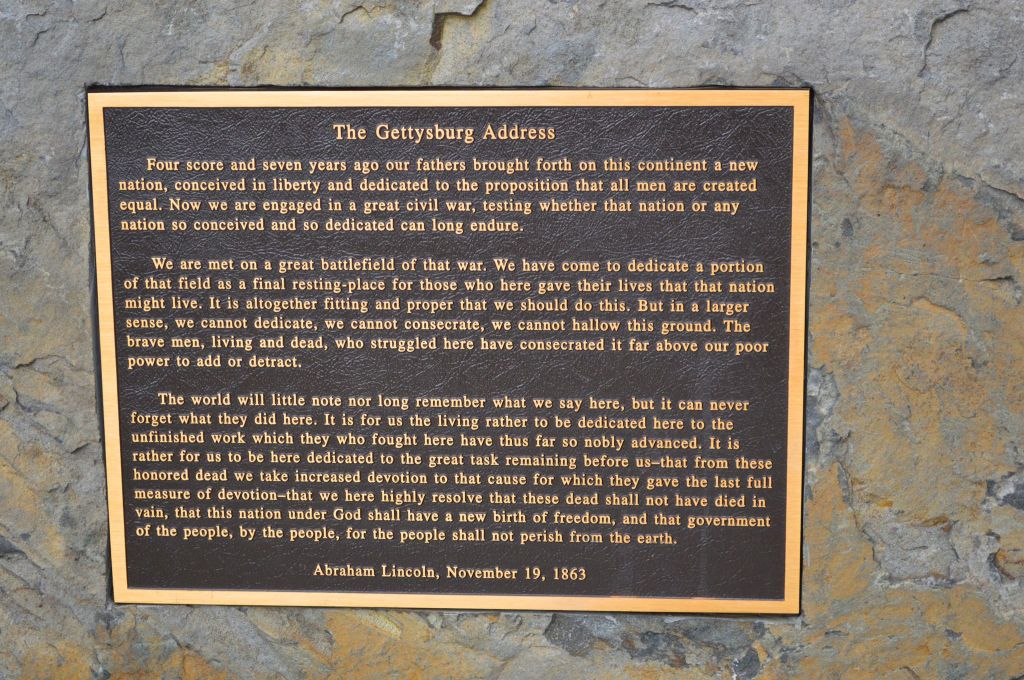
Before I left Gettysburg in my wake for that third time in my life, I stopped in the gift shop — now, a gift shop on steroids — and bought water for the ride home, a soldier bag for my husband (he’d hate it if I called it a murse, which it is), and a mug depicting the Gettysburg address for me. Just outside the gift shop sat a table where visitors could “Send a Message to the Troops” via postcard. I filled one out, and hoped it found someone out in some far-off “battlefield” and makes her or him feel thought-of and important.

I stopped to snap a selfie with a bronze statue of President Abraham Lincoln before getting on the road, just long enough to hear a strange conversation unfold between a father and son coming up the path to see the museum. “Lincoln,” the child exclaimed when he saw the statue where I was taking my selfie. “Take a picture of me, Daddy,” the little boy pleaded. There was an awkward pause before the father said, “Nah. Nah. Not now. Besides, he was on the other side.”

I thought of my great-grandmother again in that moment, by all accounts a church-going, southern, conservative Republican woman to her core. There was never any question how she came down on such matters. Slavery was immoral, a sin, and a war fought on slavery’s behalf — pitting neighbor against neighbor, countryman against countryman, brother versus brother — was, too. This was not up for debate.

She’d brought me to that hallowed battlefield to instill that in me. 

“War is cruelty.”

It felt tragic, almost surreal, to see a child brought to that solemn place and taught otherwise — its lessons not just missed but mistaken, misrepresented, warped.  Once again it feels surreal to see members of Congress masticating the possibility of bloodshed, or to read articles by pundits pondering whether Civil War in the United States is inevitable or has already begun. 

Perish the thought.