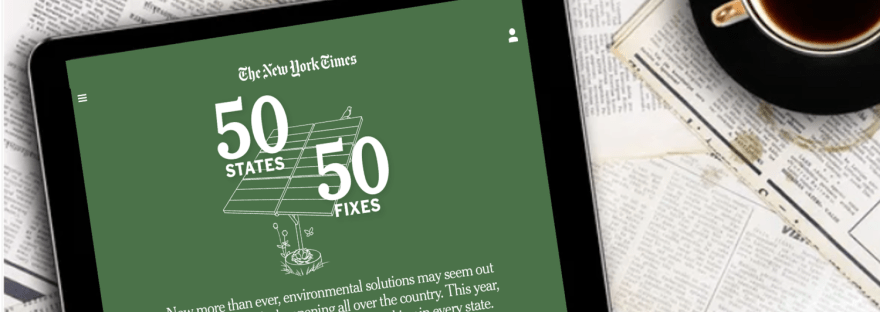
50 States, 50 Fixes: How local climate solutions are resonating across America — my conversation with The New York Times’ Climate Editor Lyndsey Layton.
#NYTimes #climate #localnews
Writer. Editor. Photographer.
50 States, 50 Fixes: How local climate solutions are resonating across America — my conversation with The New York Times’ Climate Editor Lyndsey Layton.
#NYTimes #climate #localnews
Chris Reen is Editor & Publisher (E&P) Magazine‘s Publisher of the Year.
Chris Reen is honored for his approachable optimism, reverence for journalism and a record of innovation, resilience and service to community.
QUICK READ: How top journalists protect sources and turn secrets into stories
Read at the link or in the September 2025 Editor & Publisher print edition:
“This is an area where more boards of directors than ever are looking for continued updates, not just on the state of the law and the state of enforcement policy, but what it all means in terms of their own companies’ practices. … This is complicated stuff.” — Camille Olson, partner, Seyfarth Shaw LLP
E&P’s August 2025 Cover Story: Experts weigh in on how DEI can survive and evolve in today’s volatile media and legal landscape
https://www.editorandpublisher.com/stories/whats-next-for-dei-in-newsrooms,257042
Quick Read: The Houston Chronicle investigative team—double the size it was just a year ago—digs deep into the questions that matter most to Houstonians
E&P started a series a couple of years ago, which we call “J-school profiles.” To create a bridge between the next-generation of aspiring journalists and E&P’s readers — many of whom hail from C-suite offices at news organizations small to massive — we began to write about journalism schools across the country. We wanted to know how curricula is changing as technology and journalism itself evolve, and how young people coming into the profession see their future roles.
Often, during those conversations with faculty and students, the topic of journalism’s “impact” came up. Many of those young people spoke about being compelled to pursue journalism because they wanted to do work that is meaningful, that inspires change, that has real, measurable value. In speaking with deans and professors, they often echoed hearing this from their students — the desire to be impactful. And yet, some of those educators also spoke from a place of concern, noting the important distinction between pursuing stories that may ultimately have impact and being an advocate for a particular community or cause.
It left me wondering: At what point does creating impactful journalism cross over into the realm of advocacy? And what are the ethical implications? The answer, it would seem, isn’t clear-cut, but I’d argue it’s still a discussion worth having. So, I asked three experts about their takes on advocacy versus journalism. Here’s what they had to say:
In the latest installment of E&P’s “Reporting On” series, we look at the environment beat, with particular interest in reporting on communities impacted by pollution and contamination.
This was a particularly personal assignment for me, having grown up in a town with a notorious Superfund site not far from my childhood home. It was likely a contributor to lifelong health problems for our family and for so many others in our community. Today, nearly six decades after the malfeasance that contaminated the site — and despite EPA intervention and remediation efforts — the land remains contaminated by military-grade Vietnam-era defoliants (just one category of “forever chemicals.”). Not long ago, it was sold to a developer who built housing on it.
Reporting on these public health and safety dangers is critical journalism. At the link, I speak with two reporters — Halle Parker at NPR affiliate WWNO in New Orleans and Alex Rozier at Mississippi Today — about the importance and challenges of environmental storytelling.
Elinor R. Tatum, publisher and editor-in-chief of New York Amsterdam News, exemplifies what it means to be E&P’s Publisher of the Year. For 30 years, she’s thoughtfully led the news organization through formidable challenges—the advent of the internet and digital media, greater competition for audience, uncertainty related to revenue, and most recently, the COVID pandemic era.
Tatum’s contribution far exceeds her work for the newspaper. She’s devoted her time and expertise to elevating other news media outlets and creating a sense of camaraderie so needed throughout the news media today. She’s a strategic risk taker and innovator—a change agent for the local news community, and especially the Black press.
And one of the many things I found to be so inspirational about Tatum as I wrote this month’s cover story was her long history of motivating, encouraging, empowering and challenging her staff, peers, all of us.
Read about Publisher Tatum at the link below, and check out E&P’s Editor-in-Chief Robin Blinder’s editorial introduction here: https://www.editorandpublisher.com/stories/inspiration-in-harlem,252692?newsletter=252745&vgo_ee=aWQmgzV5rfy%2BxfAMqNpxLpDgiOmuqKa8RiKGAIgxC8yh5T9ZH4Vq%3AFy1VRjwwp9beea%2F5LyuRkhAuWNTKp5vs
https://www.editorandpublisher.com/stories/leading-with-grace-and-power,252691
In late summer, I spoke with two journalists — Julian Borger, world affairs editor for The Guardian, and Nabih Bulos, who is the Los Angeles Times’ Middle East bureau chief — tasked with telling the story of the broadening war in Gaza. We spoke about the challenges of war coverage — about safety, working with local fixers and other journalists on the ground, about reporting on a region that it was nearly impossible to gain access to, and about the unpredictable nature of the work itself. For foreign correspondents, war means perpetual motion, a never-ending chase for anecdotes and atrocities, and meaningful context in sea of gray.
The only certainty, it seemed to me, was the volatility and the potential for the war to entrap or entice other nations and other terrorist groups to join the fight. And that’s precisely how it’s playing out. With just a few days of my discussions with Bulos and Borger, Hezbollah fired rockets into northern Israel.
Since, Israel retaliated by detonating pagers and mobile devices they believed to be in the hands of Hezbollah operatives. Iran-launched missiles rained down on Israel, and now the world holds its collective breath for Israel’s inevitable response to Iran’s assault. The one-year anniversary of the war passed.
The statistics I cited in the story are already obsolete. Since October 7, 2023, the war has now claimed the lives of 1,706 Israelis, 42,409 Palestinians, and 2,448 in Lebanon.
It is also one of the deadliest wars in the modern era for journalists. 128 have died. 40 have been wounded. At least 2 remain missing, according to the Committee to Protect Journalists. Please consider their sacrifices as you read this latest installment in our “Reporting On” series:
https://www.editorandpublisher.com/stories/reporting-on-the-war-in-the-middle-east,252455