In late summer, I spoke with two journalists — Julian Borger, world affairs editor for The Guardian, and Nabih Bulos, who is the Los Angeles Times’ Middle East bureau chief — tasked with telling the story of the broadening war in Gaza. We spoke about the challenges of war coverage — about safety, working with local fixers and other journalists on the ground, about reporting on a region that it was nearly impossible to gain access to, and about the unpredictable nature of the work itself. For foreign correspondents, war means perpetual motion, a never-ending chase for anecdotes and atrocities, and meaningful context in sea of gray.
The only certainty, it seemed to me, was the volatility and the potential for the war to entrap or entice other nations and other terrorist groups to join the fight. And that’s precisely how it’s playing out. With just a few days of my discussions with Bulos and Borger, Hezbollah fired rockets into northern Israel.
Since, Israel retaliated by detonating pagers and mobile devices they believed to be in the hands of Hezbollah operatives. Iran-launched missiles rained down on Israel, and now the world holds its collective breath for Israel’s inevitable response to Iran’s assault. The one-year anniversary of the war passed.
The statistics I cited in the story are already obsolete. Since October 7, 2023, the war has now claimed the lives of 1,706 Israelis, 42,409 Palestinians, and 2,448 in Lebanon.
It is also one of the deadliest wars in the modern era for journalists. 128 have died. 40 have been wounded. At least 2 remain missing, according to the Committee to Protect Journalists. Please consider their sacrifices as you read this latest installment in our “Reporting On” series:
The alliterative “Pancakes & Politics” is so much more than a forum for Detroit to talk about pressing issues. And Hiram Jackson is so much more than a newspaper publisher. Pancakes & Politics was his vision nearly 20 years ago. He shared with me the origin story of the event, which is held several times each year, bringing together Detroit’s business community, public officials and change-makers not just to discuss problems but to find solutions.
This is a story about journalism, pragmatism, communities of color, local news collaboration, leadership, and one man who’s made a measurable, remarkable difference in the city and beyond. Read on at the link.
Nuzzi was placed on leave this week — and should lose her job — at “New York” magazine for an undisclosed personal relationship with presidential candidate Robert F. Kennedy, Jr., a controversial public figure she was assigned to report on. People have speculated about the degree of ethical breach, which Nuzzi contends did not veer into a physical relationship. She has been castigated and slut-shamed online, while Kennedy’s behavior has largely been brushed aside as de rigueur for the serial-philandering, vaccine-denying, dog-eating, dead-bear staging, whale head-sawing, brain worm-addled oddball he is.
Make no mistake, Nuzzi’s behavior is a gross — and I mean that in every sense of the word — ethical breach. It reflects poorly on her, certainly, but it also stains the “New York” magazine brand. Nuzzi is just 31 years old and entitled to make journalistic mistakes that we all made in our young careers, but this one is beyond the pale. She should be fired, and she should have to rebuild her career and earn the trust of the public before given another megaphone — print, broadcast or otherwise.
But this is hardly a condemnation of journalism, as Fassler claims in his headline. The public and especially the news media itself needs to get away from these broad, sweeping condemnations. Look at the sins of David Pecker’s tabloid empire and its “catch and kill” practices. Imagine if every reporter at local papers and nonprofit news outlets around the country had to carry the weight of that on their shoulders. It’s patently out of context and unfair.
If you read past the headline, what Fassler is getting at is Nuzzi’s case is — and should be — an indictment of access journalism. Access journalism is when journalists favorably report on their subjects and sources in order to be granted access to them, to gain insider insight, and to get scoops that elude other news outlets.
Nuzzi is certainly a glaring example of a journalist who’s traded on access — and, I dare say, on her beauty. Across news media, we’ve had some of the most popular, visible and broadly followed journalists who can be accused of the same, even at the nation’s most prolific legacy institutions. It is a bane, no question, yet not a reflection of the whole.
Nuzzi’s recent work has been “sus,” as the kids say, and Fassler gives a number of examples of that. Yet, controversy attracts eyeballs and audience — still the most coveted currency in today’s news business. And she (and others) have been rewarded for it.
Still, to lump all journalists and media companies in with Nuzzi and those who enabled her along the way — even in a headline — does disservice to all the earnest, dedicated and toe-the-line reporters around the country.
And it emboldens the “dishonest press” and “enemies of the people” rhetoric. Let’s stop that.
In yet another installment of how the political press is silly, one right-leaning outlet leveraged FOIA to discover that the vice president—now candidate for the presidency—hadn’t included a teenage summer job at McDonald’s on job applications. The scandal! Stipulating that this is common practice in résumé tailoring, it nonetheless got me thinking about my first official summer job, for which I needed to get a work permit because I was just 15.
I wanted independence from my parents, to make my own money. I “applied” at a family-owned farm just down the road from our house. The owner, Denise, didn’t ask for any printed résumé. The interview went something like this:
Denise: Can you get up early in the morning?
Me: Yes. (But actually thinking, maybe.)
Denise: You don’t mind long hours? You’re not a complainer, are ya?
Me: I’m used to picking vegetables and being in the fields. (It was true. We’d lived in a rented brick ranch back then, which sat on farmland that was slowly being developed for housing. The landlord discounted the rent if we tended to the fields and he got his take of the harvest. We grew tomatoes, squash, corn, green beans, you name it. Here I am with one of my prize zucchinis.)
Denise: No back problems?
Me: No.
Denise: You’re hired. Can you start today?
My parents liked the idea of manual labor and how it kept me busy and out of trouble. And that it did. At dawn, I’d walk the half-mile to work, carrying a brown bag lunch. To beat the heat, Farmer Denise had us in the fields early. By us, I mean me and about a dozen or so farm hands who drove the flatbed trucks, and Spanish-speaking migrant workers who picked, like me.
Most of the season, we were tasked with picking tomatoes. You’d have to grab them off the vine at just the right time, when they were newly ripe and hadn’t yet split nor spoiled. We’d fill half-bushel baskets with tomatoes and then walk them back to the flatbed trucks parked at the end of our rows. We were paid a penny per tomato. Denise would inspect every single one at the end of the day, and toss aside any unsuited for market.
We picked rain or shine and in temperatures that soared into the 90s most days that summer. My skin browned; my muscles ached. The migrant workers laughed at me when I’d stand and stretch and moan from all the squatting and bending over. They were so much faster at picking those tomatoes. I always had the need to excel, but in this, I felt like an underachiever.
At lunchtime, we’d pile onto one of the trucks, to be carted back to the main barn, where we could eat our sack lunches in the shade. I sat alone and ate my white-bread sandwiches, coveting the homemade delicacies the others shared over spirited conversations.
At the end of the day, I’d walk back home, filthy and exhausted—and if it was a good-pickin’ day, $15 cash my pocket. I thought about my fellow workers and how for me, that money was to be spent on frivolity—a new pair of jeans, some lip gloss, the latest LP I had to have. For them, it was livelihood. I couldn’t help but wonder how they paid for housing, food, clothing and other necessities on those wages. And yet, they never seemed to complain.
Just when I thought I’d mastered the job, tomato season gave way to pumpkin season, and I got a dose of true backbreaking labor. Pumpkins don’t seem heavy individually, but when you pick about 150 of them and walk each of them down the long row to the truck, in crippling heat, you come to hate the sight of those orange gourds and relish smashing them.
Naturally, the job taught me a lot—the value of money, the feeling of hard labor, the determination and hardships of migrant workers, the relentless demands of a discerning boss, and so much more. Even still, when I went to apply for jobs post-college, farm worker wasn’t on my résumé.
Way, way back in grad school, I studied rhetoric—the art of using words to persuade. Ever since I’ve been fascinated by politics and oration, which brings me to our Presidential race: Trump/Vance v. Harris/Walz.
There are clear policy differences between the two parties. We can vote on those according to our values and priorities. But what’s notably distinctive is the tone of the campaigns.
One paints a picture of a dystopian America, a nation alone on the world stage, alliances be damned. Not just America First, but America Only. It’s a campaign based on grievances—personal grievances of the man at the top of the ticket, who spends his rallies disparaging people who don’t bend the knee in fealty or espouse his loosely held principles. It is a campaign that not only doesn’t extend a handshake to all Americans, it disparages them in cruel, incredible terms. It is a campaign that portrays too many Americans as “others,” to be feared, hated, prosecuted, persecuted, or worse. A campaign that describes the nation’s cities—our multicultural centers of commerce, technology and art—as hellscapes, and a campaign that reimagines the future of America in the regressive Project 2025. It’s a campaign replete with speeches pining for a dialing back to 2016, a dialing back on policy, on “settled” law, on rights, on innovation, on societal progress and intellectualism. It looks at humanity and showcases the worst of it. It is a campaign about retribution (Trump’s words). It is relentlessly angry.
From Donald J. Trump’s Truth Social account, August 6, 2024Vice Presidential candidate JD Vance is starting to mimic the culture-wars rhetoric of his running mate. Despite the thorough debunking of this claim days ago, this post still appears on Vance’s X.com page as of August 6, 2024.
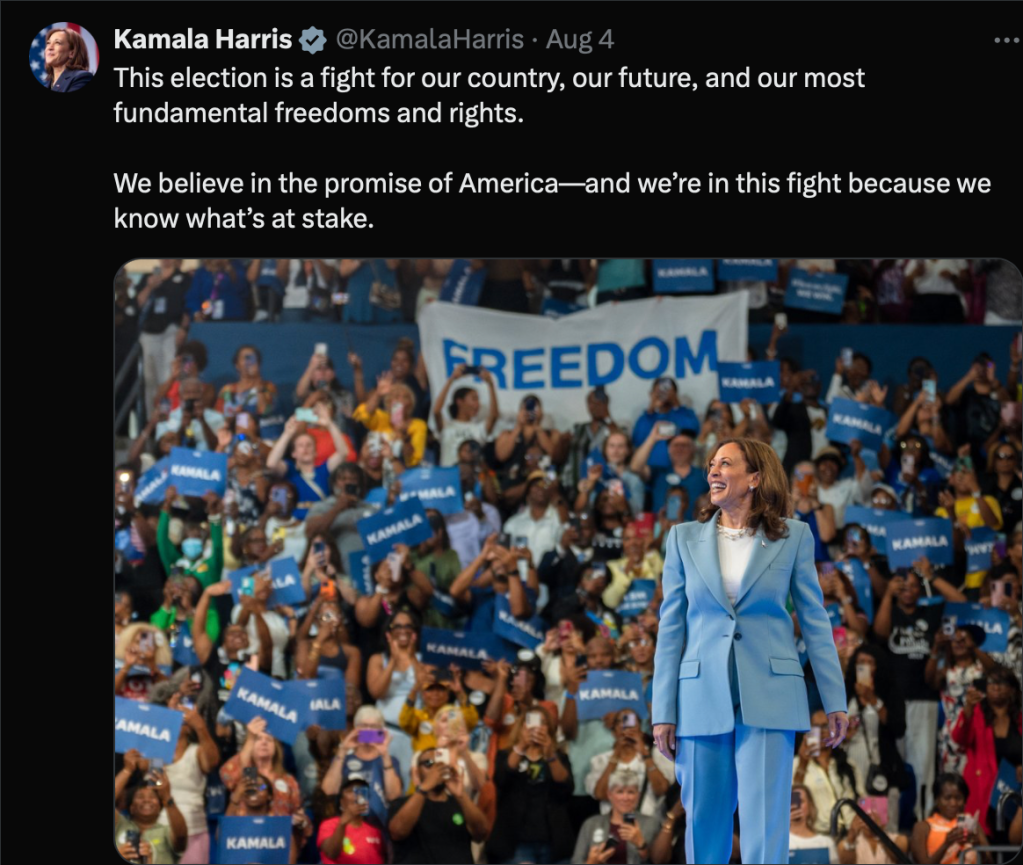
By comparison, the other campaign strikes a tone that’s hopeful, aspirational, empathetic. You’ll find no “losers and suckers” admonishments in the deep cuts. It’s a campaign with a Presidential hopeful who is attacked—like so many women—for being accomplished and yet unapologetically happy. They call her “giggles” and “crazy” and “cackling” when she expresses joy.
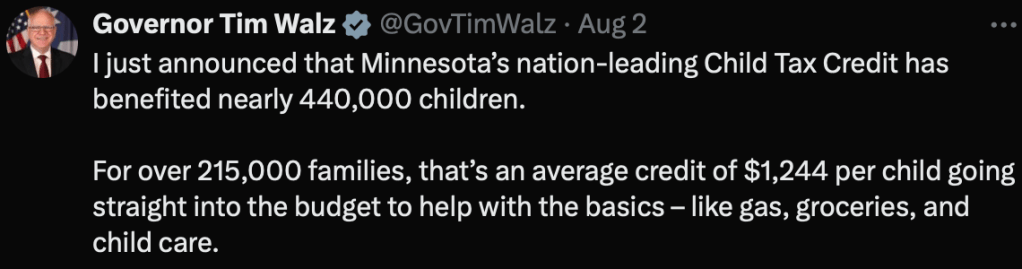
Now, she has a running mate, who seems happy, too—not pollyannish about what ails our nation, but excited for the prospect of their proposed solutions to heal them.
Vice Presidential candidate Tim Walz expresses empathy for Minnesota’s families who are struggling to make ends meet — offering solutions not bluster.
And unlike the falsely masculine rhetoric coming from the other campaign, this VP doesn’t hide his softness, his compassion. He laughs, and not at others’ expense. Hours old, this campaign already feels lighter, forward-focused.
So many Americans are politically exhausted and parched. They’re looking for the water source in that dystopian desert. And if you think a message of hope, aspiration and joy doesn’t sell in the nasty news cycle-obsessed world of modern-day politics, I give you eight years of President Barack Obama as evidence people find it refreshing, resounding and winning.
In the wake of Vice President Kamala Harris’s pick for a running mate, Governor Tim Walz, the Obamas weighed in on what Walz brings to the ticket, including “his ability to talk like a human being and treat everyone with decency and respect.”Former President Barack Obama and First Lady Michelle Obama take their final flight on Marine One, as they fly over Washington, D.C. following the inauguration of President Donald J. Trump. Photo: G.A. Peck
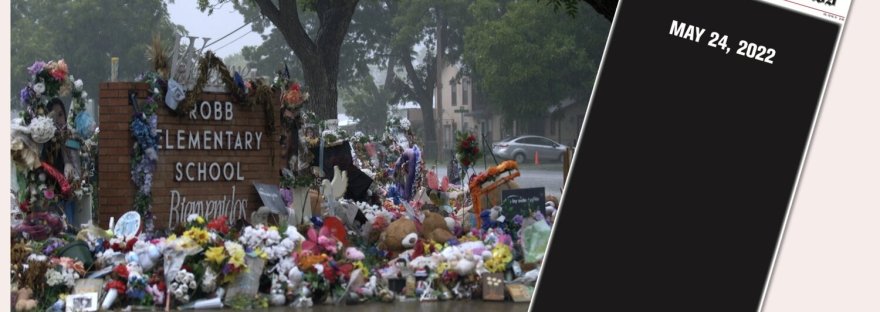
In the week that followed the horrific mass shooting at Robb Elementary in Uvalde, Texas, I was one of thousands of calls into the local newspaper, the Uvalde Leader-News. I was working on a story for E&P—part of the magazine’s “Reporting On” series—about journalists who have the daunting task of reporting mass shootings.
On a few occasions that week, a member of the newsroom there would answer—audibly exhausted and grief-stricken, yet polite and professional—and take down my message for the owner-publisher Craig Garnett. I, of course, wanted to speak with him about my assignment, to learn in those still-raw moments what it takes for a newsroom to cover a story of this magnitude and tragedy. But so much more importantly, I wanted to express my sorrow, to let him and his entire newsroom know that we shared in their grief. After all, a member of our news community had been personally and profoundly impacted by this crime. ULN’s Crime Reporter Kimberly Mata-Rubio’s 10-year-old daughter, Lexi, was among the victims.
Despite an enormous weight on his shoulders, Garnett called me back a few days later, and generously, thoughtfully spoke about what his newsroom was going through. Through tears that seemed never-ending, I wrote the story.
I’ve thought about that local paper—Garnett and the small, tight-knit staff—the Rubio family, and the community of Uvalde every day since.
I had the great honor to reconnect with Garnett last week, to talk about the ABC News documentary, “Print It Black,” now streaming on Hulu. It’s a difficult-to-watch yet important film that I implore everyone to see—a complex, nuanced and honest look at mass shootings in America, about life in a small town, about racism, poverty and classicism, and about a local newsroom rising to an occasion for which it never could prepare.
It’s hard for me to believe that nearly 20 years have passed since ProPublica first came on the news media scene. I immediately followed their work, because I believed in their mission and the void they were filling. Yet, I worried that the then-fledgling news outlet and the nonprofit model wouldn’t pan out.
Thankfully, they flourished.
We wanted to write about ProPublica now, in a year when its journalists earned a 7th Pulitzer Prize (added to a considerably long list of other awards) and has become an unquestionable leader in the industry — not just for the impactful journalism their newsroom produces, but for the way in which they’re enabling other newsrooms around the country to excel in their own accountability work through partnerships.
I spoke with two of the editors who’ve been there since the beginning — about what it was like to stake their careers on the new nonprofit; how the newsroom has evolved; and what keeps them motivated all these years in. At the link, hear from Charles Ornstein, ProPublica’s managing editor, local, and Editor-in-Chief Stephen Engelberg.
This ranks as one of the most fun and fascinating conversations I’ve had this year about the power of the printed newspaper and media literacy.
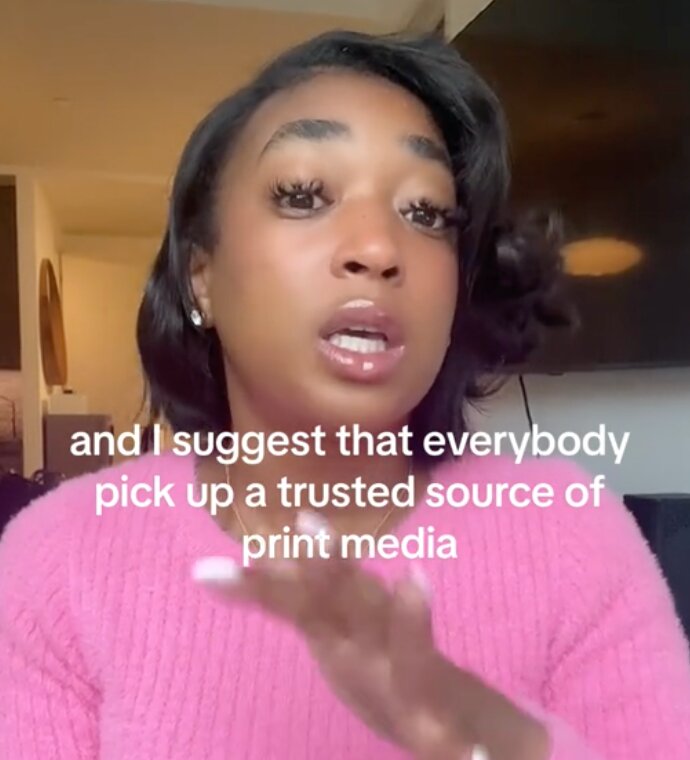
Meet TikTok’s “Print Princess,” Kelsey Russell, who leverages the platform to introduce her audience to news of the day; how to be critical about what they read; and how print can give us a break from screen time, as well as help us more meaningfully consider and retain information.
Among our news community, we frequently talk about “trust in news” and how it has eroded to dangerous levels. I’d suggest there are myriad reasons for that, including some that date back centuries. The press has always been a convenient punching bag. When people don’t like what they read, they naturally want to discount the information.
Some of the phenomenon is patently new, as we’ve seen with the increase in “lawfare” suits designed to chill journalists and shutter news organizations outright. There’s also the toxic political rhetoric, even shouted from the highest offices in the land, expressly to make people doubt watchdog and accountability reporting.
Now, we’re contending with Artificial Intelligence (AI), too, which is training people to doubt what they read and view.
Some of it is well-deserved. The press doesn’t always get the story right, especially in the rush to report first. Quality journalists among the American media are contrite when it happens, acknowledging their mistakes and offering corrections or retractions. Far too many outlets masquerading as trusted sources of news peddle misinformation and never acknowledge their failures to report accurately. That’s harmful, industry-wide.
I’d suggest the public also has a cynical view of how news is gathered and produced when they hear about strategic misdeeds, such as tabloid-style “catch and kill” stories — for example, when an adult film actress’ story about an affair with a politician never sees the light of day because the publisher and the porn star are paid to suppress it. It’s easy for the public to conflate that kind of “news” with what earnest, professional journalists produce day-in, day-out.
Indeed, there are many reasons — deserved and not — for the lack of trust in news today, but the important thing is that we’re thinking about it as an existential threat and doing our best to counter it. That’s why I’m bullish on The New York Times decision to convene a “trust team” that’s keenly focused on this issue.
At the link, read about my conversation with Edmund Lee, editor of The Times’ trust team and one of the ways they’ve built more transparency and familiarity into the display of news.












 Gretchen A. Peck