
It’s hard for me to believe that nearly 20 years have passed since ProPublica first came on the news media scene. I immediately followed their work, because I believed in their mission and the void they were filling. Yet, I worried that the then-fledgling news outlet and the nonprofit model wouldn’t pan out.
Thankfully, they flourished.
We wanted to write about ProPublica now, in a year when its journalists earned a 7th Pulitzer Prize (added to a considerably long list of other awards) and has become an unquestionable leader in the industry — not just for the impactful journalism their newsroom produces, but for the way in which they’re enabling other newsrooms around the country to excel in their own accountability work through partnerships.
I spoke with two of the editors who’ve been there since the beginning — about what it was like to stake their careers on the new nonprofit; how the newsroom has evolved; and what keeps them motivated all these years in. At the link, hear from Charles Ornstein, ProPublica’s managing editor, local, and Editor-in-Chief Stephen Engelberg.
I’ve long appreciated the concept of hyperlocal news. What better way to make communities and neighborhoods feel seen and heard than to cover the news expressly for them and about them? We’ve seen news outlets like Block Club Chicago and Trib Total Media have rousing success taking a street-level neighborhood approach to news.
I was pleasantly surprised when E&P’s Robin Blinder and Mike Blinder returned from Borrell Miami this spring with a new story in hand about hyperlocal news—TV and radio broadcasters leveraging their brands and trustful audiences to launch hyperlocal digital sites and streaming services. So, I followed up with Gordon Borrell to get his take on why hyperlocal news was seeing a renaissance of sorts and followed up with three media executives in the throes of starting up new hyperlocal media properties. Here are their stories:
This ranks as one of the most fun and fascinating conversations I’ve had this year about the power of the printed newspaper and media literacy.
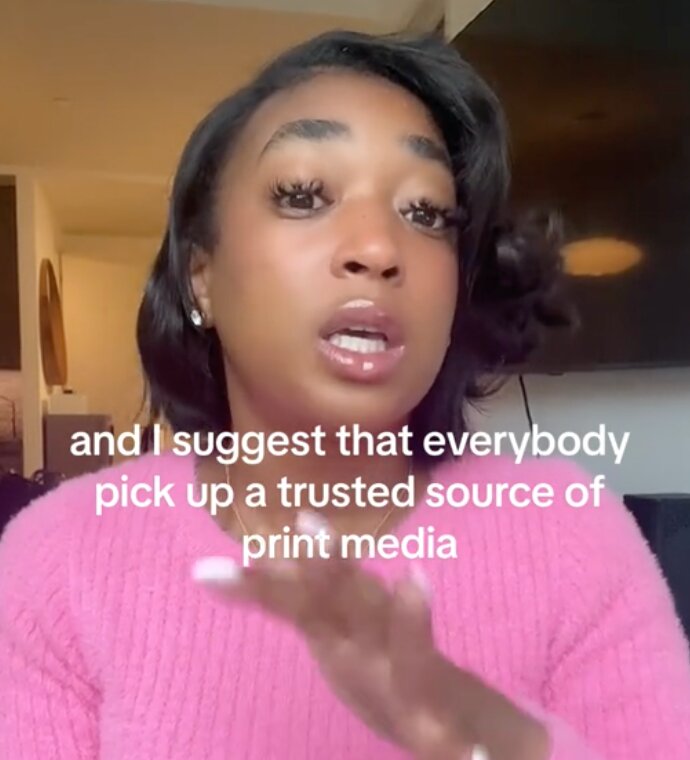
Meet TikTok’s “Print Princess,” Kelsey Russell, who leverages the platform to introduce her audience to news of the day; how to be critical about what they read; and how print can give us a break from screen time, as well as help us more meaningfully consider and retain information.
Among our news community, we frequently talk about “trust in news” and how it has eroded to dangerous levels. I’d suggest there are myriad reasons for that, including some that date back centuries. The press has always been a convenient punching bag. When people don’t like what they read, they naturally want to discount the information.
Some of the phenomenon is patently new, as we’ve seen with the increase in “lawfare” suits designed to chill journalists and shutter news organizations outright. There’s also the toxic political rhetoric, even shouted from the highest offices in the land, expressly to make people doubt watchdog and accountability reporting.
Now, we’re contending with Artificial Intelligence (AI), too, which is training people to doubt what they read and view.
Some of it is well-deserved. The press doesn’t always get the story right, especially in the rush to report first. Quality journalists among the American media are contrite when it happens, acknowledging their mistakes and offering corrections or retractions. Far too many outlets masquerading as trusted sources of news peddle misinformation and never acknowledge their failures to report accurately. That’s harmful, industry-wide.
I’d suggest the public also has a cynical view of how news is gathered and produced when they hear about strategic misdeeds, such as tabloid-style “catch and kill” stories — for example, when an adult film actress’ story about an affair with a politician never sees the light of day because the publisher and the porn star are paid to suppress it. It’s easy for the public to conflate that kind of “news” with what earnest, professional journalists produce day-in, day-out.
Indeed, there are many reasons — deserved and not — for the lack of trust in news today, but the important thing is that we’re thinking about it as an existential threat and doing our best to counter it. That’s why I’m bullish on The New York Times decision to convene a “trust team” that’s keenly focused on this issue.
At the link, read about my conversation with Edmund Lee, editor of The Times’ trust team and one of the ways they’ve built more transparency and familiarity into the display of news.
Ever wonder what it takes to produce Pulitzer Prize-winning journalism? I spoke with reporters and editors at three newsrooms that were awarded Pulitzers earlier this month. They spoke about the inspiration behind their award-winning series; the labors and resources the projects required; the dilemmas they faced during the news gathering; and ultimately, the impact.
I was talking to some Boomer-generation family members not long ago, who’d expressed frustration about the state of the world — not about big things, like war or the state of democracy, but about small, comparatively insignificant things. They complained about how nothing interested them on TV anymore, about the popularity of Taylor Swift, and how print menus had been replaced by QR codes. These grievances seemed petty to me, so I found myself imparting wisdom I gained far too late in life: “Not everything is made for you,” I told them.
It dawned on me that if you see things in the world in two categories — things you like = good; things you don’t like = bad — you’ll live your life in a state of perpetual frustration or agitation. It’s a far more pleasant existence to think, just because I don’t like something — just because it wasn’t produced with me as an audience or consumer in mind — doesn’t make something bad, unworthy, corrosive or a danger to society. Other people may like it, and they have a right to enjoy it and to exist, and it need not have any impact on you at all.
This same philosophy can — and should — be applied to people and lifestyles, too.
I thought about this as I read reporter Peggy Noonan’s account of attempting to interview protesters on Columbia University’s campus. She wrote about how they didn’t want to talk to her. “Friends, please come say hello and tell me what you think,” she implored them.
Frankly, if that’s how she approached the students, I wouldn’t be a bit surprised that they opted not to speak with her. “Friends …” does make it sound a bit disingenuous, like someone trying to draft you into a religious sect.
Journalist Peter Baker of The New York Times boosted Noonan’s remarks on X/Twitter, implying the students wouldn’t speak to her because they weren’t capable of articulating their reason for protesting.
Last week, when I spoke with several editors of school newspapers on campuses around the country, they all talked about students’ reluctance to speak to the press.
The editors explained to me that the student protesters — in fact their entire generation — is media savvy but also distrustful of the press. They worry of their remarks being misunderstood or intentionally misconstrued. They’ve grown up in an era in which “fake news” is a familiar concept and social media can make one inarticulate remark take on a life of its own.
Anish Vasudevan, the editor-in-chief of The Daily Orange at Syracuse University, explained how student protesters on campus have designated “media-trained” spokespersons expressly for these reasons.
As I spoke with these student journalists, it also confirmed how much newsroom “representation” matters today, especially among young people. They’re more inclined to feel seen, heard and understood when they’re talking to reporters who have some shared perspective, whether that’s ethnicity, gender, geography, race, language, education, a common campus, age or generation.
In many cases, student reporters were able to land the most meaningful interviews with their fellow students, because representation matters. It helps repair some of the deteriorated trust in news media when we see ourselves represented among the storytellers.
Maybe this story — this moment in history — isn’t for journalists like Noonan or Baker to chronicle. And that’s ok.
Artificial Intelligence (AI) shows a lot of productivity promise for news publishers, but in its early iterations, AI is also proving to be perilous. E&P has been covering AI developments frequently, and this month we look at how Generative AI is changing the way people search for and retrieve information from AI-enabled search engines.
For the user, a query to an AI-enabled search engine may provide a thorough responses that satisfies their question. The risk remains that those response summaries may be flawed with fallacies, depending on how the AI engine was trained.
The other concern for news publishers is how users behave based on the search response. They may be satisfied with the result and sated, and resist scrolling down for additional search results and links to other sources, including news articles. That should trouble any news media business that relies on a healthy influx of web traffic and has for years invested in improving SEO performance.
We invited no less than 30 publishers about how they’re preparing for AI-search disruption. Some spoke on background; others opted not to comment at all, citing an uncertainty about what to do. There’s no shame in that. AI is new and developing at lightning speed, and we’re all just trying to figure out where this path is leading. But a few publishers are ahead of the curve and implementing new ways to nurture more direct relationships with readers/viewers/listeners, thereby relying less on search traffic. We tell two of their stories at the link:
As with many other states today, Vermont is contending with a new cannabis economy. It has opened up a wellspring of opportunity for new businesses (dispensaries, growers and other cannabis-focused commercial organizations), associations, and for the state government to allocate and invest new tax revenue.
Building on a legacy news brand that dates back a century, Vermont News & Media saw its own opportunity to create a cannabis title, “Green Mountain Vermont Cannabis News,” to inform the public about cannabis laws and regulations, new businesses and jobs, and how to enjoy wider access to locally grown products. They’ve taken a different approach to the publication than other cannabis titles, choosing to reflect the state’s craft-cannabis culture.
E&P’s “Reporting On” series takes a look at what it’s like to be a journalist tasked with covering a national/international crisis, or an urgent public policy concern. This month, we spoke with journalists who report on the nation’s borders and ports. With as much national media—and particularly “cable news”—coverage as we have about the southern border, in particular, there is so much more to the story.
I learned a lot from these exceptional reporters, who take us to the border itself; share stories of what its like in communities like Chicago, where the border crisis has been brought to their doorsteps; who help sort through the politics and the realities; and turn our attention to the vulnerabilities of the nation’s ports, so critical to our economy and yet so rarely covered in the detail they deserve.
I set aside my own biases about immigration and allowed the reporters’ stories to stand tall here. But I’m perhaps not unlike so many other Americans who see that immigration is a many-layered complicated issue that’s just not being treated earnestly and effectively by our elected leaders. On radio and TV, we hear gripes about people not coming here “the right way,” but unlike the immigration channels of one or two generations ago, today’s path to citizenship is messy, long, prohibitive, frightening, expensive, and completely out of reach for so many immigrants. We’re failing in not exposing that story.
Having spent part of my childhood living in South America, I also know how dire and deadly life can be in nations to our south—measurably worse today than even in the 1970s. I can understand why people want to or are forced to leave their homes, their families, their livelihoods and their way of life. It’s not hyperbole to say it can be a life-or-death decision.
This is not to discount the serious and steady threat of bad actors coming across the border and exploiting desperate people, parents and their children. We need to stop them, and we often do. But surveillance technology, concertina wire, a big tall wall, and border enforcement alone won’t solve this crisis; it requires a retooling of foreign policy and thoughtful diplomacy rather than isolationism.
We are a champion nation. We broadcast to the world about our exceptionalism, what makes us special, what makes us wealthy, what makes us progressive, what makes us leaders, what makes us (comparatively) safe, what makes us free. To expect people from all over the world—especially poor nations plagued by crime and corruption—not to want to come here, in fact to risk their lives to become an American, is ill-considered.
Social media can be a minefield for journalists to navigate today. Social platforms are a great tool for extending the reach and impact of reporting, and it’s also part of our everyday non-professional lives, as well. It’s a way to communicate with friends and family, a way to make connections, network, socialize, have a say in our communities, and even find love.
But being active participants in the social scene comes with obstacles. Social opens journalists up to public scrutiny in a way that bylines alone never did. It can paint us as targets for bad actors, and set us up for condemnation over our judgments about what we share professionally and personally.
Think about the common practice of “liking” someone else’s post. As a person in news, there may be many reasons to do that. I’ve used a “like” to bookmark a post I want to expediently revisit. I’ve hit the thumbs up to boost the journalism itself because I feel the reporting is important and am glad the outlet invested in it. These aren’t necessarily endorsements or affirmations of the “message” of the post, but from time to time, I’ll like a post because I do “approve of this message.” So, there are nuances here, yet even a simple “like” can get a journalist in hot water today, as we saw just recently occur at the BBC.
At E&P, we wanted to take a closer look at how news media publishers are addressing dilemmas about professional conduct on social platforms. We found many don’t have formal policies in place beyond their long-standing ethics rules, but quite a few are considering how to formalize a policy, so there are no gray areas when issues arise. I was heartened to speak with a number of editors who trust their reporters to act responsibly in social scenarios and, in fact, give them a great deal of leeway to still participate in social circles without fear of oppressive oversight and penalty.
At the link, check out my conversations with a few of those thoughtful editors: