News & Publishing, Politics & Public Policy, TV, Radio, Audio, Uncategorized

Nuzzi is not all of us

I cringed when I saw Jeremy Fassler’s headline for his Medium column this week, “The Olivia Nuzzi Scandal Is an Indictment of Journalism.” 

Nuzzi was placed on leave this week — and should lose her job — at “New York” magazine for an undisclosed personal relationship with presidential candidate Robert F. Kennedy, Jr., a controversial public figure she was assigned to report on. People have speculated about the degree of ethical breach, which Nuzzi contends did not veer into a physical relationship. She has been castigated and slut-shamed online, while Kennedy’s behavior has largely been brushed aside as de rigueur for the serial-philandering, vaccine-denying, dog-eating, dead-bear staging, whale head-sawing, brain worm-addled oddball he is. 

Make no mistake, Nuzzi’s behavior is a gross — and I mean that in every sense of the word — ethical breach. It reflects poorly on her, certainly, but it also stains the “New York” magazine brand. Nuzzi is just 31 years old and entitled to make journalistic mistakes that we all made in our young careers, but this one is beyond the pale. She should be fired, and she should have to rebuild her career and earn the trust of the public before given another megaphone — print, broadcast or otherwise. 

But this is hardly a condemnation of journalism, as Fassler claims in his headline. The public and especially the news media itself needs to get away from these broad, sweeping condemnations. Look at the sins of David Pecker’s tabloid empire and its “catch and kill” practices. Imagine if every reporter at local papers and nonprofit news outlets around the country had to carry the weight of that on their shoulders. It’s patently out of context and unfair. 

If you read past the headline, what Fassler is getting at is Nuzzi’s case is — and should be — an indictment of access journalism. Access journalism is when journalists favorably report on their subjects and sources in order to be granted access to them, to gain insider insight, and to get scoops that elude other news outlets. 

wrote about access journalism in a 2021 “Editor & Publisher” magazine. 

Nuzzi is certainly a glaring example of a journalist who’s traded on access — and, I dare say, on her beauty. Across news media, we’ve had some of the most popular, visible and broadly followed journalists who can be accused of the same, even at the nation’s most prolific legacy institutions. It is a bane, no question, yet not a reflection of the whole. 

Nuzzi’s recent work has been “sus,” as the kids say, and Fassler gives a number of examples of that. Yet, controversy attracts eyeballs and audience — still the most coveted currency in today’s news business. And she (and others) have been rewarded for it. 

Still, to lump all journalists and media companies in with Nuzzi and those who enabled her along the way — even in a headline — does disservice to all the earnest, dedicated and toe-the-line reporters around the country. 

And it emboldens the “dishonest press” and “enemies of the people” rhetoric. Let’s stop that. 

News & Publishing, Politics & Public Policy, Printing and Imaging

Talking newspapers with Kelsey Russell

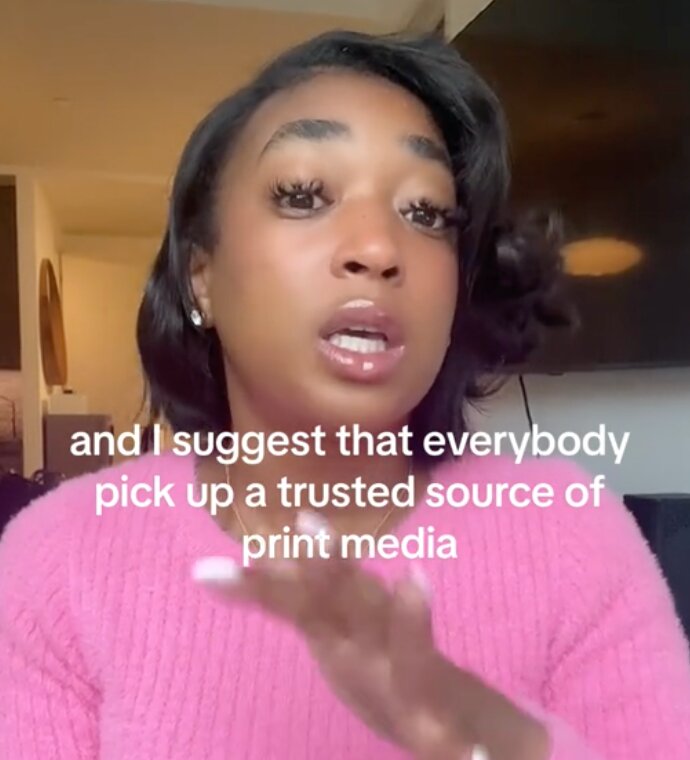
This ranks as one of the most fun and fascinating conversations I’ve had this year about the power of the printed newspaper and media literacy.

Meet TikTok’s “Print Princess,” Kelsey Russell, who leverages the platform to introduce her audience to news of the day; how to be critical about what they read; and how print can give us a break from screen time, as well as help us more meaningfully consider and retain information.

https://www.editorandpublisher.com/stories/meet-the-print-princess-tiktok-personality-kelsey-russell-uses-social-media-to-spark-critical,250283

TV, Radio, Audio

Apprenticing the emperor (sans clothes)

Slate published an article today, written by Producer Bill Pruit. It’s a behind-the-scenes look at The Apprentice and the subsequent cult of personality it created with clever editing, flashy production, and seemingly earnest, eager contestants willing to do anything to get a chance to work alongside the guy with his name on all the buildings. 

It probably doesn’t come as a surprise that the revelations of the article reveal Donald J. Trump’s toxicity, racism, sexism and narcissism. We’ve all seen these traits on international display, including Trump’s proclivity for insults, retribution and sadism. It doesn’t surprise me at all to learn that he flippantly used slurs, including the “N word,” especially after what he did to the “Central Park Five.”

No, none of this “new information” surprises me. 

What does surprise me is the longevity of The Apprentice. Mark Burnett unquestionably has the secret sauce for long-run “reality” shows. Despite little tweaks to the Survivor game and casting, it’s still the same format as it was 24 years ago when it was novel. And people still watch it and want to be on it. 

But The Apprentice was a different animal. 

In 2004, I tuned in because I liked the concepts — the challenge of creating and championing a product or service; how to target and hone its marketing; how to hustle; how to multitask; how to work as a team; how to defend your decisions and your work; and how to ensure your own survival in a cut-throat business environment. 

But as an astute watcher from the beginning, I almost immediately spotted a pattern from week to week and across the first few seasons: Donald Trump was a lousy businessman. That fact played out in the real world over decades. He notoriously leveraged the bankruptcy courts to stiff vendors and employees, while preserving what empire remained. He published a bestseller he hadn’t written, and according to the ghostwriter, he likely never read. He cut corners, grifted, sold people inferior products, and cheated at every turn.

He is one of the few — if not the only — casino owners who actually lost money on those enterprises. That’s an astounding feat of failure.

And it became clear as he sat center stage at The Apprentice’s ominously illuminated conference room table, that he lacked even the most fundamental business insights. From week to week, he showed glaring inconsistencies in those principles — favoring honesty one week, rewarding deceit the next; espousing the virtues of creativity in one episode, only to scold the most out-of-the-box thinking the next. 

In most episodes, it seemed that it didn’t matter how the contestants performed their tasks; who stayed and who got fired appeared more about who made the best television for one more week — or, even more cynically, how they looked.

Trump himself shined only in the moments when he was doing what he does best — grilling people, shaming them, making them grovel and beg, and of course stoking his own ego. And that made for good reality drama for a while, but I think for actual business people, it fizzled quickly. It certainly did for me, and I tuned out after a few seasons — annoyed that I’d invested as much time as I had in the show.

The Celebrity Apprentice, which ultimately replaced the original format, extended the show’s life by virtue of well-known contestants and a charity payout. But the fundamental problem with the show endured: Trump was an unpredictable, bloviating showman, but not an executive of any measurable caliber. 

News & Publishing, Politics & Public Policy

The New York Times assembles a trust team

Among our news community, we frequently talk about “trust in news” and how it has eroded to dangerous levels. I’d suggest there are myriad reasons for that, including some that date back centuries. The press has always been a convenient punching bag. When people don’t like what they read, they naturally want to discount the information. 

Some of the phenomenon is patently new, as we’ve seen with the increase in “lawfare” suits designed to chill journalists and shutter news organizations outright. There’s also the toxic political rhetoric, even shouted from the highest offices in the land, expressly to make people doubt watchdog and accountability reporting. 

Now, we’re contending with Artificial Intelligence (AI), too, which is training people to doubt what they read and view.

Some of it is well-deserved. The press doesn’t always get the story right, especially in the rush to report first. Quality journalists among the American media are contrite when it happens, acknowledging their mistakes and offering corrections or retractions. Far too many outlets masquerading as trusted sources of news peddle misinformation and never acknowledge their failures to report accurately. That’s harmful, industry-wide.

I’d suggest the public also has a cynical view of how news is gathered and produced when they hear about strategic misdeeds, such as tabloid-style “catch and kill” stories — for example, when an adult film actress’ story about an affair with a politician never sees the light of day because the publisher and the porn star are paid to suppress it. It’s easy for the public to conflate that kind of “news” with what earnest, professional journalists produce day-in, day-out. 

Indeed, there are many reasons — deserved and not — for the lack of trust in news today, but the important thing is that we’re thinking about it as an existential threat and doing our best to counter it. That’s why I’m bullish on The New York Times decision to convene a “trust team” that’s keenly focused on this issue. 

At the link, read about my conversation with Edmund Lee, editor of The Times’ trust team and one of the ways they’ve built more transparency and familiarity into the display of news.

#newsmedia #journalism #TheNewYorkTimes

Book Publishing, News & Publishing, Politics & Public Policy, Printing and Imaging

Can we be a democratic society without libraries and free access to information?

When I was growing up, libraries seemed this quiet, unassuming certainty in everyday life. They were well-funded, accessible to everyone in the community, no matter why nor when you needed them. I saw librarians as all-knowing beings, who could find even the most obscure title on the stacks, without so much as a glance at a card catalog. 

I worked for a while at my university library, in the periodical section. When students came in looking for references, I’d pull out newspapers and magazines from the bowels of the back or help them learn to use the microfiche machines — high-tech back then. 

It may have been my paternal grandmother and her mother (Ida Locke, a librarian seen here) who encouraged my early reading. 

Great-grandmother Locke lived with my grandparents, and I have fond memories of her seated on their sofa, a stack of books always present on the end table beside her. An insatiable reader, she could sail through a book in a single afternoon. She was a quiet, tiny mouse of a woman, always dressed for going out, even when there was no place to go. I can’t remember her voice, because she rarely offered even a hint of a smile nor a string of spoken words. But when I’d visit, she’d pat the sofa next to her, inviting me to sit and tell her what I was reading that week. Born to a German community in rural West Virginia, books were her way to rise above, to escape, to aspire — to work and have autonomy as a woman of that era. 

Books didn’t change her nature — who she was or how she conducted her simple, frugal life — but they did broaden her perspective and informed her understanding of the world outside of her own.

I think about her a lot lately, as libraries are under attack from so many directions. Funding is imperiled. Politics has landed on their doorsteps. Shamefully, surreally, book bans — patently anti-liberty and anti-intellectual — are part of our national discourse. Librarians themselves are harassed and forced out of their jobs by politically motivated and dark money-funded mobs. Can democracy survive under these circumstances, I wonder? It feels symbolic of how we’ve lost our way. 

Book Publishing, News & Publishing, Politics & Public Policy

About “Going There”

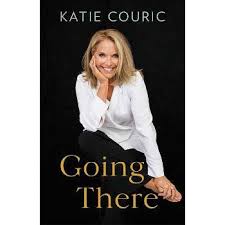
Katie Couric’s 2021 memoir is perfectly titled: Going There

It’s clever, because it relates to so many facets of her story—the places she went (physically and emotionally) over the course of her decades-long career in news; the torment of recalling profound loss and grief; or how she took a chance at love again. 

Whether you’ve been a fan or a casual observer, Couric’s familiar voice comes through in the text. 

Full disclosure, I once felt full-on fangirl when Couric retweeted me during the pandemic—both of us grateful for journalists who were covering “the front lines” of COVID.  

As far as women in news go, Couric is legendary. And her memoir could’ve easily gone down a chest-thumping path, boasting of her myriad hard-news features and epic longevity on TV screens. Instead, there’s a raw, earnest quality to her retelling of the story that’s genuine and approachable, like Couric herself, as we come to see.

She shares with us what it was like to grieve her husband, her sister, her parents. She speaks honestly about loss, motherhood, exhaustion, but also about love, redemption and gratitude. 

I’ve always felt the most effective memoirs are those that demonstrate a change and a maturation of the autobiographer: what you learn, who you come, what you overcome. 

Life isn’t Instagram. 

Going There is deeply introspective, particularly when Couric recounts her regrets and miscalculations along the way—missing signs that her beloved first-husband Jay was ill; unwisely choosing partners after his death; anecdotally putting career ahead of family; and a slew of professional missteps that make her (and us) cringe today. 

Most of all, it’s a tome about journalism and TV news, from a woman’s point of view during a transformative time, spanning the age of overt misogyny and sexual misconduct to the post-#MeToo modern day. 

Couric peels back the curtain on what it was like to navigate network politics, sexism and fierce competition, not just between the TV networks, but sometimes among your own network team. I’ll think about “60 Minutes”—a staple Sunday-night show in our home growing up—a little differently after learning how Couric was treated by the producers and fellow journalists. 

Recently, in conversation with someone else in news, I used the term “working sources,” and I was met with silence on the other end of the line; then, a question: What do you mean by ‘working sources?’ More condemnation than question. And I explained what I feel it’s like to land an important interview, particularly with someone who may be initially reluctant to go on record, let alone on camera. I spoke of building trust, of having conversations, perhaps meeting in person, explaining my process, being fully transparent and honest—but, in effect, working to get the interview.

Couric gives us a no-holds-barred account of “working sources,” crediting her bookers and producers for contortionist-like moves to woo them. In the print world that I know, there are clearly defined ethics on such matters, and one of them is that we don’t accept gifts from them, and they shouldn’t expect from us in return. It seems TV news is a bit more cut-throat competitive, and that there are gray areas on such matters. 

I (and I’m sure a lot of women readers) also appreciated how Couric spoke about trying to balance the two sides of her professional personality—serious, right-toned journalist versus the quirkier, fun, silly, sometimes smart-ass side of her personality. The TODAY Show gave her the perfect platform for that balancing act. 

“Katherine or Katie, the serious journalist or the smiley cutup … the tension between those two sides of my nature would run like a fault line through my career,” she reflects.

Couric writes about Jeff Zucker and Matt Lauer, men with whom she’d had as close a professional relationship as you might have; both proved grave disappointments in the end.  

Couric took a lot of heat when Going There first came out, particularly about her recounting of an interview with SCOTUS Justice Ruth Bader Ginsburg. Couric asked Justice Ginsburg about Colin Kaepernick’s protests. The Justice expressed how she found it disgraceful—not what you might expect from a liberal-leaning, First Amendment-affirming judge. Couric revealed how she wrestled with the editorial decision about whether to keep the exchange in the interview, or to cut it out. Critics decried that it was Couric’s duty to broadcast her remarks, that it was journalistic malpractice not to. She’s not objective, they said, citing Couric’s admission that she greatly admired Ginsburg. 

But that’s journalism. You bring personal perspective to your reporting. How can you not? You are a person, a citizen, with lived experiences like anyone else. You learn things, and those things inform you as you move through life and, professionally, into others’ lives. These editorial dilemmas come up in nearly every interview or reporting assignment, especially in hard news and investigative journalism. 

“I know I’m being fair when everybody’s mad at me,” Walter Kronkite once told Couric. 

If all this sounds intriguing, I hope you’ll read the book, and check out Couric’s Instagram for more of her “smiley cutup” side.

News & Publishing, Politics & Public Policy, Uncategorized

The White House Task Force Briefings Should No Longer Be Televised

Since the creation of the White House task force, and the President’s naming of his Vice President, Mike Pence, as its mealymouthed leader, there has been a steady drumbeat from media critics who think the Press should tune out.

They’ve argued that the President has done more harm than good by holding these nearly daily on-camera events. I wholeheartedly disagreed, primarily because he’s the President, and without a functioning Press Secretary – the new one refuses to work with us, like her predecessor – these are precious opportunities to carry the President’s messages to the American people, allowing them to judge for themselves the content, and to question him, challenge him, and speak truth to power, as is our role and responsibility.

I have held that belief for all these exhausting weeks, even when the President missed every opportunity to express genuine, sincere empathy for those who are sick, the tens of thousands who have died horrific deaths, or to their families who are forced to grieve in silence, alone.

I believed we had to cover the briefings even when it became clear that the President’s posturing would always be to deflect criticism, to shirk responsibility, and to pick petty fights with Governors who have been desperate for information, gear, equipment and financial aid – desperate to try to save their constituents lives.

I felt we should still cover the briefings even when the President would openly question his own appointees to the task force – infectious-disease experts who come equipped with data and analyses that he flippantly disregards in real time.

Even when critics cried, “He’s using these as substitute campaign rallies,” I still felt we have to cover them. To ignore them would be irresponsible and a dereliction of our duty, right?

I, along with so many of my colleagues in news, have cringed when he’s used the precious time to admonish journalists, especially women reporters, accusing anyone who asks a pointed, legitimate question of being “fake news” or worse. The tough-guy act feels like a two-pronged strategy. On the one hand, it’s textbook Orwellian; if you can convince people not to believe anything, they won’t believe the truth about you. The other purpose, I believe, is to create audio and video clips for conservative media outlets to run, showing the President “fighting back” – macho and chest thumping.

I suppose with some people who are firmly planted in the President’s corner, no matter his egregious unforced errors, it works to get their blood boiling, their anger stoked. It juices up the base.

A hard-boiled German who’s been around, even I welled up the day the President boasted about how great the ratings were for his briefings, as New York City and other communities across the nation zipped up hundreds of body bags in that single day. The lack of empathy was shocking, gutting really. It made me question if we’ll live through this – as individuals and as a nation.

Admittedly, as the time has passed, I have questioned the approach of the Press sitting before him. I believed that if they could simply target their questions to the experts and keep them keenly focused on the public health and safety information Americans need to know, that it would somehow keep these briefings from veering off course.

I suggested to broadcasters that they factor in a longer delay so that they could digitally filter out anything that was overtly false or potentially harmful to the viewing public. None of that has worked.

The President went on to use the briefings to recklessly promote a drug that hadn’t been rigorously tested through clinical trials as a treatment for COVID-19 infection. Despite warnings across the globe that its use was linked to heart failure and stroke in these cases, he continued to promote it. Lupus patients suddenly couldn’t get their prescriptions filled for the drug, putting their very lives at risk while the President continued to promote it. We later learned that he has a financial stake in the pharmaceutical company that makes it.

Donald J. Trump also used taxpayer dollars to produce a campaign video, which he shamelessly played during one notorious briefing, perking up the ears of watchdog agencies. He’s defied social/physical distance rules established by the White House Correspondents Association, designed to keep the Press and the President himself safe from infection during these daily meetings. He’s repeatedly invited pet network OANN into the room in defiance of these very rules, allowing its “reporters” to pitch him softball, seemingly planned and scripted questions designed to stroke the President’s ego and disparage political opponents. It’s right out of the Authoritarian Playbook.

I have been hyperaware of the lack of real leadership on display here. A leader, even in cases of notable accomplishments and success, reflects back and thinks: “How could we have done even better?” There’s no introspection by the President of the United States. He is incapable of it.

And still – even with all this in our wake – I was of the mind that the Press had to broadcast and cover these briefings, because he’s the President of the United States, and it is our duty to shine lights on him whenever we have access, and especially when we don’t.

But that’s all changed for me now. I have come around to the position the critics have taken – that we should no longer broadcast these briefings in real time. My professional opinion changed when the President used last weeks’ time before the American people to encourage the protesters who have taken the streets – some dressed as if they’re going to war, some sporting swastika and other antisemitic symbols, others with Confederate flags – to defy the very orders his own task force established. For weeks, the President, the Vice President, the doctors, and other members of the Administration have stood before us preaching the importance of following the guidelines and reading from lists of things that the President said we should all be grateful for – Federally supplied personal protection equipment, respirators, financial aid, military vessels and personnel, field hospitals, short-lived testing sites, and more.

Now, the President and the Vice President are lauding the protesters, empathizing with their “cabin fever,” and refusing to admonish their reckless disregard for the health and safety of not just “the others” – their fellow American citizens – but their own health and that of their own families. It overtly demonstrates that the President and the Vice President have not taken their roles seriously, that they haven’t even bought into the guidelines they’ve established, and that they do not care how many Americans will die as a result of their politicking.

There’s a Willie Nelson song that goes, “Turn out the lights; the party’s over. They say that all good things must end.” The White House Task Force briefings had the potential to do some really good things – to inform the public, to help keep us all safe. They haven’t risen to the occasion.

Legitimate news organizations should shut off the lights and remove the cameras from the briefing room. Send in your reporters, but cover the briefings straight, giving no room for the President to make an on-camera mockery out of them and us.

The public-servant doctors on the task force should take a different approach, too. It’s time to “go rogue” and speak directly to the American people without the President’s political filter. It’s long overdue. Our nation is depending on you.

Politics & Public Policy

Farewell, Sarah

Farewell, Sarah

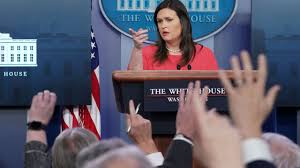
As Sarah Huckabee Sanders’ tenure as the White House Press Secretary wanes, I am cognizant of how much time has passed since she was named to the position, and all of the former Trump Administration personnel and cabinet members she’s seen come and go.

Indicted former National Security Advisor Michael Flynn lasted a mere 24 days on the job. Chief of Staff Reince Preibus tried to manage a Trump White House for 192 days. Sean Spicer got a pink slip at 182 days. Former White House Communications Director Michael Dubke was only there for 88 days.

For perspective, it has been 94 days since the Press Secretary held her last official briefing with the White House Press Corp. That’s her primary duty.

Remarkably, Huckabee Sanders has been on the job for nearly two years now, as others have come and gone. Like another familiar Mark Burnett Production, she outwitted and outlasted.

The 36-year-old was born in Hope, Arkansas, hometown to one William Jefferson Clinton. Some might say she had two strikes against her growing up. Her father – Mike Huckabee – was both a preacher and a politician. He is also a musician, so take from that what you will.

The youngest of his children, Sarah grew up in the public purview, and clearly paid close attention to her father’s political maneuvering. She studied political science at university, despite those observations.

Huckabee Sanders isn’t just tough, she’s smart – and almost immediately, she proved measurably sharper, quicker-witted and less inclined to defensive anger than her Press Secretary predecessor. She also proved a good student and a quick study, picking up Trump’s formulaic song-and-dancing nearly out of the gate.

You’ll spot the pattern now, too:

1. Overstate a problem.
2. Credit the Trump as being the only one who can solve it. Speak in grandiose, superlative terms.
3. When asked a question, double down. Restate the problem; restate the President’s solution.
4. When asked again, restate it, more emphatically. Appear annoyed.
5. When challenged again, interrupt and feign offense – as in, how dare you ask me that question/waste my time. Then, insult the questioner, implying that the person is daft, biased or nefariously motivated.
6. Cut off line of questioning.

These rhetorical shell games are second nature to New York-native Trump. They likely didn’t come as easily to an Arkansas gal.

But she applied herself.

If the President is the confidence man, Huckabee Sanders sometimes felt like his hungry street-scrappy eager-to-learn protégé. When she spoke on behalf of the President, it felt practiced, rehearsed, drilled in.

Though the climate in the briefing room might lead spectators to think that there was real deep-seeded animosity between the Press Secretary and the Press, that sentiment perhaps was one-sided. She is, after all, the Press Secretary who refused to denounce her boss’ assertions that media is an “enemy of the people,” while standing in a room with them.

Still, the Press Corps rushes to assemble and sit still before her and raise their hands and ask mostly softball questions, because they’re only granted two.

They didn’t expect her to be a perfectly honest broker. They realize it’s her job to spin. But they do hope for professionalism, access to her, and a baseline agreement that the Press is there as a representative of – not the enemy of — the American people.

Many of Huckabee Sanders’ critics have labeled her a liar and propagandist. They say it as if it’s somehow novel and new. But that’s the job, isn’t it? The President is entitled to have PR representation, after all. That she does it with skill and aplomb is what makes those critics even more infuriated.

Though she proved to be sharp and nimble on her feet, Huckabee Sanders was never smarter nor faster than most of the people wearing Press passes in that room, who detect and adjudicate corruption, slick personality, rhetorical subterfuge and disinformation, day in and day out.

There were plenty of moments when I and others in the media felt kinship with and empathy for the Press Secretary. None of us wished for her to be harassed at a restaurant. If any segment of the population sympathizes with what it’s like to be belittled, verbally assaulted, threatened or even violently victimized just for doing your job, it’s the Press.

In the aftermath of that dinner interruptus, Huckabee Sanders was granted Secret Service protection – a first for a White House Press Secretary – and the incident became just more political nonsense, more American-versus-American cannon fodder. Sadly, she let that happen.

By contrast, Kamala Harris, a sitting U.S. Senator and Presidential candidate had to be protected by MoveOn.org host Karine Jean-Pierre when an animal rights protester recently jumped on stage at a speaking event and grabbed a mic from the Senator’s hand before he was “escorted out.”

None of this behavior is acceptable; that should be a bipartisan position. Sarah missed the opportunity to be the voice to say so.

My most sympathetic-to-Sarah moment came on Anthony Scaramucci’s notorious first day on the job. Cute and dimple-cheeked, with a dazzling smile and a gift of gab that had certainly opened many doors for the new White House Communications Director, Scaramucci brought a guy-you’d-like-to-have-a-beer-with demeanor and convivial candor to the podium.

He immediately squandered all of that favorable equity when he invited the Press Secretary up to the podium with him – fresh from a photo shoot, hair blown out, cheeks thickly rouged, contouring lines cartoonish under the unforgiving lighting, and a smoky eye that became the subject of a joke at the White House Correspondents’ Dinner that year, sparking outrage and forever ending comic participation at the annual event.

I wonder if she thinks about that now – that her hurt feelings smothered a 105-year tradition, an annual event that represents a temporary cease-fire between politicians and Press, in the interest of charity.

I’ve often wondered why her feelings didn’t seem hurt when Scaramucci brought her up on the podium that day and told the world how much more appealing she was with her new vamped-up look. When he advised her to keep the glam squad on staff full time, I cringed. I’m sure I wasn’t the only one.

And she never needed the eyeliner. She was perfectly lovely without all the gunk on her face. More so.

In the end, bad judgment – or karma – got Scaramucci six days later. He was out, but she endured.

Huckabee Sanders didn’t just survive the role, she thrived in it. And, in her, Trump got both an accomplished spin doctor and an Evangelical Whisperer. What the President himself lacks in spirituality and religious discipline, he makes up for with a deep bullpen of zealots. They pray over him and lay hands on him. They anoint him and empower him. And when one of his disciplines speaks to them – no matter the veracity or absurdity of her message to them – they believe her, because she is one of them.

Huckabee Sanders’ legacy as Press Secretary will sadly include a petty crackdown on the White House Press Corps and threats of rescinded press credentials and impeded access. She will also be remembered for lying to the Special Counsel and having to issue a mea culpa for it. If that were you and me, we’d be jailed for perjury.

None of us in news will easily forget the time she knowingly tweeted out a “deep fake” video, to falsely accuse CNN’s Jim Acosta of assaulting a young female aid. It was vicious, and even when she was lambasted for perpetuating it, she refused to delete the video and refused to apologize for the defamatory intent.

There was also the time she denied the United States was detaining kids in cages at the border – despite Jacob Soboroff’s exemplary first-hand reporting to the fact – and later asserted that inhumane border policy, with children dying under our watch, was sanctioned by God because the Bible says people should obey laws.

During Huckabee Sanders’ time as Press Secretary, plenty of us media types have opined about the value to tasking reporters and tech crews to the Briefing Room if the lies are so unvarnished, so garish, so dangerous, that reporting on them – on what she says, on what the President asserts – feels like a betrayal of our oath to accurately and intelligently inform the public. And yet, when Sarah Huckabee Sanders (infrequently) comes to the podium, there they are, ready to fulfill their end of the pact.

Post Huckabee Sanders, the notion of the crafty, calculating, but mostly noble Press Secretary portrayed in The West Wing by Allison Janney seems contrived and romanticized, quaint now – a thing of the past, like black-and-white TVs, paper boys slinging the news, and people who can’t wait to “read all about it.”

It is remarkable that Huckabee Sanders lasted a couple of years in this role – not 3.5 years, as the President alleged in a tweet yesterday. After all, he hasn’t yet been President for that long.

Though she graciously said that the gig was “the honor of a lifetime,” I imagine the constant scrutiny and a mad-king boss might leave a person shaken, exhausted and uncertain how to personally heal and professionally follow it up.

I also imagine that she’ll have some atoning to do, this preacher’s daughter – that is, if lying is still considered sinful per the Baptist Church. Conservative estimates put the President at a remarkable 10,000+ lies told since his inauguration. She echoed thousands of them. Now someone else will.

Godspeed, Sarah.
News & Publishing

In Turbulent Media Climate, National and State Press Associations Continue to Serve as Advocates and Educators for Their Members

By Gretchen A. Peck

The business of newspapers is no longer competitive. While most towns may still have a local community newspaper, very few have two. Now, the culture is more collaborative, with publishers willing to work together, and share both their challenges and successes with one another.

Bringing them together are national and state press associations. They’ve felt the same struggles as their members, but they are proving to be invaluable allies in the quest to overcome them.

Read more at Editor & Publisher magazine:

https://www.editorandpublisher.com/feature/in-turbulent-media-climate-national-and-state-press-associations-continue-to-serve-as-advocates-and-educators-for-their-members/


News & Publishing

Three News Outlets Form Oregon Capital Bureau to Expand Coverage

By Gretchen A. Peck

In Oregon, newspaper publishers have recognized the need to provide their communities with better and deeper coverage of state government and politics. Their answer was the creation of the Oregon Capital Bureau.

Under the editorial leadership of veteran investigative reporter Les Zaitz, the Bureau leverages the newsroom talent of three local news organizations: the Pamplin Media Group, publisher of the Portland Tribune and 24 other weekly, twice-weekly and monthly titles; EO Media Group, publisher of the East Oregonian, Daily Astorian and nine other titles; and the Salem Reporter, a digital news service that Zaitz heads up as editor. The Salem Reporter—co-founded by Zaitz and real estate developer Larry Tokarski—recently launched in September.

Read further at Editor & Publisher magazine: https://www.editorandpublisher.com/a-section/three-news-outlets-form-oregon-capital-bureau-to-expand-coverage/?fbclid=IwAR1Gov8Bsc1FeuifrhjZweTxysIGODwPkixEskcNoEVMuulyEjwXHZGGn8k

Photo courtesy of Les Zaitz