E&P’s “Reporting On” series takes a look at what it’s like to be a journalist tasked with covering a national/international crisis, or an urgent public policy concern. This month, we spoke with journalists who report on the nation’s borders and ports. With as much national media—and particularly “cable news”—coverage as we have about the southern border, in particular, there is so much more to the story.
I learned a lot from these exceptional reporters, who take us to the border itself; share stories of what its like in communities like Chicago, where the border crisis has been brought to their doorsteps; who help sort through the politics and the realities; and turn our attention to the vulnerabilities of the nation’s ports, so critical to our economy and yet so rarely covered in the detail they deserve.
I set aside my own biases about immigration and allowed the reporters’ stories to stand tall here. But I’m perhaps not unlike so many other Americans who see that immigration is a many-layered complicated issue that’s just not being treated earnestly and effectively by our elected leaders. On radio and TV, we hear gripes about people not coming here “the right way,” but unlike the immigration channels of one or two generations ago, today’s path to citizenship is messy, long, prohibitive, frightening, expensive, and completely out of reach for so many immigrants. We’re failing in not exposing that story.
Having spent part of my childhood living in South America, I also know how dire and deadly life can be in nations to our south—measurably worse today than even in the 1970s. I can understand why people want to or are forced to leave their homes, their families, their livelihoods and their way of life. It’s not hyperbole to say it can be a life-or-death decision.
This is not to discount the serious and steady threat of bad actors coming across the border and exploiting desperate people, parents and their children. We need to stop them, and we often do. But surveillance technology, concertina wire, a big tall wall, and border enforcement alone won’t solve this crisis; it requires a retooling of foreign policy and thoughtful diplomacy rather than isolationism.
We are a champion nation. We broadcast to the world about our exceptionalism, what makes us special, what makes us wealthy, what makes us progressive, what makes us leaders, what makes us (comparatively) safe, what makes us free. To expect people from all over the world—especially poor nations plagued by crime and corruption—not to want to come here, in fact to risk their lives to become an American, is ill-considered.
Social media can be a minefield for journalists to navigate today. Social platforms are a great tool for extending the reach and impact of reporting, and it’s also part of our everyday non-professional lives, as well. It’s a way to communicate with friends and family, a way to make connections, network, socialize, have a say in our communities, and even find love.
But being active participants in the social scene comes with obstacles. Social opens journalists up to public scrutiny in a way that bylines alone never did. It can paint us as targets for bad actors, and set us up for condemnation over our judgments about what we share professionally and personally.
Think about the common practice of “liking” someone else’s post. As a person in news, there may be many reasons to do that. I’ve used a “like” to bookmark a post I want to expediently revisit. I’ve hit the thumbs up to boost the journalism itself because I feel the reporting is important and am glad the outlet invested in it. These aren’t necessarily endorsements or affirmations of the “message” of the post, but from time to time, I’ll like a post because I do “approve of this message.” So, there are nuances here, yet even a simple “like” can get a journalist in hot water today, as we saw just recently occur at the BBC.
At E&P, we wanted to take a closer look at how news media publishers are addressing dilemmas about professional conduct on social platforms. We found many don’t have formal policies in place beyond their long-standing ethics rules, but quite a few are considering how to formalize a policy, so there are no gray areas when issues arise. I was heartened to speak with a number of editors who trust their reporters to act responsibly in social scenarios and, in fact, give them a great deal of leeway to still participate in social circles without fear of oppressive oversight and penalty.
At the link, check out my conversations with a few of those thoughtful editors:
Last month, I had the pleasure of quality zoom time with Editor and General Manager Patti Epler and Vice President of Operations and Philanthropy Ben Nishimoto at the Honolulu Civil Beat. We spoke about how the nonprofit local news outlet is doing critical work not only in Honolulu, where they’re based, but on the surrounding islands, as well, which have seen local news sources imperiled. They produced essential journalism during the Lahaina wildfires, and continue to tell the stories of the government agencies’ response to the crisis and how the community is recovering and rebuilding.
After this article went to press, we learned that Patti is opting for a new role, becoming more of an editor-at-large while still serving as general manager. They are in search of a new editor-in-chief to lead the newsroom. What a wonderful opportunity for a qualified candidate to lead this impressive team — in Hawaii, no less!
Photo: Honolulu Civil Beat’s team has grown to 33, including newsroom, operations and fundraising teams. They’ve won the Society of Professional Journalists Hawaii Chapter’s “Best Overall News Site” 13 years in a row. They’ve also been honored with awards from the Asian American Journalists Association, the Institute for Nonprofit News, the Online Journalism Awards, the News Leaders Association and E&P, among others. (Photo by David Croxford/Civil Beat/2023)
Journalists in war zones navigate complexities, danger and how to make the story resonate with audiences far removed — geographically and emotionally — from the fighting
From the December 2023 Editor & Publisher magazine:
In an era plagued by media consolidation, hedge fund ownership and gutted newsrooms — or “ghost papers” — investigative journalism has fallen by the wayside at too many newsrooms across the country. Investigative journalism is labor- and time-intensive and often expensive to produce. It also requires skilled journalists to do the work.
What does it take to create and lead an investigative team today? E&P asked five investigative editors. Read on at the link.
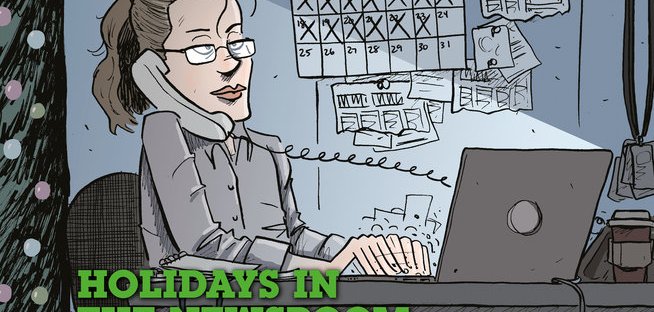
Editor & Publisher (E&P) Magazine closes out the year with a cover story dedicated to all the journalists and editors keeping us informed during the year-end holidays. It’s a bittersweet story, as you will see, not unlike a holiday spent apart from loved ones, or the end of another year, now past. I wanted to especially thank Rob Tornoe for illustrating the cover. He so perfectly captured the moments when the newsroom is otherwise quiet, when the world around celebrates, but there’s a lead to chase, a story to tell and the public to serve.
As 2022 comes to a close, my social feeds have been heavy with news of layoffs across media and tech worlds.
It’s the loss of local news that feels most ominous. We’ll start the new year with fewer journalists in newsrooms, fewer columnists to stoke our minds, fewer visual journalists to show us new perspectives, fewer production, sales, audience and administrative pros to ensure that the news reaches subscribers and the public.
The threads that gut me most chronicle all the stories of little to great importance that journalists produced over time in service to employers and the community. There are the investigative pieces, expensive and sometimes tedious to produce; stories holding the powerful and elected to account; stories about the economy, housing, the food chain, immigration, public policy, foreign policy, crime, war, the heavy stuff.
There are endearing examples of human interest stories about the many inspiring people who contribute to our communities. There are the stories about events, art, food and local traditions that help us to feel connected to one another, to have the sense and security of a community around us.
Who will tell these stories, elevate these voices, speak these revelations when newsrooms are scuttled?
I’ve had the pleasure of another year reporting on the state of news for Editor & Publisher magazine, my 12th year with the title. It’s been a humbling, troubling, yet exhilarating year in news. Here are just a few of the stories I’ve had the privilege to tell:
My final E&P dispatch of the year is bittersweet, like the holidays or the end of a year. We wanted to tell the stories of journalists who’ve worked a newsroom, a sound booth or a TV studio on one of the major year-end holidays. We wanted to know about festivities, food (because you know that’s important to us) and newsroom traditions, but also about the memorable events reported on those holidays — a reminder that the public’s need to know never takes a holiday.
I was so grateful for all the reporters, editors, photographers, on-air hosts, everyone who shared their memories with me. Throughout those conversations ran two themes — what a privilege it is to do this job, and how so many journalists lost their jobs this year, how so many have had to (reluctantly or enthusiastically) leave the profession.
I’d like to extend a special thanks to E&P Columnist and Cartoonist Rob Tornoe, who illustrated the cover and perfectly captured the experience of chasing a lead while the newsroom is quiet and the world around you celebrates.
My New Year’s wish is that all of these talented, smart, earnest people — indispensable members of our news family — land upright and ready to lead us toward a new trajectory. ~ G
One recipient, Block Club Chicago, hopes to “supercharge” operations with the funding
WATCH: E&P Reports welcomes Shamus Toomey and Stephanie Lulay of Block Club Chicago, and the American Journalism Project’s Anna Nirmala and Sarabeth Berman to talk about venture philanthropy and nonprofit local news:
With new local owners, former Gannett-owned newspapers benefit from reinvestment
By Gretchen A. Peck
Gannett remains at the top of the leaderboard for newspaper ownership. It publishes over 1,000 weekly titles and more than 100 dailies, amassed over the years through independent acquisitions and headlining mergers. But the company turned heads in the newspaper world when it recently began selling off some of those newspapers, mostly small-market and community titles that local owners were eager to buy.
The shadow of hedge fund and corporate ownership leaves newsrooms in fear they’ll be picked clean
By Gretchen A. Peck
This summer, Alden Global Capital acquired Tribune Publishing and its titles, from small community newspapers to major metro titles like its flagship, The Chicago Tribune, and The Baltimore Sun. It wasn’t the first newspaper acquisition for this hedge fund firm, nor is it the only firm of its kind eyeing the nation’s newspapers. But this acquisition was profound, making Alden Global Capital the owner, in effect, of more than 200 newspapers across the land. It was a deal rife with drama, as the Tribune newsrooms publicly pleaded for some other savior. In the end, no eccentric billionaire philanthropist descended on the scene to save them. Instead, the newsrooms steeled themselves for the future.





 Gretchen A. Peck