The host of NPR’s TED Radio Hour speaks about audio storytelling and a recent partnership with Columbia University Irving Medical Center
Often when I speak with people around the news world, I learn something new. Each interview offers me a fresh professional perspective on journalism, storytelling, audience and business models. My conversation with NPR’s Manoush Zomorodi did that and more.
Zomorodi is the esteemed and well-sourced host of NPR’s TED Radio Hour. She recently found a new way to “engage audience” by enlisting listeners in a cooperative study with Columbia University’s Irving Medical Center. The project began with Zomorodi’s personal reflection on how technology—a topic she often covers on her show—was impacting her energy level, her focus, and overall health.
She learned of a study that indicated that our sedentary lifestyles, exacerbated by the time we spend on digital devices, was profoundly harmful. But there was also good news. A little bit of “gentle movement” every 30 minutes could potentially offset the harm. She wanted to test the theory, and so the partnership with Columbia’s scientists did just that.
At the link, read about my conversation with Zomorodi for Editor & Publisher. Professionally, she taught me a new way to “engage audience,” quite literally, but her work also changed the way I approach my own health. In news speak, it was impactful.
This headline may not be entirely true, and yet, it was in this pre-Middle School era of my life when I first began to fully “understand the value of a dollar.”
I find that’s a popular phrase passed down through generations, an invaluable life lesson or a rite of passage. For two sixth-grade classes in the 1970s, their introduction to commerce and capitalism began that week.
That was the year that the number of students had outgrown the school, and some lucky contractor got the local school system bid for providing pop-up classrooms made out of stitched-together double-wide trailers. Two sixth-grade classes shared the one we’d been sentenced to, with a sliding partition between the two groups, each with its own teacher.
The partition was an insufficient barrier that mostly rendered us distracted by what was happening with the kids on the other side. When they laughed, our heads swiveled. When we acted up, they’d go silent and giggle as they listened to our punishment being levied. One teacher would have to raise her voice to keep the attention of her class whenever the sounds of the other teacher seemed more interesting.
And vice versa, and so it went.
Imagine the delight in our little hearts when one day the partition was folded in on itself, the two classrooms of kids facing off at last. The once competitive teachers joined forces and announced that we were going to learn about running a business and paying bills. They went on to explain that for a period of one week, there would be no traditional classroom lessons and that our trailer would be transformed into a microcosmic town.
Each of us had a role to play in the town. They asked for a show of hands when assigning roles like bankers, retailers, landlords, food purveyors, even insurance carriers.
I was the only one who wanted to run the town’s newspaper.
The town also needed governance, and so a show of hands indicated which of my classmates aspired to political life – managing their day-to-day duties while also running for a handful of offices, including mayor and sheriff.
We spent a day or two planning and building the town. Creative cardboard cutouts became our storefronts. Logos were designed, and signs went up over our storefronts. My classmates got right to work. The banker “handprinted” money and distributed a precisely equal amount of cash to each of the town’s residents, so everyone had a level playing field – a comparatively endearing socialist start to what would end in survival-of-the-fittest capitalistic carnage.
The most popular business, by far, was the town baker, who sold decadent treats to a classroom of kids given the freedom to make their own nutritional and expenditure decisions.
We didn’t speak of food allergies back then.
I got right to work wearing all the hats at the newspaper – a lot like things are today.
I reported and designed the layout. I “printed” the paper on the front office’s mimeograph. Printing is a big cost for actual newspapers, but I’d managed to get the paper and “press” for free. This would be seen as an ethical breach for actual newspapers.
I had to hock the paper, selling single copies to passersby. I sold advertising and wrote ad copy. I had to distribute the paper when it was hot off the press.
And though everyone wanted to read the paper – mostly to see if they were in it – few wanted to buy the paper. It was hard to compete with Mom-baked brownies.
I spent the week walking around the perimeter of the trailer, interviewing my classmates about the health of their businesses or who they liked in the pending election. I wrote trends pieces about how the town’s residents thought the rent was too damned high and how they wanted to be able to spend more of their money on luxury items, like those chocolately brownies. I vaguely remember writing an expose on the insurance carrier in town, who I saw as a huckster selling vapor.
“People give you money, but what do they really get in return,” I grilled him like I was Woodward or Bernstein.
One by one, the small businesses fell, exiling their owners from town, to a corner of the trailer-classroom to watch an episode of “Free to be You and Me” or to throw a sixth-grade temper tantrum, perhaps.
Naturally, the bank endured; it thrived off of the interest. The insurance carrier – who had minimal overhead costs and a contained, safe environment that put odds in his favor – stayed afloat. The baker had fistfuls of colorful cash by week’s end. And the newspaper endured, though I, too, was pretty busted. By the time I’d covered my own costs – rent, insurance, crayons – I didn’t have enough currency for much else.
I’d spent days coveting my classmates’ disposable income and how they frivolously, happily spent it on baked goods and insurance policies.
Somehow, I’d managed to get the news out, but it wasn’t easy, and it wasn’t lucrative.
Journalists in war zones navigate complexities, danger and how to make the story resonate with audiences far removed — geographically and emotionally — from the fighting
From the December 2023 Editor & Publisher magazine:
In an era plagued by media consolidation, hedge fund ownership and gutted newsrooms — or “ghost papers” — investigative journalism has fallen by the wayside at too many newsrooms across the country. Investigative journalism is labor- and time-intensive and often expensive to produce. It also requires skilled journalists to do the work.
What does it take to create and lead an investigative team today? E&P asked five investigative editors. Read on at the link.
In the 1990s, I worked at a law firm while getting my grad degree. My job wasn’t clearly defined. I answered phones, paid the bills, and drafted correspondence and pleadings for the senior partners. One of the partners worked in criminal law, and working with his team allowed me insight into some horrific crimes — not the least of which was a compelling case against the Archdiocese for the alleged sexual abuse and rapes now made famous by the Netflix documentary, “The Keepers.”
That same attorney introduced me to a convicted murderer, for whom he was mounting a death penalty appeal. The man had been sentenced to death, along with a buddy, for murdering a Baltimore woman in her home. She was a single gal, a professional who lived alone. According to the defendants’ testimony, they’d gone to her home one evening, thinking she wasn’t there. Once inside, they scouted the first floor, looking for items of value to grab. They came to the kitchen and felt hunger pangs. They opened the refrigerator, took out some ingredients and began cooking up a snack on her stove.
But she was home.
Upstairs, she was sleeping in an early bed. The clanging sound of pots and pans and cooking utensils woke her. She stirred, and the sound jolted the intruders down below. One of the men grabbed a 10-inch chef’s knife — at trial, they’d pointed fingers at each other, accusing the other of wielding the knife — and they went upstairs.
They forced her back to the bed. To silence her screams, they put a pillow over her face. Then, the man holding the knife stabbed her dozens of times, including a final blow that penetrated the pillow and impaled her through the breastplate.
As I tell you this story, the hair on your arms might stand at attention. You might feel revulsion at the brutality of it. You might for just a fleeting moment consider what it was like for her in those final horrific moments. But you’ll never really understand the violence unless you saw the crime scene photos.
I had to sift through them one day, stacks upon stacks of black-and-white glossies taken by law enforcement and shown to jurors as evidence during the trial. To this day, I can remember how she looked, frail and tiny and limp. The simple furnishings around her defied why anyone would want to rob her. She had so little, just starting out in life.
Blood was everywhere — pooling on the sheets, seeping through the soft, worn pillowcase, where the knife was embedded in her body. It was splattered on the walls, the carpet, the nightstand.
I’m sure my heart fell out of rhythm when I noticed in one of the photos that she was wearing a nightgown with Ziggy, a cartoon character, childlike. I had the same nightgown when I was a teenager. I have a photo of me in it from one Christmas morning.
I cried for hours in our little law library. I still cry when I think about those images — when I think of her — today. They were hard to look at, certainly for the jurors who were deciding the defendants’ fate. But they needed to see them, to fully understand, to grapple with the violence, to make informed decisions and to act accordingly.
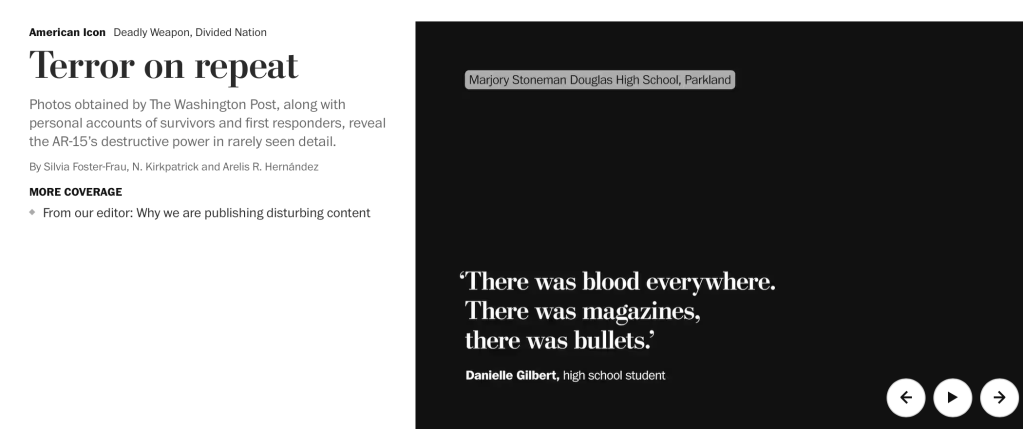
Yesterday, The Washington Post published a controversial investigative piece, “American Icon: Terror on Repeat, a rare look at the devastation caused by AR-15 shootings.”
The piece is controversial for its graphic photos, showing the horror, carnage and death inflicted by people with access to a weapon of war — a gruesome tool designed expressly for hunting human beings.
As long as I have worked in news, there has been fervent debates among journalists about graphic images and what is beyond the pale for the viewing public. This is not an easy professional nor moral call. And it’s often the case that new outlets are accused of exploitation and shock value for publishing violent imagery.
I spoke with a Pulitzer-awarded photojournalist this week, for whom I have the utmost respect. She’s been covering war for more than 23 years, and has paid witness to the very worst of humanity, the very worst violence, the absolute worst gore. Over the course of her career, she’s faced this dilemma an untold number of times, weighing which images to submit for publication and which ones are simply too grotesque to inflict on others.
She spoke thoughtfully about her worry that if a photograph is too distasteful to a person, they’ll simply turn the page or switch the channel and move along, negating all of the work and danger it took to capture it, negating the story of the victims.
If they can’t stand to look at the photo, they can’t care about the people, she explained to me.
We talked a little about the skills a journalist acquires on the war beat, and how they translate here in America for local news reporters who find themselves covering crises, like mass shootings. If you’re intrigued, I’ve written more about our conversation in the December issue of Editor & Publisher.
I implore you to look at the photos in WaPo’s important piece of journalism.
Fit yourself in the cowboy boots of young people running from rapid gunfire, when moments before they were singing along to country music.
Stand over the body bags lining an elementary school hallway, with the corpses and parts of children zippered inside, and imagine what it’s like to be their parents, their friends, the adults who failed to protect them.
Fight the urge to turn away from the picture of pews, soaked in blood, the walls of the church pockmarked and splintered by an AR-15s spray.
No narrative, no amount of pontificating, no amount of wrestling with the right adjectives can communicate the story more honestly and accurately than these videos and photos.
He’s right: Why should these images only haunt him and the victims’ families? We’re all responsible for gun violence in this country, because we turn away, we move on, we conscientiously — by choice — build up our tolerance to it.
I get tangled up on the question of whether it’s the press’s duty to somehow soften the blow, to make violence and murder more palatable to the public? Or is it a newsroom’s duty to depict the crime and its aftermath with unobscured clarity?
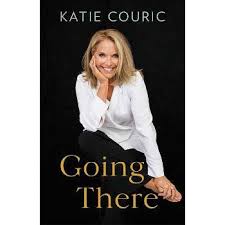
Katie Couric’s 2021 memoir is perfectly titled: Going There
It’s clever, because it relates to so many facets of her story—the places she went (physically and emotionally) over the course of her decades-long career in news; the torment of recalling profound loss and grief; or how she took a chance at love again.
Whether you’ve been a fan or a casual observer, Couric’s familiar voice comes through in the text.
Full disclosure, I once felt full-on fangirl when Couric retweeted me during the pandemic—both of us grateful for journalists who were covering “the front lines” of COVID.
As far as women in news go, Couric is legendary. And her memoir could’ve easily gone down a chest-thumping path, boasting of her myriad hard-news features and epic longevity on TV screens. Instead, there’s a raw, earnest quality to her retelling of the story that’s genuine and approachable, like Couric herself, as we come to see.
She shares with us what it was like to grieve her husband, her sister, her parents. She speaks honestly about loss, motherhood, exhaustion, but also about love, redemption and gratitude.
I’ve always felt the most effective memoirs are those that demonstrate a change and a maturation of the autobiographer: what you learn, who you come, what you overcome.
Life isn’t Instagram.
Going There is deeply introspective, particularly when Couric recounts her regrets and miscalculations along the way—missing signs that her beloved first-husband Jay was ill; unwisely choosing partners after his death; anecdotally putting career ahead of family; and a slew of professional missteps that make her (and us) cringe today.
Most of all, it’s a tome about journalism and TV news, from a woman’s point of view during a transformative time, spanning the age of overt misogyny and sexual misconduct to the post-#MeToo modern day.
Couric peels back the curtain on what it was like to navigate network politics, sexism and fierce competition, not just between the TV networks, but sometimes among your own network team. I’ll think about “60 Minutes”—a staple Sunday-night show in our home growing up—a little differently after learning how Couric was treated by the producers and fellow journalists.
Recently, in conversation with someone else in news, I used the term “working sources,” and I was met with silence on the other end of the line; then, a question: What do you mean by ‘working sources?’ More condemnation than question. And I explained what I feel it’s like to land an important interview, particularly with someone who may be initially reluctant to go on record, let alone on camera. I spoke of building trust, of having conversations, perhaps meeting in person, explaining my process, being fully transparent and honest—but, in effect, working to get the interview.
Couric gives us a no-holds-barred account of “working sources,” crediting her bookers and producers for contortionist-like moves to woo them. In the print world that I know, there are clearly defined ethics on such matters, and one of them is that we don’t accept gifts from them, and they shouldn’t expect from us in return. It seems TV news is a bit more cut-throat competitive, and that there are gray areas on such matters.
I (and I’m sure a lot of women readers) also appreciated how Couric spoke about trying to balance the two sides of her professional personality—serious, right-toned journalist versus the quirkier, fun, silly, sometimes smart-ass side of her personality. The TODAY Show gave her the perfect platform for that balancing act.
“Katherine or Katie, the serious journalist or the smiley cutup … the tension between those two sides of my nature would run like a fault line through my career,” she reflects.
Couric writes about Jeff Zucker and Matt Lauer, men with whom she’d had as close a professional relationship as you might have; both proved grave disappointments in the end.
Couric took a lot of heat when Going There first came out, particularly about her recounting of an interview with SCOTUS Justice Ruth Bader Ginsburg. Couric asked Justice Ginsburg about Colin Kaepernick’s protests. The Justice expressed how she found it disgraceful—not what you might expect from a liberal-leaning, First Amendment-affirming judge. Couric revealed how she wrestled with the editorial decision about whether to keep the exchange in the interview, or to cut it out. Critics decried that it was Couric’s duty to broadcast her remarks, that it was journalistic malpractice not to. She’s not objective, they said, citing Couric’s admission that she greatly admired Ginsburg.
But that’s journalism. You bring personal perspective to your reporting. How can you not? You are a person, a citizen, with lived experiences like anyone else. You learn things, and those things inform you as you move through life and, professionally, into others’ lives. These editorial dilemmas come up in nearly every interview or reporting assignment, especially in hard news and investigative journalism.
“I know I’m being fair when everybody’s mad at me,” Walter Kronkite once told Couric.
If all this sounds intriguing, I hope you’ll read the book, and check out Couric’s Instagram for more of her “smiley cutup” side.
Within the past five years — and certainly during the height of the pandemic — I began to notice the term “building community” come up in conversation a lot, particularly with local news publishers and journalists. It’s certainly not a new concept — the idea that a local newspaper (or news site) doesn’t just inform the community; it also provides a thread that runs through the community, creating a sense of belonging and a reminder of shared vested interests.
Every local news outlet does this in some way. It’s inherent. But E&P went in search of stories of news media publishers striving to meaningfully connect with the community and to foster community engagement in positive ways. At the link, you’ll read about two of them — The Lansing Journal and The Spokesman-Review.
I lived in Pennsylvania for about 20 years—in Philadelphia and the surrounding ‘burbs. I got to know Pittsburgh through friends who called the city home and trips down the PA Turnpike (a gorgeous drive, by the way) to visit with them. It’s a city integral to American history and innovation—a city that saw industry come and go, forcing it to reinvent itself. It rose to the challenge.
With three rivers converging, it’s also a part of the state well-concerned with conservation and pollution. Fracking hasn’t helped.
Pittsburgh has always seemed to me a city in need of a robust news presence and journalists unafraid to tell its stories—the bad, as well as the good. And make no mistake, there’s lots of good, too. But if there’s anyone who can ensure that Pittsburgh’s news media landscape flourishes, it’s Andrew Conte, Ph.D., director of the Center for Media Innovation at Point Park University.
I spoke with Dr. Conte for E&P’s June issue—about the Center, local news sustainability, citizen journalism, and an exciting new collaboration between otherwise-competitive news media publishers around the city and suburbs. It’s a new “news ecosystem” for the city, and another example of how Pittsburgh continues to be a place of reinvention and innovation.
Read the story for free at the link, and share your thoughts on Conte’s vision in the comments.
I gleaned a lot from my conversation with Tim Franklin, senior associate dean, professor and the John M. Mutz Chair in Local News at Medill, and Larry DeGaris, executive director of the Medill Spiegel Research Center, about the Subscriber Engagement Index — and what the members’ data has revealed about audience, engagement and the (other) bad C-word, “churn.” When it comes to compelling content, it appears quality and originality is a key factor to inspiring sign-ups, ensuring brand loyalty, and subscriber retention.
Check out the Quick Read from Editor & Publisher at the link, and let us know if your newsroom is being intentional about creating journalism that is special, critical and that subscribers can’t get anywhere else. Thanks for reading!









 Gretchen A. Peck