When I was growing up, libraries seemed this quiet, unassuming certainty in everyday life. They were well-funded, accessible to everyone in the community, no matter why nor when you needed them. I saw librarians as all-knowing beings, who could find even the most obscure title on the stacks, without so much as a glance at a card catalog.
I worked for a while at my university library, in the periodical section. When students came in looking for references, I’d pull out newspapers and magazines from the bowels of the back or help them learn to use the microfiche machines — high-tech back then.
It may have been my paternal grandmother and her mother (Ida Locke, a librarian seen here) who encouraged my early reading.
Great-grandmother Locke lived with my grandparents, and I have fond memories of her seated on their sofa, a stack of books always present on the end table beside her. An insatiable reader, she could sail through a book in a single afternoon. She was a quiet, tiny mouse of a woman, always dressed for going out, even when there was no place to go. I can’t remember her voice, because she rarely offered even a hint of a smile nor a string of spoken words. But when I’d visit, she’d pat the sofa next to her, inviting me to sit and tell her what I was reading that week. Born to a German community in rural West Virginia, books were her way to rise above, to escape, to aspire — to work and have autonomy as a woman of that era.
Books didn’t change her nature — who she was or how she conducted her simple, frugal life — but they did broaden her perspective and informed her understanding of the world outside of her own.
I think about her a lot lately, as libraries are under attack from so many directions. Funding is imperiled. Politics has landed on their doorsteps. Shamefully, surreally, book bans — patently anti-liberty and anti-intellectual — are part of our national discourse. Librarians themselves are harassed and forced out of their jobs by politically motivated and dark money-funded mobs. Can democracy survive under these circumstances, I wonder? It feels symbolic of how we’ve lost our way.
The host of NPR’s TED Radio Hour speaks about audio storytelling and a recent partnership with Columbia University Irving Medical Center
Often when I speak with people around the news world, I learn something new. Each interview offers me a fresh professional perspective on journalism, storytelling, audience and business models. My conversation with NPR’s Manoush Zomorodi did that and more.
Zomorodi is the esteemed and well-sourced host of NPR’s TED Radio Hour. She recently found a new way to “engage audience” by enlisting listeners in a cooperative study with Columbia University’s Irving Medical Center. The project began with Zomorodi’s personal reflection on how technology—a topic she often covers on her show—was impacting her energy level, her focus, and overall health.
She learned of a study that indicated that our sedentary lifestyles, exacerbated by the time we spend on digital devices, was profoundly harmful. But there was also good news. A little bit of “gentle movement” every 30 minutes could potentially offset the harm. She wanted to test the theory, and so the partnership with Columbia’s scientists did just that.
At the link, read about my conversation with Zomorodi for Editor & Publisher. Professionally, she taught me a new way to “engage audience,” quite literally, but her work also changed the way I approach my own health. In news speak, it was impactful.
This headline may not be entirely true, and yet, it was in this pre-Middle School era of my life when I first began to fully “understand the value of a dollar.”
I find that’s a popular phrase passed down through generations, an invaluable life lesson or a rite of passage. For two sixth-grade classes in the 1970s, their introduction to commerce and capitalism began that week.
That was the year that the number of students had outgrown the school, and some lucky contractor got the local school system bid for providing pop-up classrooms made out of stitched-together double-wide trailers. Two sixth-grade classes shared the one we’d been sentenced to, with a sliding partition between the two groups, each with its own teacher.
The partition was an insufficient barrier that mostly rendered us distracted by what was happening with the kids on the other side. When they laughed, our heads swiveled. When we acted up, they’d go silent and giggle as they listened to our punishment being levied. One teacher would have to raise her voice to keep the attention of her class whenever the sounds of the other teacher seemed more interesting.
And vice versa, and so it went.
Imagine the delight in our little hearts when one day the partition was folded in on itself, the two classrooms of kids facing off at last. The once competitive teachers joined forces and announced that we were going to learn about running a business and paying bills. They went on to explain that for a period of one week, there would be no traditional classroom lessons and that our trailer would be transformed into a microcosmic town.
Each of us had a role to play in the town. They asked for a show of hands when assigning roles like bankers, retailers, landlords, food purveyors, even insurance carriers.
I was the only one who wanted to run the town’s newspaper.
The town also needed governance, and so a show of hands indicated which of my classmates aspired to political life – managing their day-to-day duties while also running for a handful of offices, including mayor and sheriff.
We spent a day or two planning and building the town. Creative cardboard cutouts became our storefronts. Logos were designed, and signs went up over our storefronts. My classmates got right to work. The banker “handprinted” money and distributed a precisely equal amount of cash to each of the town’s residents, so everyone had a level playing field – a comparatively endearing socialist start to what would end in survival-of-the-fittest capitalistic carnage.
The most popular business, by far, was the town baker, who sold decadent treats to a classroom of kids given the freedom to make their own nutritional and expenditure decisions.
We didn’t speak of food allergies back then.
I got right to work wearing all the hats at the newspaper – a lot like things are today.
I reported and designed the layout. I “printed” the paper on the front office’s mimeograph. Printing is a big cost for actual newspapers, but I’d managed to get the paper and “press” for free. This would be seen as an ethical breach for actual newspapers.
I had to hock the paper, selling single copies to passersby. I sold advertising and wrote ad copy. I had to distribute the paper when it was hot off the press.
And though everyone wanted to read the paper – mostly to see if they were in it – few wanted to buy the paper. It was hard to compete with Mom-baked brownies.
I spent the week walking around the perimeter of the trailer, interviewing my classmates about the health of their businesses or who they liked in the pending election. I wrote trends pieces about how the town’s residents thought the rent was too damned high and how they wanted to be able to spend more of their money on luxury items, like those chocolately brownies. I vaguely remember writing an expose on the insurance carrier in town, who I saw as a huckster selling vapor.
“People give you money, but what do they really get in return,” I grilled him like I was Woodward or Bernstein.
One by one, the small businesses fell, exiling their owners from town, to a corner of the trailer-classroom to watch an episode of “Free to be You and Me” or to throw a sixth-grade temper tantrum, perhaps.
Naturally, the bank endured; it thrived off of the interest. The insurance carrier – who had minimal overhead costs and a contained, safe environment that put odds in his favor – stayed afloat. The baker had fistfuls of colorful cash by week’s end. And the newspaper endured, though I, too, was pretty busted. By the time I’d covered my own costs – rent, insurance, crayons – I didn’t have enough currency for much else.
I’d spent days coveting my classmates’ disposable income and how they frivolously, happily spent it on baked goods and insurance policies.
Somehow, I’d managed to get the news out, but it wasn’t easy, and it wasn’t lucrative.
Journalists in war zones navigate complexities, danger and how to make the story resonate with audiences far removed — geographically and emotionally — from the fighting
From the December 2023 Editor & Publisher magazine:
Within the past five years — and certainly during the height of the pandemic — I began to notice the term “building community” come up in conversation a lot, particularly with local news publishers and journalists. It’s certainly not a new concept — the idea that a local newspaper (or news site) doesn’t just inform the community; it also provides a thread that runs through the community, creating a sense of belonging and a reminder of shared vested interests.
Every local news outlet does this in some way. It’s inherent. But E&P went in search of stories of news media publishers striving to meaningfully connect with the community and to foster community engagement in positive ways. At the link, you’ll read about two of them — The Lansing Journal and The Spokesman-Review.
I gleaned a lot from my conversation with Tim Franklin, senior associate dean, professor and the John M. Mutz Chair in Local News at Medill, and Larry DeGaris, executive director of the Medill Spiegel Research Center, about the Subscriber Engagement Index — and what the members’ data has revealed about audience, engagement and the (other) bad C-word, “churn.” When it comes to compelling content, it appears quality and originality is a key factor to inspiring sign-ups, ensuring brand loyalty, and subscriber retention.
Check out the Quick Read from Editor & Publisher at the link, and let us know if your newsroom is being intentional about creating journalism that is special, critical and that subscribers can’t get anywhere else. Thanks for reading!
The past few years have been remarkable for news media publishers, which have enjoyed some particularly public and powerful support. In the U.S. Congress, representatives and senators from both sides of the aisle sponsored legislative proposals that would secure press protections (the PRESS Act), get news agencies a seat at the table in negotiations with Big Tech (Journalism Competition & Preservation Act, the JCPA), and a proposal that would provide financial relief to local news businesses (the Local Journalism Sustainability Act, or LJSA).
Under Founder Steve Waldman’s direction, Rebuild Local News has been lobbying statehouse legislators to adopt bills that would provide tax credits to small businesses that advertise in local news media, to newsrooms that retain or hire more journalists and to individuals who subscribe or donate to a local news outlet.
While these champions for local news have been hard at work, powerful forces have been running a counteroffensive — undermining the press, impeding access and making it easier for members of the public and political class to sue news organizations.
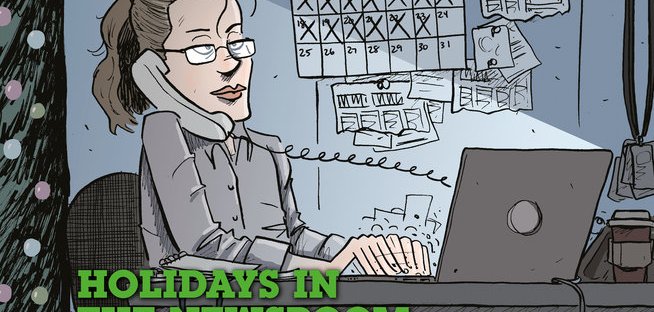
Editor & Publisher (E&P) Magazine closes out the year with a cover story dedicated to all the journalists and editors keeping us informed during the year-end holidays. It’s a bittersweet story, as you will see, not unlike a holiday spent apart from loved ones, or the end of another year, now past. I wanted to especially thank Rob Tornoe for illustrating the cover. He so perfectly captured the moments when the newsroom is otherwise quiet, when the world around celebrates, but there’s a lead to chase, a story to tell and the public to serve.
As 2022 comes to a close, my social feeds have been heavy with news of layoffs across media and tech worlds.
It’s the loss of local news that feels most ominous. We’ll start the new year with fewer journalists in newsrooms, fewer columnists to stoke our minds, fewer visual journalists to show us new perspectives, fewer production, sales, audience and administrative pros to ensure that the news reaches subscribers and the public.
The threads that gut me most chronicle all the stories of little to great importance that journalists produced over time in service to employers and the community. There are the investigative pieces, expensive and sometimes tedious to produce; stories holding the powerful and elected to account; stories about the economy, housing, the food chain, immigration, public policy, foreign policy, crime, war, the heavy stuff.
There are endearing examples of human interest stories about the many inspiring people who contribute to our communities. There are the stories about events, art, food and local traditions that help us to feel connected to one another, to have the sense and security of a community around us.
Who will tell these stories, elevate these voices, speak these revelations when newsrooms are scuttled?
I’ve had the pleasure of another year reporting on the state of news for Editor & Publisher magazine, my 12th year with the title. It’s been a humbling, troubling, yet exhilarating year in news. Here are just a few of the stories I’ve had the privilege to tell:
My final E&P dispatch of the year is bittersweet, like the holidays or the end of a year. We wanted to tell the stories of journalists who’ve worked a newsroom, a sound booth or a TV studio on one of the major year-end holidays. We wanted to know about festivities, food (because you know that’s important to us) and newsroom traditions, but also about the memorable events reported on those holidays — a reminder that the public’s need to know never takes a holiday.
I was so grateful for all the reporters, editors, photographers, on-air hosts, everyone who shared their memories with me. Throughout those conversations ran two themes — what a privilege it is to do this job, and how so many journalists lost their jobs this year, how so many have had to (reluctantly or enthusiastically) leave the profession.
I’d like to extend a special thanks to E&P Columnist and Cartoonist Rob Tornoe, who illustrated the cover and perfectly captured the experience of chasing a lead while the newsroom is quiet and the world around you celebrates.
My New Year’s wish is that all of these talented, smart, earnest people — indispensable members of our news family — land upright and ready to lead us toward a new trajectory. ~ G
With new local owners, former Gannett-owned newspapers benefit from reinvestment
By Gretchen A. Peck
Gannett remains at the top of the leaderboard for newspaper ownership. It publishes over 1,000 weekly titles and more than 100 dailies, amassed over the years through independent acquisitions and headlining mergers. But the company turned heads in the newspaper world when it recently began selling off some of those newspapers, mostly small-market and community titles that local owners were eager to buy.








 Gretchen A. Peck