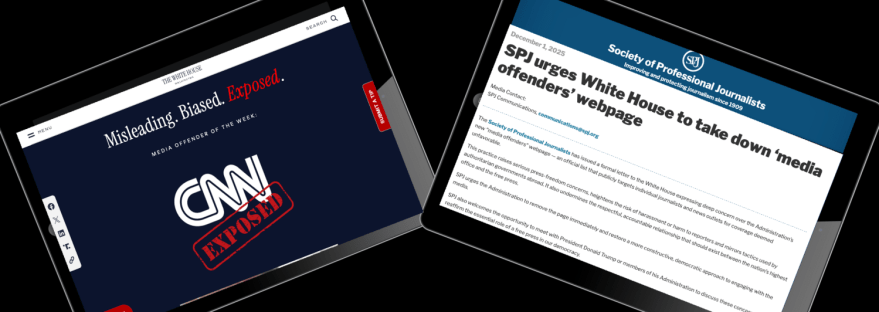
Presidents critical of the press aren’t new, but Trump’s tactics represent a significant escalation. At the link, read my conversation about the White House’s online “burn book,” with Christoph Mergerson, Ph.D., assistant professor at the University of Maryland’s Philip Merrill College of Journalism.
“This is an area where more boards of directors than ever are looking for continued updates, not just on the state of the law and the state of enforcement policy, but what it all means in terms of their own companies’ practices. … This is complicated stuff.” — Camille Olson, partner, Seyfarth Shaw LLP
E&P’s August 2025 Cover Story: Experts weigh in on how DEI can survive and evolve in today’s volatile media and legal landscape
Quick Read: The Houston Chronicle investigative team—double the size it was just a year ago—digs deep into the questions that matter most to Houstonians
I spend many of my days telling the stories of local newsrooms around the country doing exemplary work, serving their communities with practical information, uplifting perspectives — building community, as we say. Over the decades I’ve been on this “beat,” it’s been thoroughly rewarding work. Not only do I enjoy turning the spotlight on these storytellers, it’s fortified my long-standing belief that journalism is foundational to democracy. Without the First Amendment, nothing that becomes before or after it in the U.S. Constitution really matters. Without it, a nation spirals into autocracy, theocracy, despotism. Without it, corruption runs unbridled.
And I still believe this with every cell and synapse of my being.
But I’ve grown weary. The constant onslaught of anti-press rhetoric, endorsed by the highest offices in the land has admittedly weakened my resolve in recent years. The nation’s slide toward authoritarianism — our inability to even argue from a baseline of facts — is such a profound disappointment. At times, it makes me wonder if all the hard work of my colleagues in the media is worth it when it increasingly feels like screaming into a void.
I felt at the lowest point when I read the news that ABC News had settled a lawsuit brought by the President elect for comments made by anchor George Stephanopoulos during a “This Week” interview with Rep. Nancy Mace (R-SC). During the interview, the news anchor pressed Mace on her endorsement of the then candidate, considering Mace herself has spoken openly about being raped when she was a teenager. During his query, the anchor said that Donald J. Trump had been found liable for rape in the civil defamation suit E. Jean Carroll brought and won — with the jury awarding her $83.3 million.
Trump took issue with the word “rape” and filed suit against the network. Keep in mind that even the judge in the case described the initiating offense in this way: “The jury’s finding of sexual abuse therefore necessarily implies that it found that Mr. Trump forcibly penetrated her vagina.”
If forcibly penetrating a woman’s vagina – whether with a penis, an object or a hand — isn’t “rape,” then once again, it feels as if we’re not operating from a baseline of facts. It feels like arguing semantics in Atwood’s Gilead.
Before the case could advance further to the discovery phase, ABC News and George Stephanopoulos agreed to a settlement that required an escrowed $15 million to fund a future Donald J. Trump Presidential museum, another $1 million for Trump’s legal fees, and a public apology by the journalist – in other words, an admission of defamation.
Tim Miller and William Kristol — notably former Republicans — had a conversation about the perils of criticizing Trump. They wrote on thebulwark.com, “ABC News and George Stephanopoulos have joined the preemptive capitulation parade by settling Trump’s defamation suit—and by conspicuously paying out protection money ahead of the inauguration. The potential chilling effect on a key First Amendment issue is breathtaking.”
Northeastern Professor Dan Kennedy opined in his newsletter: “What Stephanopoulos said arguably wasn’t even false, and surely it didn’t amount to actual malice. A deep-pockets defendant like Disney ought to stand up for the First Amendment lest its cowardly capitulation to Trump harm other media outlets without the wherewithal to fight back.”
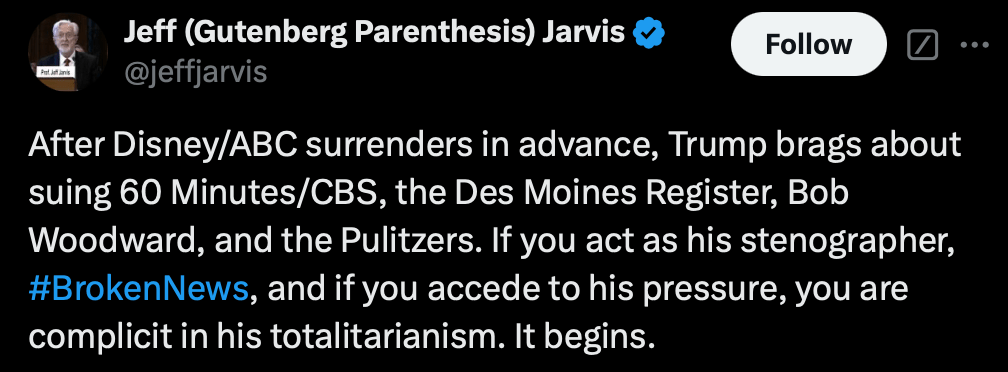
On Twitter/X, Jeff Jarvis, author and journalist, issued a warning:
Of course, none of us had a seat at the conference table surrounded by high-hourly-rate lawyers, so it’s purely speculation as to why the news media publisher agreed to settle. Some say the legal definition of rape in New York is a higher benchmark than this form of sexual assault. Others said the network didn’t want to be forced into protracted and expensive discovery, during which the President’s legal team could request all sorts of documentation, from producers’ correspondence to business strategy, personal calendars and diaries, footage from every show that mentioned Trump, social media posts, you name it.
Discovery is long and hard fought, typically with the Plaintiff asking for everything under the sun, and the Defendant having to go to court to argue against each non-related or protected journalist-source item.
Still others speculated that the $15 million settlement was such an insignificant amount for the parent organization, the Walt Disney Company, that it just made sense to pay it and get it over and done with. After all, an ongoing legal battle would’ve further impeded the network’s ability to gain access or fairly report on the incoming Administration. All of these reasons could simultaneously be true, too.
But the impact of the settlement has ripples — no, asphyxiating currents — that will reach far beyond the parties. It’s ammunition for a President and party that has continued to portray the press as “the enemy of the people.” It may not further embolden Trump himself to bring lawsuits against news outlets — he’s done that, usually unsuccessfully, for decades and long before he fatefully descended down the Trump Tower escalator to declare his first candidacy. And there’s no sign that he plans to slow down. Last week, he filed suit against the Gannett-owned Des Moines Register and pollster Ann Selzer over an unfavorable poll they published prior to election, alleging the poll — a poll, for goodness sakes — was akin to “election interference.”
But it will embolden others, particularly the political and powerful classes, to wield lawfare as a weapon to intimidate the press, to send a chill through the media, and in some cases, to kill off news outlets entirely — destroyed by the weight of defending protracted legal battles. Death by billable hour.
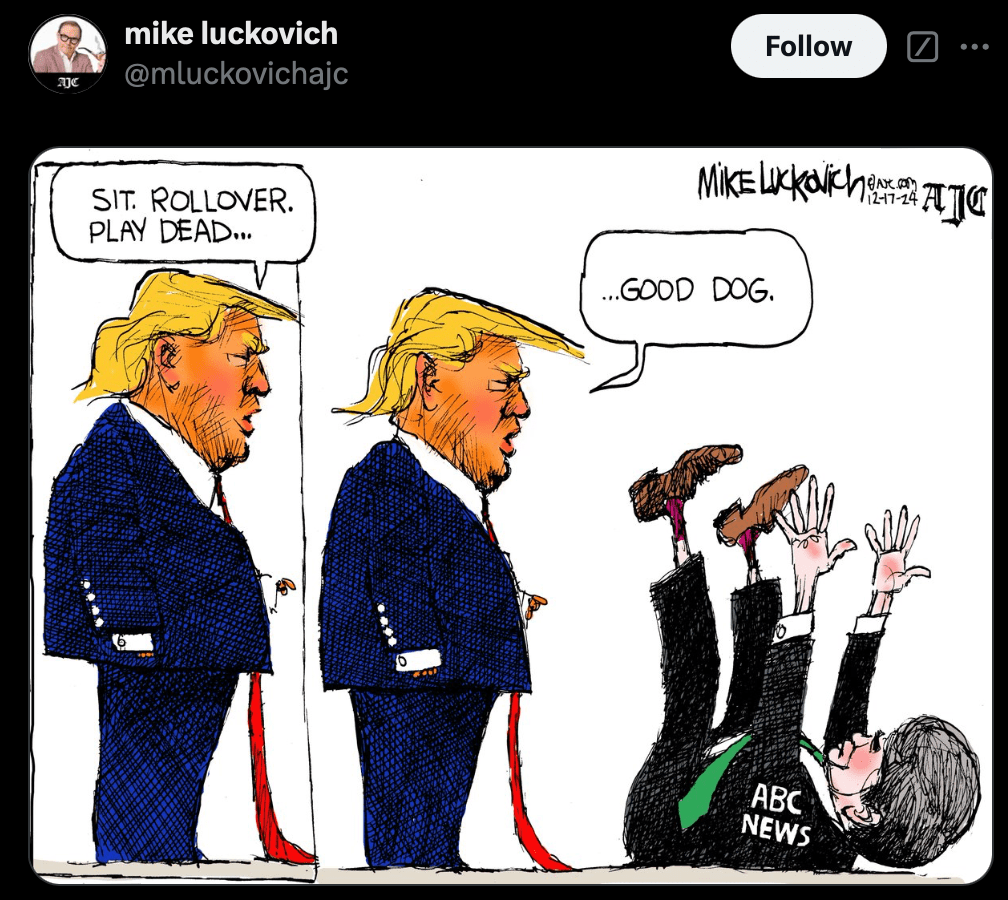
Atlanta Journal-Constitution Cartoonist Mike Luckovich so perfectly memorialized the settlement, shared on Twitter/X:
In E&P’s January issue, Columnist Rob Tornoe shares a conversation with Luckovich about being a political cartoonist in the era of Trump. You’ll want to read it.
And let’s be clear, lawfare is not just a threat to large media conglomerates. It oozes down to regional and local newsrooms, as well.
“I fear the federal attack on the press will trickle down locally, and it will be harder to get information through normal channels and freedom of the press requests,” Katie Honan, reporter for THE CITY, observed in Nieman Lab’s “Predictions for Journalism, 2025” series.
The other way it corrodes our profession is by signaling to journalists that your company, your superiors, may not have your back. They may, in fact, sell you out, make you pay, make you grovel. As a journalist there is little that’s more demoralizing than feeling as though your superiors would throw you under the bus rather than stand in solidarity with you.
Jonathan V. Last at The Bulwark wrote that “Disney has cut off ABC News at the knees and put everyone in its news division on notice that they will not be supported by corporate if they make enemies with Trump world.”
But I’m feeling a little better, a little stronger, more resolved for a couple of reasons. This Des Moines Register case is so petty, so meritless, it’ll surely be tossed out, right?
Right?
And I spent the past few weeks learning about the journalism program at the University of Oregon, where the curricula, the practical experiences and skills the students learn, and the remarkable faculty who guide them have sent some welcome breezes from the west to lift my wings. Asked about the aspirations and temperament of the new class of journalists coming into the profession, one member of the faculty described them generally as motivated, inspired, idealistic, energetic.
In late summer, I spoke with two journalists — Julian Borger, world affairs editor for The Guardian, and Nabih Bulos, who is the Los Angeles Times’ Middle East bureau chief — tasked with telling the story of the broadening war in Gaza. We spoke about the challenges of war coverage — about safety, working with local fixers and other journalists on the ground, about reporting on a region that it was nearly impossible to gain access to, and about the unpredictable nature of the work itself. For foreign correspondents, war means perpetual motion, a never-ending chase for anecdotes and atrocities, and meaningful context in sea of gray.
The only certainty, it seemed to me, was the volatility and the potential for the war to entrap or entice other nations and other terrorist groups to join the fight. And that’s precisely how it’s playing out. With just a few days of my discussions with Bulos and Borger, Hezbollah fired rockets into northern Israel.
Since, Israel retaliated by detonating pagers and mobile devices they believed to be in the hands of Hezbollah operatives. Iran-launched missiles rained down on Israel, and now the world holds its collective breath for Israel’s inevitable response to Iran’s assault. The one-year anniversary of the war passed.
The statistics I cited in the story are already obsolete. Since October 7, 2023, the war has now claimed the lives of 1,706 Israelis, 42,409 Palestinians, and 2,448 in Lebanon.
It is also one of the deadliest wars in the modern era for journalists. 128 have died. 40 have been wounded. At least 2 remain missing, according to the Committee to Protect Journalists. Please consider their sacrifices as you read this latest installment in our “Reporting On” series:
The alliterative “Pancakes & Politics” is so much more than a forum for Detroit to talk about pressing issues. And Hiram Jackson is so much more than a newspaper publisher. Pancakes & Politics was his vision nearly 20 years ago. He shared with me the origin story of the event, which is held several times each year, bringing together Detroit’s business community, public officials and change-makers not just to discuss problems but to find solutions.
This is a story about journalism, pragmatism, communities of color, local news collaboration, leadership, and one man who’s made a measurable, remarkable difference in the city and beyond. Read on at the link.
Nuzzi was placed on leave this week — and should lose her job — at “New York” magazine for an undisclosed personal relationship with presidential candidate Robert F. Kennedy, Jr., a controversial public figure she was assigned to report on. People have speculated about the degree of ethical breach, which Nuzzi contends did not veer into a physical relationship. She has been castigated and slut-shamed online, while Kennedy’s behavior has largely been brushed aside as de rigueur for the serial-philandering, vaccine-denying, dog-eating, dead-bear staging, whale head-sawing, brain worm-addled oddball he is.
Make no mistake, Nuzzi’s behavior is a gross — and I mean that in every sense of the word — ethical breach. It reflects poorly on her, certainly, but it also stains the “New York” magazine brand. Nuzzi is just 31 years old and entitled to make journalistic mistakes that we all made in our young careers, but this one is beyond the pale. She should be fired, and she should have to rebuild her career and earn the trust of the public before given another megaphone — print, broadcast or otherwise.
But this is hardly a condemnation of journalism, as Fassler claims in his headline. The public and especially the news media itself needs to get away from these broad, sweeping condemnations. Look at the sins of David Pecker’s tabloid empire and its “catch and kill” practices. Imagine if every reporter at local papers and nonprofit news outlets around the country had to carry the weight of that on their shoulders. It’s patently out of context and unfair.
If you read past the headline, what Fassler is getting at is Nuzzi’s case is — and should be — an indictment of access journalism. Access journalism is when journalists favorably report on their subjects and sources in order to be granted access to them, to gain insider insight, and to get scoops that elude other news outlets.
Nuzzi is certainly a glaring example of a journalist who’s traded on access — and, I dare say, on her beauty. Across news media, we’ve had some of the most popular, visible and broadly followed journalists who can be accused of the same, even at the nation’s most prolific legacy institutions. It is a bane, no question, yet not a reflection of the whole.
Nuzzi’s recent work has been “sus,” as the kids say, and Fassler gives a number of examples of that. Yet, controversy attracts eyeballs and audience — still the most coveted currency in today’s news business. And she (and others) have been rewarded for it.
Still, to lump all journalists and media companies in with Nuzzi and those who enabled her along the way — even in a headline — does disservice to all the earnest, dedicated and toe-the-line reporters around the country.
And it emboldens the “dishonest press” and “enemies of the people” rhetoric. Let’s stop that.
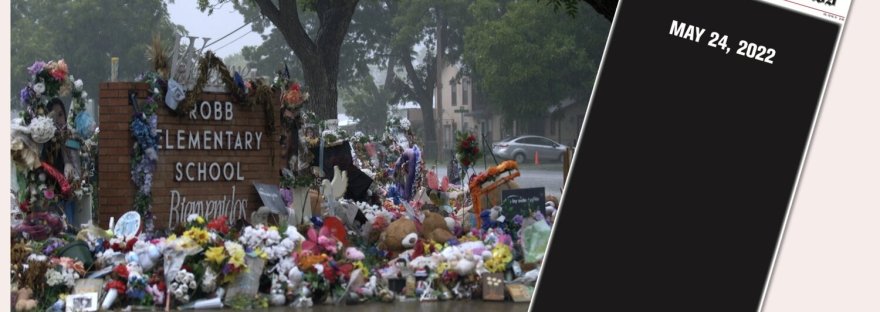
In the week that followed the horrific mass shooting at Robb Elementary in Uvalde, Texas, I was one of thousands of calls into the local newspaper, the Uvalde Leader-News. I was working on a story for E&P—part of the magazine’s “Reporting On” series—about journalists who have the daunting task of reporting mass shootings.
On a few occasions that week, a member of the newsroom there would answer—audibly exhausted and grief-stricken, yet polite and professional—and take down my message for the owner-publisher Craig Garnett. I, of course, wanted to speak with him about my assignment, to learn in those still-raw moments what it takes for a newsroom to cover a story of this magnitude and tragedy. But so much more importantly, I wanted to express my sorrow, to let him and his entire newsroom know that we shared in their grief. After all, a member of our news community had been personally and profoundly impacted by this crime. ULN’s Crime Reporter Kimberly Mata-Rubio’s 10-year-old daughter, Lexi, was among the victims.
Despite an enormous weight on his shoulders, Garnett called me back a few days later, and generously, thoughtfully spoke about what his newsroom was going through. Through tears that seemed never-ending, I wrote the story.
I’ve thought about that local paper—Garnett and the small, tight-knit staff—the Rubio family, and the community of Uvalde every day since.
I had the great honor to reconnect with Garnett last week, to talk about the ABC News documentary, “Print It Black,” now streaming on Hulu. It’s a difficult-to-watch yet important film that I implore everyone to see—a complex, nuanced and honest look at mass shootings in America, about life in a small town, about racism, poverty and classicism, and about a local newsroom rising to an occasion for which it never could prepare.







 Gretchen A. Peck