News & Publishing, photography, Politics & Public Policy, TV, Radio, Audio

Watch “Print It Black” on Hulu

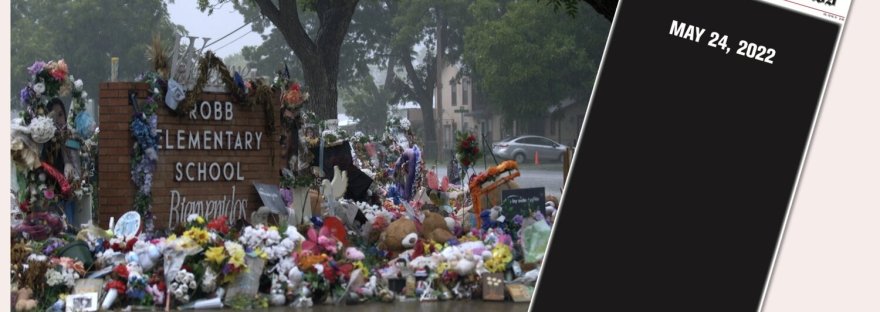
In the week that followed the horrific mass shooting at Robb Elementary in Uvalde, Texas, I was one of thousands of calls into the local newspaper, the Uvalde Leader-News. I was working on a story for E&P—part of the magazine’s “Reporting On” series—about journalists who have the daunting task of reporting mass shootings. 

On a few occasions that week, a member of the newsroom there would answer—audibly exhausted and grief-stricken, yet polite and professional—and take down my message for the owner-publisher Craig Garnett. I, of course, wanted to speak with him about my assignment, to learn in those still-raw moments what it takes for a newsroom to cover a story of this magnitude and tragedy. But so much more importantly, I wanted to express my sorrow, to let him and his entire newsroom know that we shared in their grief. After all, a member of our news community had been personally and profoundly impacted by this crime. ULN’s Crime Reporter Kimberly Mata-Rubio’s 10-year-old daughter, Lexi, was among the victims.

Despite an enormous weight on his shoulders, Garnett called me back a few days later, and generously, thoughtfully spoke about what his newsroom was going through. Through tears that seemed never-ending, I wrote the story

I’ve thought about that local paper—Garnett and the small, tight-knit staff—the Rubio family, and the community of Uvalde every day since.

I had the great honor to reconnect with Garnett last week, to talk about the ABC News documentary, “Print It Black,” now streaming on Hulu. It’s a difficult-to-watch yet important film that I implore everyone to see—a complex, nuanced and honest look at mass shootings in America, about life in a small town, about racism, poverty and classicism, and about a local newsroom rising to an occasion for which it never could prepare.

#Uvalde #LocalNews #RobbElementary #UvaldeLeaderNews #ABCNews #documentary

News & Publishing, Politics & Public Policy, TV, Radio, Audio

Producing a step-by-step FOIA guide

As FOIA director at @washingtonpost, Nate Jones is a government records specialist — expertise he gladly shares with other journalists and the public

#newsmedia #FOIA #illustration #journalism

https://www.editorandpublisher.com/stories/producing-a-step-by-step-guide-to-foia,250976

News & Publishing, TV, Radio, Audio

TV and Radio Broadcasters Launch Hyperlocal Digital and Streaming News Services

I’ve long appreciated the concept of hyperlocal news. What better way to make communities and neighborhoods feel seen and heard than to cover the news expressly for them and about them? We’ve seen news outlets like Block Club Chicago and Trib Total Media have rousing success taking a street-level neighborhood approach to news. 

I was pleasantly surprised when E&P’s Robin Blinder and Mike Blinder returned from Borrell Miami this spring with a new story in hand about hyperlocal news—TV and radio broadcasters leveraging their brands and trustful audiences to launch hyperlocal digital sites and streaming services. So, I followed up with Gordon Borrell to get his take on why hyperlocal news was seeing a renaissance of sorts and followed up with three media executives in the throes of starting up new hyperlocal media properties. Here are their stories: 

#communitynews #hyperlocalnews #TV #Radio #Streaming #digitalmedia

https://www.editorandpublisher.com/stories/from-news-deserts-to-digital-havens-the-rise-of-hyperlocal-journalism,250359

Book Publishing, Music, TV, Radio, Audio

Rebel Girl

I preordered Rebel Girl: My Life as a Feminist Punk by Kathleen Hanna. I felt it mandatory reading. I’d listened to the band(s) back in the day. I was fascinated by the lore and that Kathleen married my second favorite Beastie Boy. I wanted the backstory on it all, especially what it was like to be a woman in a band in the midst of a nearly all-male punk moment. I certainly knew what it was like to be a woman in the clubs, basements and warehouse shows where women were relegated to the perimeters by virtue of slamming male bodies and fear of being trampled or groped. 

What I didn’t know to expect was the constant struggle, the poverty, the family dysfunction, the sexual abuse, the rapes, the violence, the loneliness, despair, the anger and hatred (especially from other women), which Hanna reveals in bite-sized chapter chunks. Sometimes it’s all you can swallow before snapping the cover shut and trying to process it, wondering how the author ever did. 

Did she? 

Can you? 

It’s a question I ask myself all the time. Do we actually heal? Or do we just learn to be temporarily okay in the moment and then string those moments together to make a day, a week, a year, a decade, a lifetime? 

Hanna’s storytelling kept me captivated. I read the book in two days. After all, it’s what a memoir should be — raw, candid, honest and deeply introspective. 

TV, Radio, Audio

Apprenticing the emperor (sans clothes)

Slate published an article today, written by Producer Bill Pruit. It’s a behind-the-scenes look at The Apprentice and the subsequent cult of personality it created with clever editing, flashy production, and seemingly earnest, eager contestants willing to do anything to get a chance to work alongside the guy with his name on all the buildings. 

It probably doesn’t come as a surprise that the revelations of the article reveal Donald J. Trump’s toxicity, racism, sexism and narcissism. We’ve all seen these traits on international display, including Trump’s proclivity for insults, retribution and sadism. It doesn’t surprise me at all to learn that he flippantly used slurs, including the “N word,” especially after what he did to the “Central Park Five.”

No, none of this “new information” surprises me. 

What does surprise me is the longevity of The Apprentice. Mark Burnett unquestionably has the secret sauce for long-run “reality” shows. Despite little tweaks to the Survivor game and casting, it’s still the same format as it was 24 years ago when it was novel. And people still watch it and want to be on it. 

But The Apprentice was a different animal. 

In 2004, I tuned in because I liked the concepts — the challenge of creating and championing a product or service; how to target and hone its marketing; how to hustle; how to multitask; how to work as a team; how to defend your decisions and your work; and how to ensure your own survival in a cut-throat business environment. 

But as an astute watcher from the beginning, I almost immediately spotted a pattern from week to week and across the first few seasons: Donald Trump was a lousy businessman. That fact played out in the real world over decades. He notoriously leveraged the bankruptcy courts to stiff vendors and employees, while preserving what empire remained. He published a bestseller he hadn’t written, and according to the ghostwriter, he likely never read. He cut corners, grifted, sold people inferior products, and cheated at every turn.

He is one of the few — if not the only — casino owners who actually lost money on those enterprises. That’s an astounding feat of failure.

And it became clear as he sat center stage at The Apprentice’s ominously illuminated conference room table, that he lacked even the most fundamental business insights. From week to week, he showed glaring inconsistencies in those principles — favoring honesty one week, rewarding deceit the next; espousing the virtues of creativity in one episode, only to scold the most out-of-the-box thinking the next. 

In most episodes, it seemed that it didn’t matter how the contestants performed their tasks; who stayed and who got fired appeared more about who made the best television for one more week — or, even more cynically, how they looked.

Trump himself shined only in the moments when he was doing what he does best — grilling people, shaming them, making them grovel and beg, and of course stoking his own ego. And that made for good reality drama for a while, but I think for actual business people, it fizzled quickly. It certainly did for me, and I tuned out after a few seasons — annoyed that I’d invested as much time as I had in the show.

The Celebrity Apprentice, which ultimately replaced the original format, extended the show’s life by virtue of well-known contestants and a charity payout. But the fundamental problem with the show endured: Trump was an unpredictable, bloviating showman, but not an executive of any measurable caliber.