There are a few things in life that bring me joy, and one of them is my weekly trip to the library. Stepping inside feels like entering a portal of possibility.
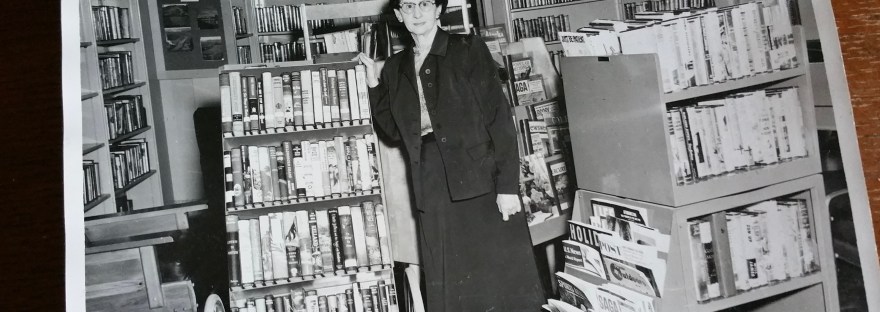
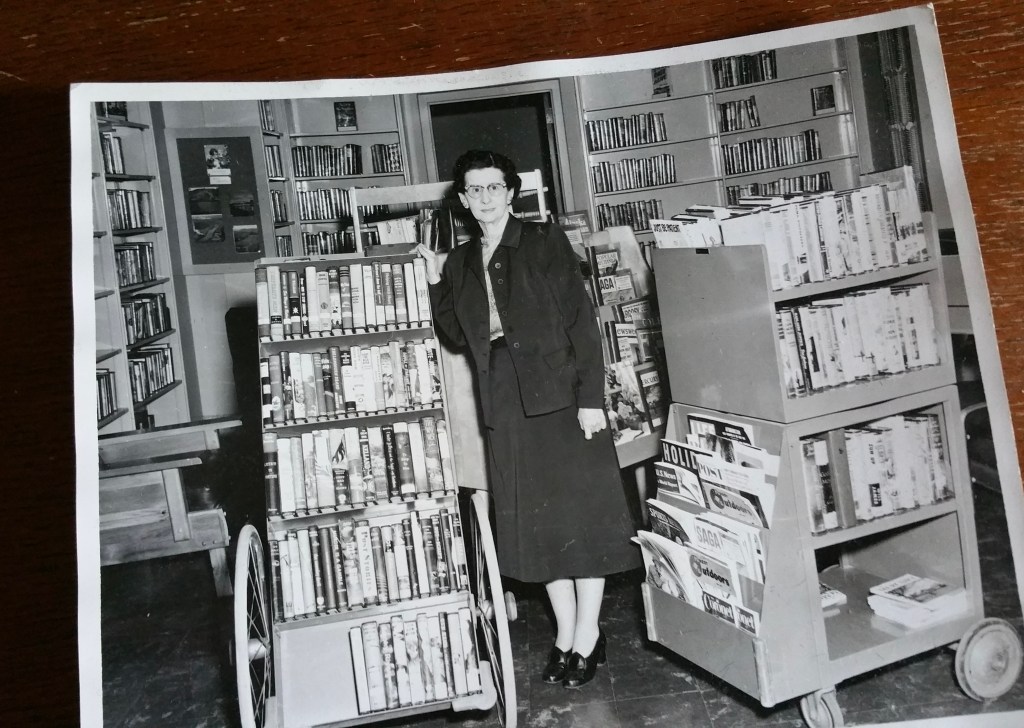
I’ve written a lot about libraries as a local community amenity and myriad ways our libraries support our communities beyond providing free access to books and periodicals. There’s also the individual, personal connection many of us have to libraries, including fond memories from childhood. Some of my earliest memories are accompanying my grandmother and great-grandmother to the library, where we’d all load up with a stack of books to devour in a weekend. (Pictured: My great-grandmother volunteers at the library.)
Now, from the vantage point of my work at Editor & Publisher, I see the shared missions of libraries and local news media: to inform and build communities, expand access to knowledge and defend the First Amendment. In honor of National Library Week, I spoke with the American Library Association’s president, Sam Helmick, about the week of celebration—with the theme “Find Your Joy”—and its critical call to action. Click the link to read, and please share your thoughts on your local library in the comments.
I believe divine intervention happens in library stacks. Something beyond a captivating cover leads you to certain books that you didn’t even know you wanted to read. During my last library visit, I left with two surprisingly related titles in my book bag — one nonfiction, one fictional:
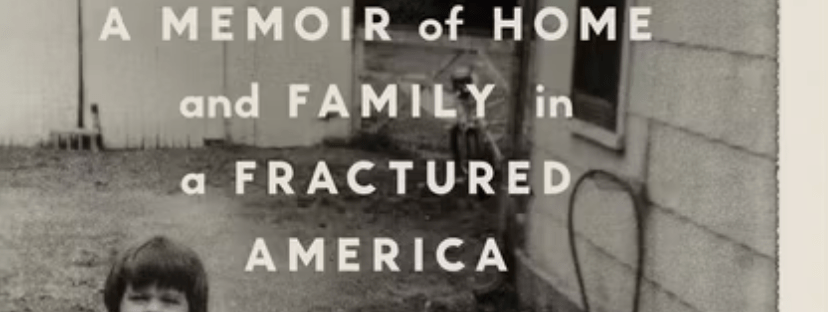
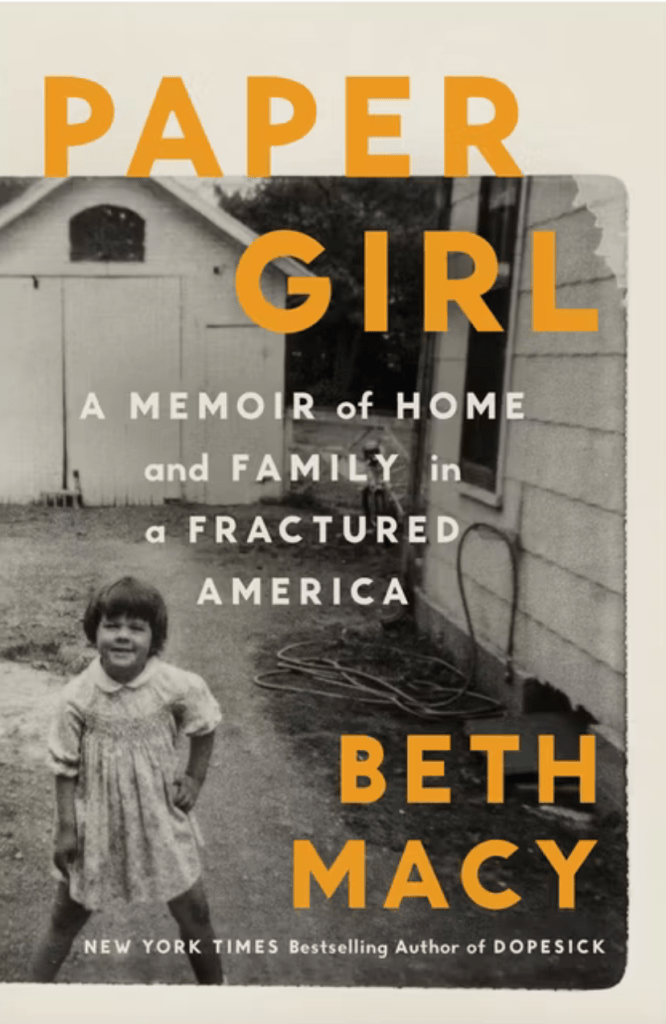
Paper Girl: A Memoir of Home and Family in a Fractured America, by journalist Beth Macy, recounts her reflections on Urbana, Ohio, her hometown.
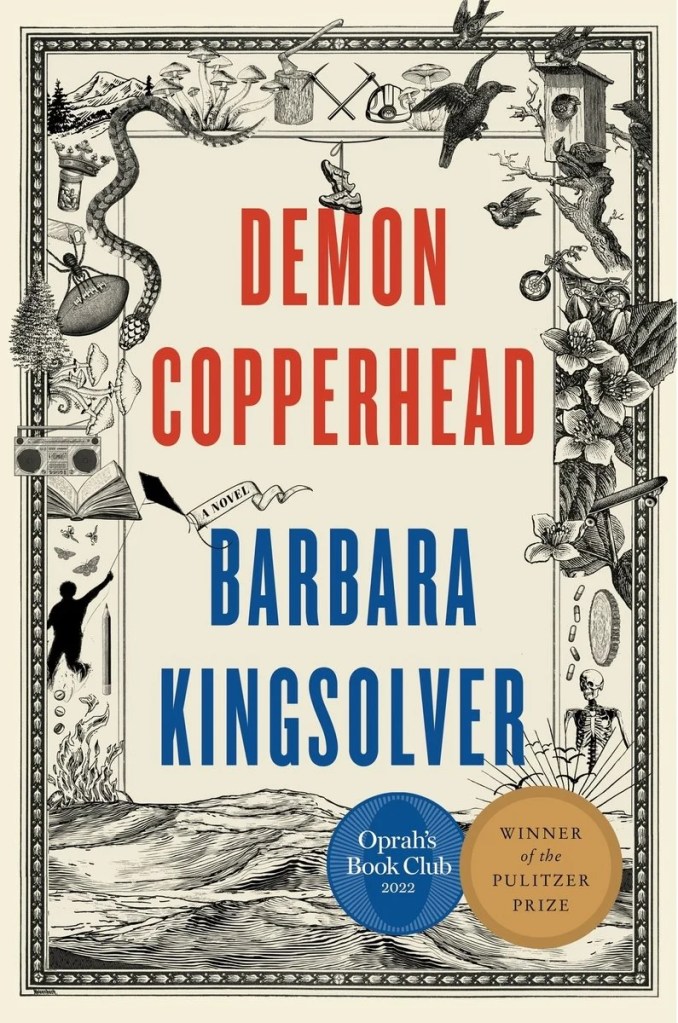
And Demon Copperhead, by Barbara Kingsolver, which is a retelling of Dickens’ David Copperfield, set in Appalachia during the height of the opioid crisis. It earned the Pulitzer Prize for Fiction in 2023.
Both are stories about places where hope dissipates over time and across tragedies. Jobs move out. Drugs move in. Despair abounds. Local newspapers shutter, while social media conspiracies run rampant. Politics becomes pastime and pew fodder.
Education becomes devalued. Truancy goes up. For example, in Paper Girl, Macy recounts how Ohio lifted the rules and benchmarks for home-schooling students. Parents struggling with their own addictions and paying the bills simply took their kids out of school while providing no formal education at home, essentially ensuring a generation of drop-outs and if-they’re-lucky minimum-wage earners.
Even with best-laid plans, people in communities like these run the risk of becoming mired in their circumstances, not by virtue of geography but by fear and poverty. Both stories articulate how often it takes aligned stars to escape — someone to see you, someone to recognize your talent, someone to believe in you, someone to give you a fair shot, plus a little dumb luck.
In both books, I recognized glimpses of my own hometown in the late-1960s and 1970s. It was easy to circle the drain there if you were a teenager. We spent our weekends at the skating rink, or cruising the downtown circuit in some senior’s car, drinking and driving (do not do this, kids), and getting loaded on whatever we could put our hands on — mostly dirt weed and liquor our parents wouldn’t notice missing from their wet bars. I smoked my first cigarette in my friend Pam’s attic bedroom when we were in 7th grade. I developed an affinity for weed and pills before I entered the 8th.
Now, kids contend with synthetic drugs and opioids, including cheap, accessible and deadly heroin and fentanyl.
In my hometown, one of the biggest events of the year was the town fair. There was a midway with rides, junk food and dizzying lights. As tweens and teens, we’d get high or drunk and walk around the fair every night for a week — our parents assuming we were off pigging out on fried foods and having wholesome fair fun. On one of those occasions, my friends dragged us into a fortune teller’s tent. For a few bucks, she’d read your fortune via tarot cards or a crystal ball like the Wicked Witch’s. When it was my turn, she snatched my cash and didn’t bother consulting either. She simply said, “You’re going to die before your 21,” and pointed me toward the exit.
That’s how far gone I was.
Much of my self-destructive behavior, I learned later in life, can be traced to childhood trauma I won’t recount here, but a lot of it was also culture. We had our share of kids who aspired, who got voted “Best This” or “Best That” in the yearbook, who played sports and avoided the allure of drugs, some whose parents socked away college funds as if it was a given.
But for so many of my peers, aspiration was as pragmatic as a daydream.
Like Journalist Beth Macy and the fictional Demon Copperhead, I had the good fortune of people who helped me transcend what could have been a wasted, brief life. There were my parents, who moved us out of the town — partly to be closer to their jobs in the D.C. suburbs, and partly to save me from the wrong crowd.
There was Debbie Riley, a court-appointed social worker assigned to me when I got busted for grand theft auto at 15 (I was a runaway who went joyriding in my friend’s brother’s car. He pressed charges, which were dropped on condition of counseling.)
Debbie Riley asked my parents to come to our first session. My father spent the hour red-faced and irate that he had to be there — and because he couldn’t seem to discipline me with tough love, nor keep me from running away from home. My mother sat stone faced and said nothing. She didn’t know what to say or do with me. At the end of the session, Debbie Riley told them they didn’t have to come to any more of our meetings; she’d meet with me alone from then on.
I never had to tell Debbie Riley about my childhood trauma, not specifically, anyway. Back then, I couldn’t have choked out the words. It took me decades to process it and to talk about it, even today, somewhat superficially. I don’t like to go too deep into those rough seas.
But it was like Debbie Riley — who probably spent every day with kids like me — could read me, or smell it on me. She knew I was broken and spiraling, but that I might be salvageable, if I wanted to be.
Way more than a decade before Robin William’s famous scene in “Good Will Hunting,” Debbie Riley took my hands in hers across her cold-metal police-department desk, and looked me in the eyes and said, “It’s not your fault. It’s not your fault.”
That scene with Matt Damon brings me to my knees every time. I see us in that moment, me and Debbie Riley — as much a breakthrough for young Will Hunting as it had been for me.
Just feeling seen lifted me a fraction of the way out of the dark pit. I started thinking about a future, about who and what I wanted to be. But I still had a long way to go.
(Spoiler alert: Beth and Demon make it out of their hometowns, too, though not unscathed.)
Sometimes the tides shift for communities like these. In the case of Urbana, new industry came to town, and there were jobs again and a little more disposable income, Macy recalls. That happened in my hometown, too. Washington, D.C.’s sprawl crept in, bringing with it new taxpaying residents who cashed big paychecks signed by defense contractors and lobbying firms. The main street transformed. No more drunken high schoolers cruising the circuit. No more 5-and-10 store once owned by my great-grandmother. Now, there were art galleries and microbreweries and restaurants with Top Chefs in their kitchens.
People who survived the leaner years now sit-pretty on homes worth 10x what they paid for them. But for so many rural communities, there’s no D.C. sprawl to swoop in like a superhero to save the day. And for too many kids, there are too few Debbie Rileys who care.
You may buy the books here, but please consider checking them out from your local library. One of the best ways to support your library is by signing up for a free library card and then using it.
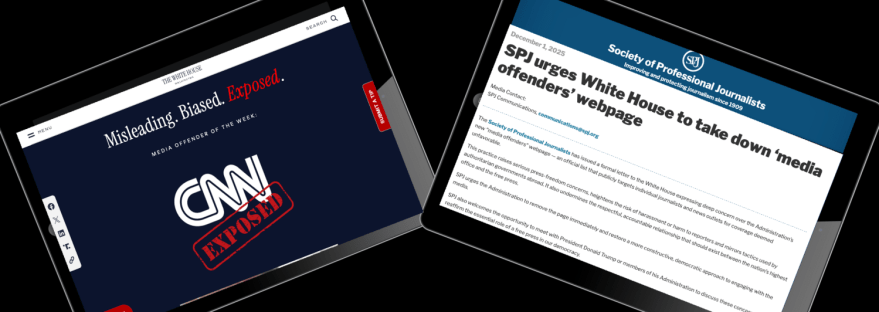
Presidents critical of the press aren’t new, but Trump’s tactics represent a significant escalation. At the link, read my conversation about the White House’s online “burn book,” with Christoph Mergerson, Ph.D., assistant professor at the University of Maryland’s Philip Merrill College of Journalism.
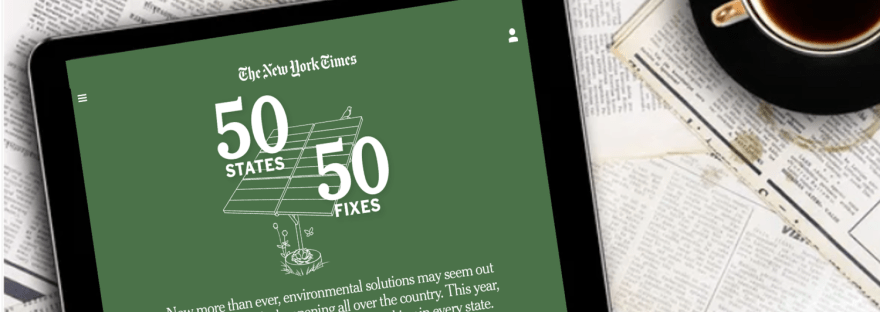
50 States, 50 Fixes: How local climate solutions are resonating across America — my conversation with The New York Times’ Climate Editor Lyndsey Layton.
“This is an area where more boards of directors than ever are looking for continued updates, not just on the state of the law and the state of enforcement policy, but what it all means in terms of their own companies’ practices. … This is complicated stuff.” — Camille Olson, partner, Seyfarth Shaw LLP
E&P’s August 2025 Cover Story: Experts weigh in on how DEI can survive and evolve in today’s volatile media and legal landscape
Quick Read: The Houston Chronicle investigative team—double the size it was just a year ago—digs deep into the questions that matter most to Houstonians
In the latest installment of E&P’s “Reporting On” series, we look at the environment beat, with particular interest in reporting on communities impacted by pollution and contamination.
This was a particularly personal assignment for me, having grown up in a town with a notorious Superfund site not far from my childhood home. It was likely a contributor to lifelong health problems for our family and for so many others in our community. Today, nearly six decades after the malfeasance that contaminated the site — and despite EPA intervention and remediation efforts — the land remains contaminated by military-grade Vietnam-era defoliants (just one category of “forever chemicals.”). Not long ago, it was sold to a developer who built housing on it.
Reporting on these public health and safety dangers is critical journalism. At the link, I speak with two reporters — Halle Parker at NPR affiliate WWNO in New Orleans and Alex Rozier at Mississippi Today — about the importance and challenges of environmental storytelling.
I spend many of my days telling the stories of local newsrooms around the country doing exemplary work, serving their communities with practical information, uplifting perspectives — building community, as we say. Over the decades I’ve been on this “beat,” it’s been thoroughly rewarding work. Not only do I enjoy turning the spotlight on these storytellers, it’s fortified my long-standing belief that journalism is foundational to democracy. Without the First Amendment, nothing that becomes before or after it in the U.S. Constitution really matters. Without it, a nation spirals into autocracy, theocracy, despotism. Without it, corruption runs unbridled.
And I still believe this with every cell and synapse of my being.
But I’ve grown weary. The constant onslaught of anti-press rhetoric, endorsed by the highest offices in the land has admittedly weakened my resolve in recent years. The nation’s slide toward authoritarianism — our inability to even argue from a baseline of facts — is such a profound disappointment. At times, it makes me wonder if all the hard work of my colleagues in the media is worth it when it increasingly feels like screaming into a void.
I felt at the lowest point when I read the news that ABC News had settled a lawsuit brought by the President elect for comments made by anchor George Stephanopoulos during a “This Week” interview with Rep. Nancy Mace (R-SC). During the interview, the news anchor pressed Mace on her endorsement of the then candidate, considering Mace herself has spoken openly about being raped when she was a teenager. During his query, the anchor said that Donald J. Trump had been found liable for rape in the civil defamation suit E. Jean Carroll brought and won — with the jury awarding her $83.3 million.
Trump took issue with the word “rape” and filed suit against the network. Keep in mind that even the judge in the case described the initiating offense in this way: “The jury’s finding of sexual abuse therefore necessarily implies that it found that Mr. Trump forcibly penetrated her vagina.”
If forcibly penetrating a woman’s vagina – whether with a penis, an object or a hand — isn’t “rape,” then once again, it feels as if we’re not operating from a baseline of facts. It feels like arguing semantics in Atwood’s Gilead.
Before the case could advance further to the discovery phase, ABC News and George Stephanopoulos agreed to a settlement that required an escrowed $15 million to fund a future Donald J. Trump Presidential museum, another $1 million for Trump’s legal fees, and a public apology by the journalist – in other words, an admission of defamation.
Tim Miller and William Kristol — notably former Republicans — had a conversation about the perils of criticizing Trump. They wrote on thebulwark.com, “ABC News and George Stephanopoulos have joined the preemptive capitulation parade by settling Trump’s defamation suit—and by conspicuously paying out protection money ahead of the inauguration. The potential chilling effect on a key First Amendment issue is breathtaking.”
Northeastern Professor Dan Kennedy opined in his newsletter: “What Stephanopoulos said arguably wasn’t even false, and surely it didn’t amount to actual malice. A deep-pockets defendant like Disney ought to stand up for the First Amendment lest its cowardly capitulation to Trump harm other media outlets without the wherewithal to fight back.”
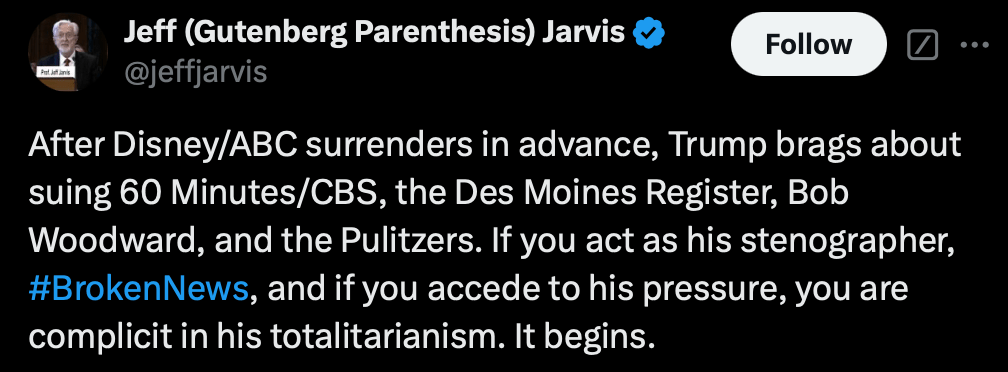
On Twitter/X, Jeff Jarvis, author and journalist, issued a warning:
Of course, none of us had a seat at the conference table surrounded by high-hourly-rate lawyers, so it’s purely speculation as to why the news media publisher agreed to settle. Some say the legal definition of rape in New York is a higher benchmark than this form of sexual assault. Others said the network didn’t want to be forced into protracted and expensive discovery, during which the President’s legal team could request all sorts of documentation, from producers’ correspondence to business strategy, personal calendars and diaries, footage from every show that mentioned Trump, social media posts, you name it.
Discovery is long and hard fought, typically with the Plaintiff asking for everything under the sun, and the Defendant having to go to court to argue against each non-related or protected journalist-source item.
Still others speculated that the $15 million settlement was such an insignificant amount for the parent organization, the Walt Disney Company, that it just made sense to pay it and get it over and done with. After all, an ongoing legal battle would’ve further impeded the network’s ability to gain access or fairly report on the incoming Administration. All of these reasons could simultaneously be true, too.
But the impact of the settlement has ripples — no, asphyxiating currents — that will reach far beyond the parties. It’s ammunition for a President and party that has continued to portray the press as “the enemy of the people.” It may not further embolden Trump himself to bring lawsuits against news outlets — he’s done that, usually unsuccessfully, for decades and long before he fatefully descended down the Trump Tower escalator to declare his first candidacy. And there’s no sign that he plans to slow down. Last week, he filed suit against the Gannett-owned Des Moines Register and pollster Ann Selzer over an unfavorable poll they published prior to election, alleging the poll — a poll, for goodness sakes — was akin to “election interference.”
But it will embolden others, particularly the political and powerful classes, to wield lawfare as a weapon to intimidate the press, to send a chill through the media, and in some cases, to kill off news outlets entirely — destroyed by the weight of defending protracted legal battles. Death by billable hour.
Atlanta Journal-Constitution Cartoonist Mike Luckovich so perfectly memorialized the settlement, shared on Twitter/X:
In E&P’s January issue, Columnist Rob Tornoe shares a conversation with Luckovich about being a political cartoonist in the era of Trump. You’ll want to read it.
And let’s be clear, lawfare is not just a threat to large media conglomerates. It oozes down to regional and local newsrooms, as well.
“I fear the federal attack on the press will trickle down locally, and it will be harder to get information through normal channels and freedom of the press requests,” Katie Honan, reporter for THE CITY, observed in Nieman Lab’s “Predictions for Journalism, 2025” series.
The other way it corrodes our profession is by signaling to journalists that your company, your superiors, may not have your back. They may, in fact, sell you out, make you pay, make you grovel. As a journalist there is little that’s more demoralizing than feeling as though your superiors would throw you under the bus rather than stand in solidarity with you.
Jonathan V. Last at The Bulwark wrote that “Disney has cut off ABC News at the knees and put everyone in its news division on notice that they will not be supported by corporate if they make enemies with Trump world.”
But I’m feeling a little better, a little stronger, more resolved for a couple of reasons. This Des Moines Register case is so petty, so meritless, it’ll surely be tossed out, right?
Right?
And I spent the past few weeks learning about the journalism program at the University of Oregon, where the curricula, the practical experiences and skills the students learn, and the remarkable faculty who guide them have sent some welcome breezes from the west to lift my wings. Asked about the aspirations and temperament of the new class of journalists coming into the profession, one member of the faculty described them generally as motivated, inspired, idealistic, energetic.
Elinor R. Tatum, publisher and editor-in-chief of New York Amsterdam News, exemplifies what it means to be E&P’s Publisher of the Year. For 30 years, she’s thoughtfully led the news organization through formidable challenges—the advent of the internet and digital media, greater competition for audience, uncertainty related to revenue, and most recently, the COVID pandemic era.
Tatum’s contribution far exceeds her work for the newspaper. She’s devoted her time and expertise to elevating other news media outlets and creating a sense of camaraderie so needed throughout the news media today. She’s a strategic risk taker and innovator—a change agent for the local news community, and especially the Black press.
And one of the many things I found to be so inspirational about Tatum as I wrote this month’s cover story was her long history of motivating, encouraging, empowering and challenging her staff, peers, all of us.






 Gretchen A. Peck