In the age of digital media, County Highway is all about print — my conversation with Editor David Samuels for Editor & Publisher magazine
Category: News & Publishing

The hardest things to see
In the 1990s, I worked at a law firm while getting my grad degree. My job wasn’t clearly defined. I answered phones, paid the bills, and drafted correspondence and pleadings for the senior partners. One of the partners worked in criminal law, and working with his team allowed me insight into some horrific crimes — not the least of which was a compelling case against the Archdiocese for the alleged sexual abuse and rapes now made famous by the Netflix documentary, “The Keepers.”
That same attorney introduced me to a convicted murderer, for whom he was mounting a death penalty appeal. The man had been sentenced to death, along with a buddy, for murdering a Baltimore woman in her home. She was a single gal, a professional who lived alone. According to the defendants’ testimony, they’d gone to her home one evening, thinking she wasn’t there. Once inside, they scouted the first floor, looking for items of value to grab. They came to the kitchen and felt hunger pangs. They opened the refrigerator, took out some ingredients and began cooking up a snack on her stove.
But she was home.
Upstairs, she was sleeping in an early bed. The clanging sound of pots and pans and cooking utensils woke her. She stirred, and the sound jolted the intruders down below. One of the men grabbed a 10-inch chef’s knife — at trial, they’d pointed fingers at each other, accusing the other of wielding the knife — and they went upstairs.
They forced her back to the bed. To silence her screams, they put a pillow over her face. Then, the man holding the knife stabbed her dozens of times, including a final blow that penetrated the pillow and impaled her through the breastplate.
As I tell you this story, the hair on your arms might stand at attention. You might feel revulsion at the brutality of it. You might for just a fleeting moment consider what it was like for her in those final horrific moments. But you’ll never really understand the violence unless you saw the crime scene photos.
I had to sift through them one day, stacks upon stacks of black-and-white glossies taken by law enforcement and shown to jurors as evidence during the trial. To this day, I can remember how she looked, frail and tiny and limp. The simple furnishings around her defied why anyone would want to rob her. She had so little, just starting out in life.
Blood was everywhere — pooling on the sheets, seeping through the soft, worn pillowcase, where the knife was embedded in her body. It was splattered on the walls, the carpet, the nightstand.
I’m sure my heart fell out of rhythm when I noticed in one of the photos that she was wearing a nightgown with Ziggy, a cartoon character, childlike. I had the same nightgown when I was a teenager. I have a photo of me in it from one Christmas morning.
I cried for hours in our little law library. I still cry when I think about those images — when I think of her — today. They were hard to look at, certainly for the jurors who were deciding the defendants’ fate. But they needed to see them, to fully understand, to grapple with the violence, to make informed decisions and to act accordingly.
Yesterday, The Washington Post published a controversial investigative piece, “American Icon: Terror on Repeat, a rare look at the devastation caused by AR-15 shootings.”
Please look at it: https://www.washingtonpost.com/nation/interactive/2023/ar-15-force-mass-shootings/
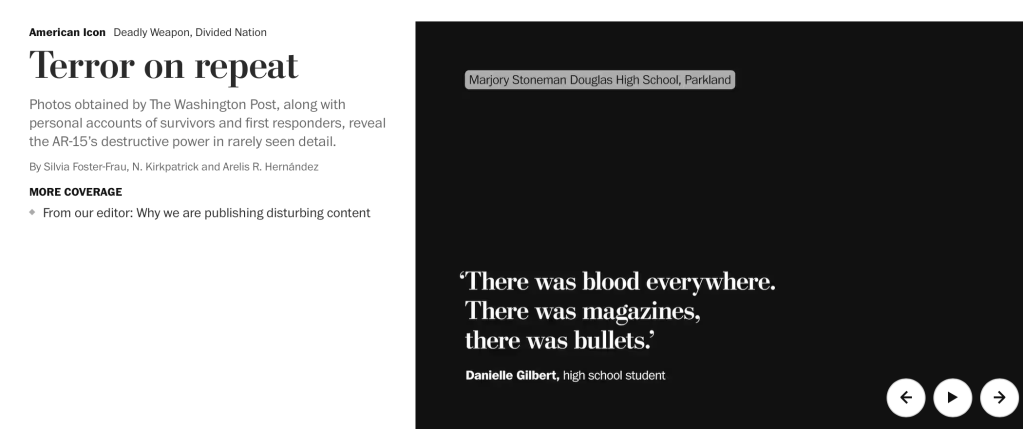
The piece is controversial for its graphic photos, showing the horror, carnage and death inflicted by people with access to a weapon of war — a gruesome tool designed expressly for hunting human beings.
As long as I have worked in news, there has been fervent debates among journalists about graphic images and what is beyond the pale for the viewing public. This is not an easy professional nor moral call. And it’s often the case that new outlets are accused of exploitation and shock value for publishing violent imagery.
I spoke with a Pulitzer-awarded photojournalist this week, for whom I have the utmost respect. She’s been covering war for more than 23 years, and has paid witness to the very worst of humanity, the very worst violence, the absolute worst gore. Over the course of her career, she’s faced this dilemma an untold number of times, weighing which images to submit for publication and which ones are simply too grotesque to inflict on others.
She spoke thoughtfully about her worry that if a photograph is too distasteful to a person, they’ll simply turn the page or switch the channel and move along, negating all of the work and danger it took to capture it, negating the story of the victims.
If they can’t stand to look at the photo, they can’t care about the people, she explained to me.
We talked a little about the skills a journalist acquires on the war beat, and how they translate here in America for local news reporters who find themselves covering crises, like mass shootings. If you’re intrigued, I’ve written more about our conversation in the December issue of Editor & Publisher.
I implore you to look at the photos in WaPo’s important piece of journalism.
Fit yourself in the cowboy boots of young people running from rapid gunfire, when moments before they were singing along to country music.
Stand over the body bags lining an elementary school hallway, with the corpses and parts of children zippered inside, and imagine what it’s like to be their parents, their friends, the adults who failed to protect them.
Fight the urge to turn away from the picture of pews, soaked in blood, the walls of the church pockmarked and splintered by an AR-15s spray.
No narrative, no amount of pontificating, no amount of wrestling with the right adjectives can communicate the story more honestly and accurately than these videos and photos.
Brett Cross, father of Uziyah “Uzi” Garcia, who was one of the children murdered at Robb Elementary, took to X/Twitter to comment on The Washington Post piece: https://twitter.com/BCross052422/status/1725139970518646866
He’s right: Why should these images only haunt him and the victims’ families? We’re all responsible for gun violence in this country, because we turn away, we move on, we conscientiously — by choice — build up our tolerance to it.
I get tangled up on the question of whether it’s the press’s duty to somehow soften the blow, to make violence and murder more palatable to the public? Or is it a newsroom’s duty to depict the crime and its aftermath with unobscured clarity?
I think WaPo made the right call.
About “Going There”
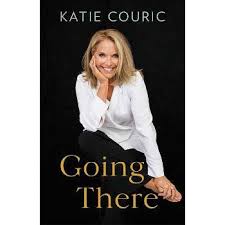
Katie Couric’s 2021 memoir is perfectly titled: Going There
It’s clever, because it relates to so many facets of her story—the places she went (physically and emotionally) over the course of her decades-long career in news; the torment of recalling profound loss and grief; or how she took a chance at love again.
Whether you’ve been a fan or a casual observer, Couric’s familiar voice comes through in the text.
Full disclosure, I once felt full-on fangirl when Couric retweeted me during the pandemic—both of us grateful for journalists who were covering “the front lines” of COVID.

As far as women in news go, Couric is legendary. And her memoir could’ve easily gone down a chest-thumping path, boasting of her myriad hard-news features and epic longevity on TV screens. Instead, there’s a raw, earnest quality to her retelling of the story that’s genuine and approachable, like Couric herself, as we come to see.
She shares with us what it was like to grieve her husband, her sister, her parents. She speaks honestly about loss, motherhood, exhaustion, but also about love, redemption and gratitude.
I’ve always felt the most effective memoirs are those that demonstrate a change and a maturation of the autobiographer: what you learn, who you come, what you overcome.
Life isn’t Instagram.
Going There is deeply introspective, particularly when Couric recounts her regrets and miscalculations along the way—missing signs that her beloved first-husband Jay was ill; unwisely choosing partners after his death; anecdotally putting career ahead of family; and a slew of professional missteps that make her (and us) cringe today.
Most of all, it’s a tome about journalism and TV news, from a woman’s point of view during a transformative time, spanning the age of overt misogyny and sexual misconduct to the post-#MeToo modern day.
Couric peels back the curtain on what it was like to navigate network politics, sexism and fierce competition, not just between the TV networks, but sometimes among your own network team. I’ll think about “60 Minutes”—a staple Sunday-night show in our home growing up—a little differently after learning how Couric was treated by the producers and fellow journalists.
Recently, in conversation with someone else in news, I used the term “working sources,” and I was met with silence on the other end of the line; then, a question: What do you mean by ‘working sources?’ More condemnation than question. And I explained what I feel it’s like to land an important interview, particularly with someone who may be initially reluctant to go on record, let alone on camera. I spoke of building trust, of having conversations, perhaps meeting in person, explaining my process, being fully transparent and honest—but, in effect, working to get the interview.
Couric gives us a no-holds-barred account of “working sources,” crediting her bookers and producers for contortionist-like moves to woo them. In the print world that I know, there are clearly defined ethics on such matters, and one of them is that we don’t accept gifts from them, and they shouldn’t expect from us in return. It seems TV news is a bit more cut-throat competitive, and that there are gray areas on such matters.
I (and I’m sure a lot of women readers) also appreciated how Couric spoke about trying to balance the two sides of her professional personality—serious, right-toned journalist versus the quirkier, fun, silly, sometimes smart-ass side of her personality. The TODAY Show gave her the perfect platform for that balancing act.
“Katherine or Katie, the serious journalist or the smiley cutup … the tension between those two sides of my nature would run like a fault line through my career,” she reflects.
Couric writes about Jeff Zucker and Matt Lauer, men with whom she’d had as close a professional relationship as you might have; both proved grave disappointments in the end.
Couric took a lot of heat when Going There first came out, particularly about her recounting of an interview with SCOTUS Justice Ruth Bader Ginsburg. Couric asked Justice Ginsburg about Colin Kaepernick’s protests. The Justice expressed how she found it disgraceful—not what you might expect from a liberal-leaning, First Amendment-affirming judge. Couric revealed how she wrestled with the editorial decision about whether to keep the exchange in the interview, or to cut it out. Critics decried that it was Couric’s duty to broadcast her remarks, that it was journalistic malpractice not to. She’s not objective, they said, citing Couric’s admission that she greatly admired Ginsburg.
But that’s journalism. You bring personal perspective to your reporting. How can you not? You are a person, a citizen, with lived experiences like anyone else. You learn things, and those things inform you as you move through life and, professionally, into others’ lives. These editorial dilemmas come up in nearly every interview or reporting assignment, especially in hard news and investigative journalism.
“I know I’m being fair when everybody’s mad at me,” Walter Kronkite once told Couric.
If all this sounds intriguing, I hope you’ll read the book, and check out Couric’s Instagram for more of her “smiley cutup” side.

Local news “builds community”
Within the past five years — and certainly during the height of the pandemic — I began to notice the term “building community” come up in conversation a lot, particularly with local news publishers and journalists. It’s certainly not a new concept — the idea that a local newspaper (or news site) doesn’t just inform the community; it also provides a thread that runs through the community, creating a sense of belonging and a reminder of shared vested interests.
Every local news outlet does this in some way. It’s inherent. But E&P went in search of stories of news media publishers striving to meaningfully connect with the community and to foster community engagement in positive ways. At the link, you’ll read about two of them — The Lansing Journal and The Spokesman-Review.
Share your story about how local news enriches your sense of community in the comments. We’d love to hear about it!

A New News Ecosystem for Pittsburgh
I lived in Pennsylvania for about 20 years—in Philadelphia and the surrounding ‘burbs. I got to know Pittsburgh through friends who called the city home and trips down the PA Turnpike (a gorgeous drive, by the way) to visit with them. It’s a city integral to American history and innovation—a city that saw industry come and go, forcing it to reinvent itself. It rose to the challenge.
With three rivers converging, it’s also a part of the state well-concerned with conservation and pollution. Fracking hasn’t helped.
Pittsburgh has always seemed to me a city in need of a robust news presence and journalists unafraid to tell its stories—the bad, as well as the good. And make no mistake, there’s lots of good, too. But if there’s anyone who can ensure that Pittsburgh’s news media landscape flourishes, it’s Andrew Conte, Ph.D., director of the Center for Media Innovation at Point Park University.
I spoke with Dr. Conte for E&P’s June issue—about the Center, local news sustainability, citizen journalism, and an exciting new collaboration between otherwise-competitive news media publishers around the city and suburbs. It’s a new “news ecosystem” for the city, and another example of how Pittsburgh continues to be a place of reinvention and innovation.
Read the story for free at the link, and share your thoughts on Conte’s vision in the comments.


The Subscriber Engagement Index data reveals key metrics for compelling subscribers and reducing churn

I gleaned a lot from my conversation with Tim Franklin, senior associate dean, professor and the John M. Mutz Chair in Local News at Medill, and Larry DeGaris, executive director of the Medill Spiegel Research Center, about the Subscriber Engagement Index — and what the members’ data has revealed about audience, engagement and the (other) bad C-word, “churn.” When it comes to compelling content, it appears quality and originality is a key factor to inspiring sign-ups, ensuring brand loyalty, and subscriber retention.
Check out the Quick Read from Editor & Publisher at the link, and let us know if your newsroom is being intentional about creating journalism that is special, critical and that subscribers can’t get anywhere else. Thanks for reading!
https://www.editorandpublisher.com/stories/original-distinctive-content-holds-value,244115
#subscriptions #newsmedia #journalism #brandloyalty

The shifting balances of press powers: While First Amendment champions work to affirm the free press, others seek to undermine it
By Gretchen A. Peck, Contributing Editor, Editor & Publisher

The past few years have been remarkable for news media publishers, which have enjoyed some particularly public and powerful support. In the U.S. Congress, representatives and senators from both sides of the aisle sponsored legislative proposals that would secure press protections (the PRESS Act), get news agencies a seat at the table in negotiations with Big Tech (Journalism Competition & Preservation Act, the JCPA), and a proposal that would provide financial relief to local news businesses (the Local Journalism Sustainability Act, or LJSA).
Under Founder Steve Waldman’s direction, Rebuild Local News has been lobbying statehouse legislators to adopt bills that would provide tax credits to small businesses that advertise in local news media, to newsrooms that retain or hire more journalists and to individuals who subscribe or donate to a local news outlet.
While these champions for local news have been hard at work, powerful forces have been running a counteroffensive — undermining the press, impeding access and making it easier for members of the public and political class to sue news organizations.
Read on at: https://www.editorandpublisher.com/stories/the-shifting-balances-of-press-powers,243446
The Baltimore Beat is Back
For E&P’s March issue, I had the pleasure of speaking with Lisa Snowden The Baltimore Beat’s editor. Last summer, Baltimore Beat returned to the local news scene after a publishing pause. They had a somewhat quiet relaunch in late summer, when other Baltimore news outlets were basking in national attention over Baltimore’s new “newspaper wars”—pitting the new Baltimore Banner against the city’s legacy paper, the Baltimore Sun.
Snowden didn’t have much time to pay attention to that media frenzy. The veteran Baltimore journalist was busy relaunching the Beat as a nonprofit local news title for Baltimore’s Black community—61.6% of the city’s population, per the U.S. Census. It is intentionally a print title (w/ a companion site) that’s strategically distributed around the city, and it’s free.
The Baltimore Beat’s revenue model relies on philanthropy and the sustained support of the community. Snowden plans to earn that support by being a practical, accessible, go-to resource for the public.
Read more at the link: https://www.editorandpublisher.com/stories/the-baltimore-beat-back-in-business-providing-local-practical-news-for-underserved-communities,242797

Holidays in the newsroom
By Gretchen A. Peck
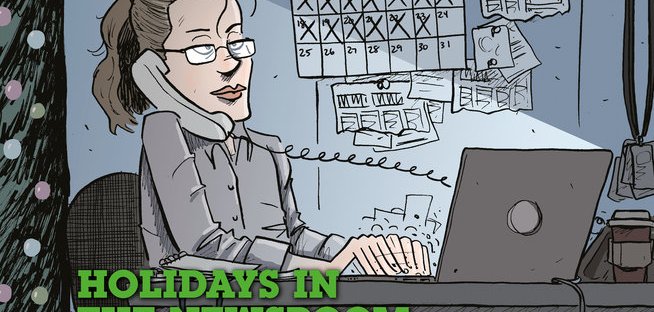
Editor & Publisher (E&P) Magazine closes out the year with a cover story dedicated to all the journalists and editors keeping us informed during the year-end holidays. It’s a bittersweet story, as you will see, not unlike a holiday spent apart from loved ones, or the end of another year, now past. I wanted to especially thank Rob Tornoe for illustrating the cover. He so perfectly captured the moments when the newsroom is otherwise quiet, when the world around celebrates, but there’s a lead to chase, a story to tell and the public to serve.
https://www.editorandpublisher.com/stories/holidays-in-the-newsroom,241313
Some thoughts on a year in news
As 2022 comes to a close, my social feeds have been heavy with news of layoffs across media and tech worlds.
It’s the loss of local news that feels most ominous. We’ll start the new year with fewer journalists in newsrooms, fewer columnists to stoke our minds, fewer visual journalists to show us new perspectives, fewer production, sales, audience and administrative pros to ensure that the news reaches subscribers and the public.
The threads that gut me most chronicle all the stories of little to great importance that journalists produced over time in service to employers and the community. There are the investigative pieces, expensive and sometimes tedious to produce; stories holding the powerful and elected to account; stories about the economy, housing, the food chain, immigration, public policy, foreign policy, crime, war, the heavy stuff.
There are endearing examples of human interest stories about the many inspiring people who contribute to our communities. There are the stories about events, art, food and local traditions that help us to feel connected to one another, to have the sense and security of a community around us.
Who will tell these stories, elevate these voices, speak these revelations when newsrooms are scuttled?
I’ve had the pleasure of another year reporting on the state of news for Editor & Publisher magazine, my 12th year with the title. It’s been a humbling, troubling, yet exhilarating year in news. Here are just a few of the stories I’ve had the privilege to tell:
I learned about anti-boycott legislation spreading through statehouses like wildfire, with repercussions to free speech and a free press. I also spoke with Mike Barnicle about the policy trend and other ways in which the 1st Amendment is under attack. https://www.editorandpublisher.com/stories/anti-boycott-laws-run-afoul-of-the-free-press,217354
We followed the dynamics between news media and big tech, diving into the Journalism Preservation & Competition Act (JCPA), copyright issues, Section 230 (let’s not go there), and an anti-trust suit working its way through the courts. https://www.editorandpublisher.com/stories/an-inequitable-partnership-turns-toxic,220234
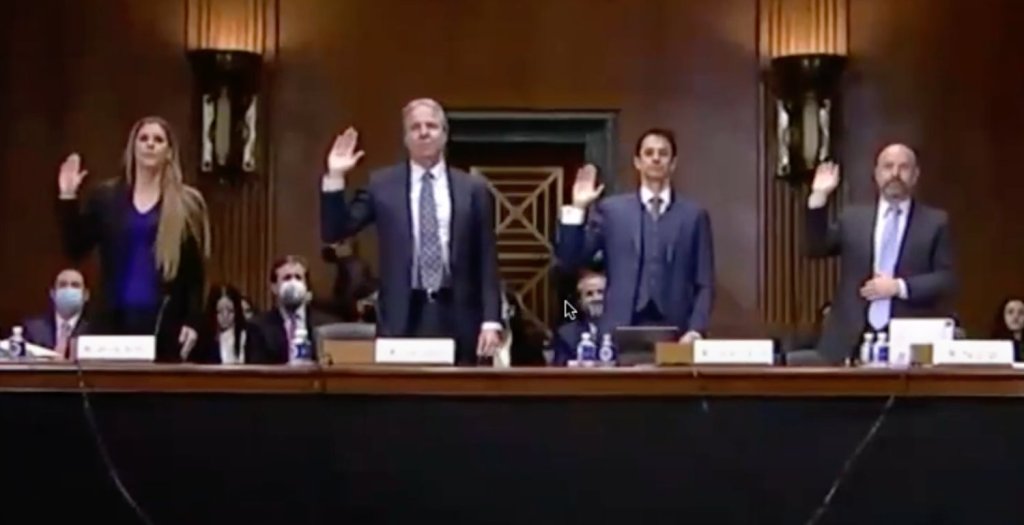
We told good-news stories, like at The Oregonian. https://www.editorandpublisher.com/stories/the-oregonian-curates-a-feel-good-news-experience,221670
E&P Publisher Mike Blinder was kind to invite me to join him on a few episodes of E&P Reports, like this spirited discussion about public notices: https://www.editorandpublisher.com/stories/floridas-public-notice-reversal-could-it-have-been-avoided-and-will-other-states-follow,221605?newsletter=221606
We reported on cybercrime and the specific threat to news organizations around the world. https://www.editorandpublisher.com/stories/cyber-threats-to-media-companies-are-on-the-rise,225421

We chronicled the development of “democracy teams” around the country. https://www.editorandpublisher.com/stories/the-washington-post-deploys-democracy-team,225938
And about how the norms, institutions and tenets of democracy are under attack: https://www.editorandpublisher.com/stories/american-democracy-in-crisis,239480
As a “daughter of Baltimore,” I had the distinct pleasure of telling the story of the 130-years-young The AFRO-American, and the inspiring family behind the news brand. https://www.editorandpublisher.com/stories/news-history-130-years-in-the-making,239598?newsletter=239660
And told the story of the brand-new Baltimore Banner: https://www.editorandpublisher.com/stories/a-banner-year-for-baltimore,227440
I got to know some truly impressive journalists this year, including many award-winners, like Samantha Max. https://www.editorandpublisher.com/stories/shattering-the-code-of-silence,231515
Under Robin Blinder’s direction as editor and co-publisher, we informed readers — mostly C-Suite news exes — about what journalists contend with today, including challenges related to mental health and physical safety. https://www.editorandpublisher.com/stories/mindful-of-mental-health,233569?newsletter=233935
We told the cautionary tales about how news media publishers are imperiled, and how the public’s trust in news is fragile and fleeting. https://www.editorandpublisher.com/stories/libel-suit-leaves-local-paper-in-crisis,237861?newsletter=238485
We reported on news outlets reporting on crises, like catastrophic Hurricane Ian. https://www.editorandpublisher.com/ian/
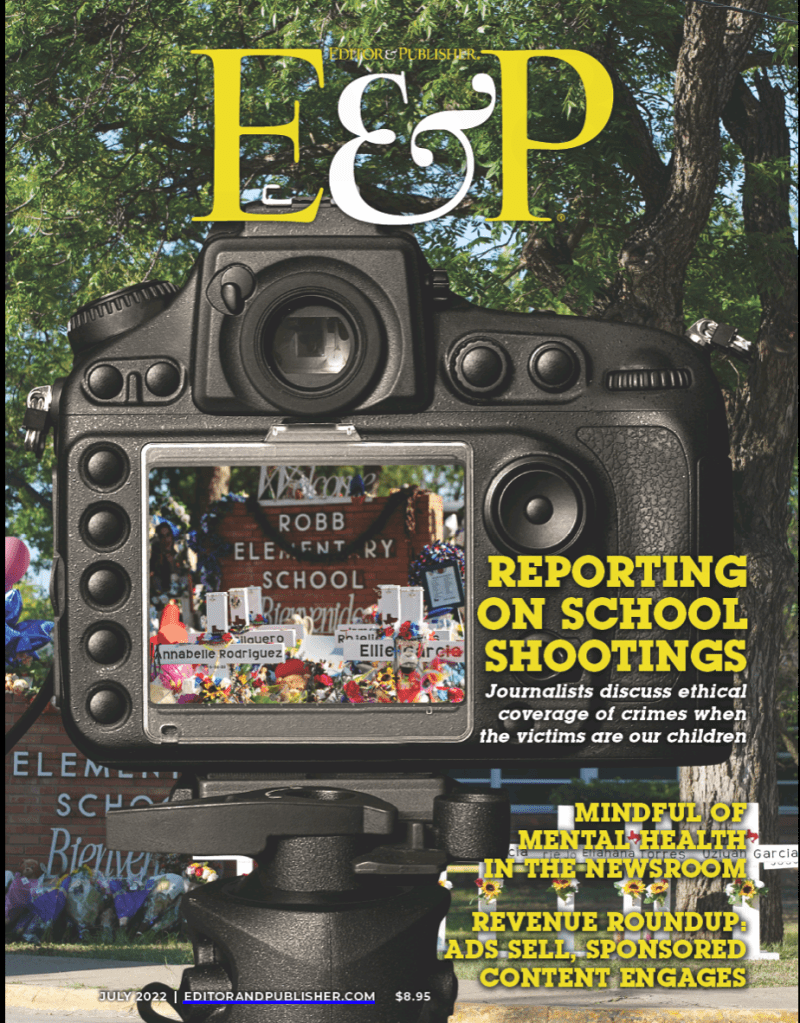
I wrote a cover story I didn’t want to write, shouldn’t have to write, nearly couldn’t bring myself to write, and have forever been changed by it: https://www.editorandpublisher.com/stories/reporting-on-school-shootings,232615
We asked tough questions of our peers, including Mike Reed, CEO of Gannett, who just directed the en-masse layoffs I mentioned at the beginning of this missive. He can expect more questions from me in the new year. https://www.editorandpublisher.com/stories/the-good-news-and-bad-news-about-gannett,240563
I learned a lot this year from some really inspiring visionaries. I hope E&P readers did, too. Everything about news is in flux, even the profession of journalism. https://www.editorandpublisher.com/stories/the-objectivity-wars-wage-on,240841
My final E&P dispatch of the year is bittersweet, like the holidays or the end of a year. We wanted to tell the stories of journalists who’ve worked a newsroom, a sound booth or a TV studio on one of the major year-end holidays. We wanted to know about festivities, food (because you know that’s important to us) and newsroom traditions, but also about the memorable events reported on those holidays — a reminder that the public’s need to know never takes a holiday.
I was so grateful for all the reporters, editors, photographers, on-air hosts, everyone who shared their memories with me. Throughout those conversations ran two themes — what a privilege it is to do this job, and how so many journalists lost their jobs this year, how so many have had to (reluctantly or enthusiastically) leave the profession.
I’d like to extend a special thanks to E&P Columnist and Cartoonist Rob Tornoe, who illustrated the cover and perfectly captured the experience of chasing a lead while the newsroom is quiet and the world around you celebrates.
You can read the entire December 2022 e-edition here: https://editorandpublisher.pressreader.com/editor-publisher
My New Year’s wish is that all of these talented, smart, earnest people — indispensable members of our news family — land upright and ready to lead us toward a new trajectory. ~ G
 Gretchen A. Peck