
Fourteen years ago, Nextdoor debuted on the digital networking scene. It carved out a niche as a website and app that facilitated connections between neighbors. It’s a digital space where they can share information, ask questions and seek recommendations relative to their geographic neighborhood.
This summer, Nextdoor unveiled a new design, returned to its original branding and logo, embraced local news — notably, at a time when other networking platforms devalue it — and incorporated Artificial Intelligence (AI) into the platform.
Some of the best Italian restaurants in Philadelphia are those you’ve never heard of. They have a small footprint, are intimate and cozy, with just a few tables. I’ve found that’s usually a good gauge of a great restaurant—symbolic that the focus is on quality rather than volume. They’re local-favorite spots, where families cook recipes passed down generations, and the vibe is spirited, familiar and comforting—like you’ve met up with some friends from the neighborhood to have a bottle of wine and some delicate handmade pasta ladled with Sunday gravy.
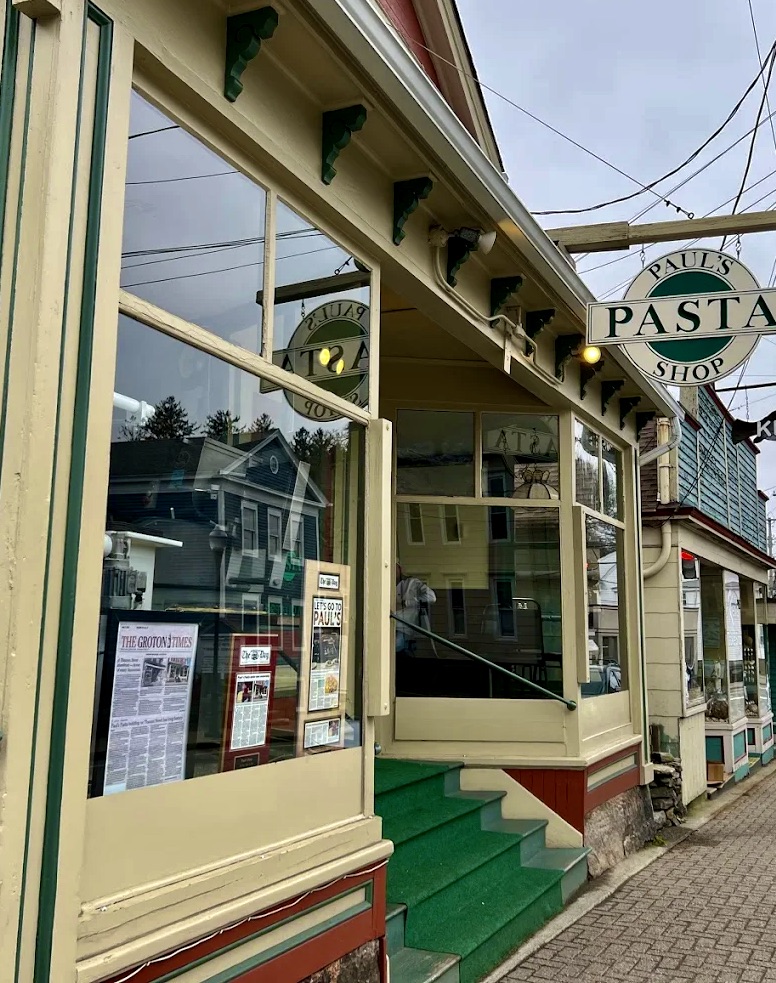
That type of culinary experience has eluded us since moving from Philadelphia more than a decade ago, until my husband and I discovered Paul’s Pasta Shop, right on the shore of the Thames River in Groton, Connecticut.
Though it was acquired by TyMark Restaurant Group in 2023, the restaurant still carries the name of its founder—Paul Fidrych. Partnered with his wife, Dorothy, Fidrych opened the restaurant in 1988, with a mission to deliver “fresh cooking and warm customer service.” Under the new ownership, the restaurant still makes good on that promise.
The dining room is tightly packed with green vinyl-covered tables, and there’s a covered deck out back, overlooking the Thames River. The menu is simple. They’re known for homemade pasta, simple green salads and a tempting dessert case. My husband tends to opt for the nightly specials, like linguini with shrimp, artichokes and sundried tomatoes. I tend to go for the house-made ravioli. You can order cheese or meat filling, or a few of each. It’s a great meal paired with a half-carafe of table wine, a basket of garlic bread and a simple house salad with the perfect amount of honey poppyseed dressing.
A half-size order of house-made cheese ravioli, topped with marinara sauce at Paul’s Pasta Shop in Groton, Connecticut. Photo: G.A. Peck
Their specialty is “spaghetti pie”—an enormous wedge of pasta, vegetables, cheese, sausage, pepperoni and sauce, baked in the oven until it develops a crust. I’m not brave enough to order it. It’s massive and requires a commitment. I’ve seen entire tables of Navy and Coast Guard service members order them and tap out halfway through. Makes for good leftovers, I bet.
The marinara sauce varies a little each time, but that’s how it goes in the kitchen, after all. Even precise recipes are subjected to variables, like the quality, season and sweetness of the tomatoes.
Is it the best marinara sauce I’ve ever had? No. But I’ve been spoiled on South Philly Italian; it’s an extremely high bar. But it’s a decent sauce; you’ll want to sop up any extra with the garlic bread.
The restaurant is approachable, unpretentious, homey. Locals wave to one another as they come through the front door. It’s particularly comforting to sit in the bustling dining room on a cold winter’s night, when you’re glad for the fellowship.
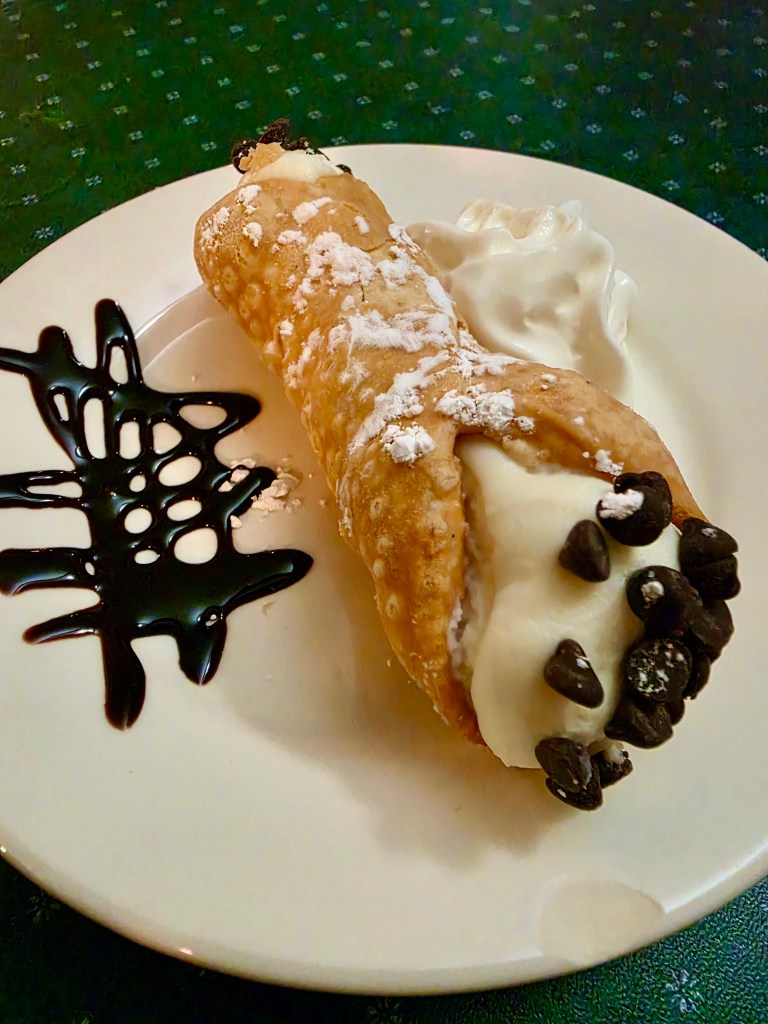
The staff is flawlessly friendly, and the service is quick. Pro tip: If you want cannoli for dessert, order them with your meal. They sell out fast.
Cannoli at Paul’s Pasta Shop in Groton, Connecticut. Order early, because they sell out quickly. Photo: G.A. Peck
Not long ago, we pulled off the highway and stopped in for dinner, and on our way out, we paused at the front of the store, where the manager, Mike, was making fresh pasta. We explained how we’d gotten into making pasta by hand at home, and he gave us some tips on dough and showed us how the commercial ravioli maker worked.
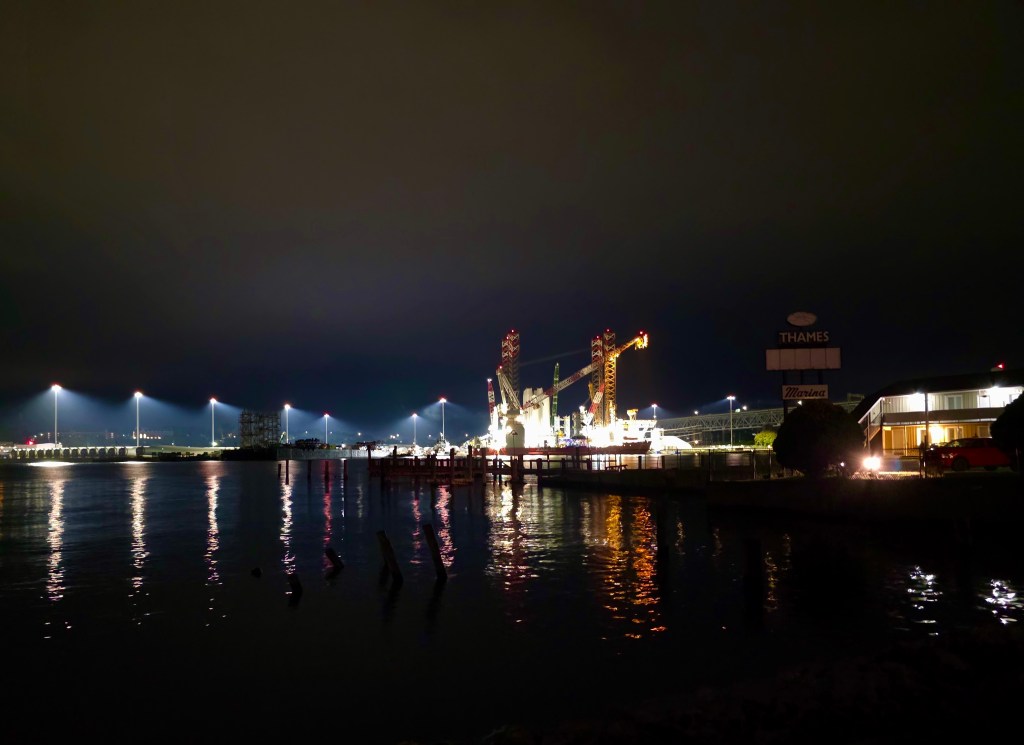
There’s limited parking behind the restaurant—right on the river, with views of the Gold Star Bridge, the State Pier, bustling with wind turbine industry, and the new Coast Guard Museum under construction in New London.
State Pier, a hub for wind energy development, is seen across the Thames River from Paul’s Pasta Shop in Groton, Connecticut. Photo: G.A. Peck
As we strolled to our car one night after a fair-valued perfectly satisfying meal, my husband declared, “It’s the closest thing to South Philly.” That’s a high compliment.
My husband and I celebrate our birthdays each year not with the exchange of gifts but with a special dinner out — typically at a restaurant we otherwise wouldn’t frequent on the daily. If the place has a chef’s tasting menu, we tend to gravitate to that.
Over the years, we’ve had some truly exceptional tasting experiences, and some that were so disappointing they ventured toward the realm of absurd. In Philadelphia many years ago, we chose Eric Ripert’s 10 Arts, where Top Chef-famous Jennifer Carroll was the executive chef at the time. It was a frou-frou place, in a beautiful old Philadelphia building, with high ceilings, thick moldings, heavy velvet draperies. Here, nouveau cuisine — coded language for tiny portions — reigned. There were perhaps six courses in all, all about a bite or two in size, none of which were particularly enticing or memorable. In fact, the only course I remember to this day was dessert — two tiny homemade marshmallows. Granted, this was before craft marshmallows became de rigueur, so credit to Chef Carroll, who was ahead of trend.
The server would present each plate with such flourish, but each time she’d leave, we’d lean in and whisper to one another. “Are we being punked?”
“Are there hidden cameras here? Is Allen Funt going to jump out from behind one of these beautiful curtains and say, ‘Smile! You’re on Candid Camera!’”
You could’ve dined using tweezers rather than forks.
We paid the comically expensive tab and resisted complaining to the server. After all, it wasn’t her fault. On the way home, we stopped at a takeout place on North Broad Street and got dinner to go.
Conversely, we’ve had some incredible tasting menu experiences — at Chef Jose Garces’ Amada in Atlantic City and his now-shuttered Tinto in Philadelphia. You can never go wrong with the tasting menu at one of Chef Morimoto’s restaurants.
For a milestone anniversary we spent in Paris, we dined at a restaurant then called Vivant. The man who’d rented us an apartment for the week recommended it, proclaiming it to be one of Paris’ best-kept secrets, especially from the throngs of tourists. This locals-favorite spot delivered perhaps the best meal I’ve ever had in my life. Each plate was delicious, gratifying and paired with a different wine. We left sated, fat and a little drunk.
Not long ago, I dined with a colleague at Boqueria in New York City, a tapas chain with a generous tasting menu option. There were so many courses, we almost needed a second two-top table to hold all the dishes placed before us. We each had no trouble choosing a favorite — the brussels sprouts salad for her, the albondigas meatballs for me.
A successful tasting menu should strike a balance between variety and, frankly, volume. The diner should leave the table feeling exposed to new culinary adventures while also feeling comfortably full from the experience.
This year, my husband and I chose The Essex in Old Saybrook, Connecticut for our co-birthday celebration. It’s a French-inspired, seafood-forward restaurant and bar, with an impossibly small, open kitchen. If you dine at the chef’s table (we didn’t), you’re treated to personal interaction with Chef Colt Taylor, who describes each course. Sit anywhere in the restaurant, and you can hear and see the kitchen team work, like a live episode of The Bear, without the cursing.
“Fire two filets, table 3,” the chef barks at the cooks on proteins. “I need runners now,” he calls out to servers when dishes are expedited and presentable. You get a sense of the hustle it takes to run a fine-dining establishment.
At The Essex, there are two main dining options — a prix fixe three-course meal, plus an amuse, salad and oven-fresh bread. Diners can choose from a list of starters, about five entrées and several desserts. We opted for the chef’s tasting menu, with nine courses, starting with an amuse-bouche and concluding with a dessert. The restaurant also has an excellent selection of craft cocktails. We settled on an oak barrel-aged Manhattan and an Apricot by Surprise (a vodka-based martini).
On this occasion, the tasting menu featured:
Amuse course:
A tiny teacup of Rosemary & Bergamot Apple Tea: A warm and comforting greeting as we came in from the cold, rainy night.
Four canapes:
1. Two pickled mussels with vichysoisse chile oil. These were intriguing, but also a bit of a tease. There were only two on a bed of empty mussel shells.
Pickled mussels and a taste of The Essex Clam Chowder
2. Parsnip & Apple “Flan”, a bite-sized cube that ate like an eggy custard, despite there being no egg in the dish, our server explained.
Octopus fritters and Parsnip-and-apple “flan”
3. Crispy Octopus fritters, on a bed of subtly sweet plum sauce.
4. A half-thimble of “The Essex Clam Chowder.” Almost enough to give us an actual taste.
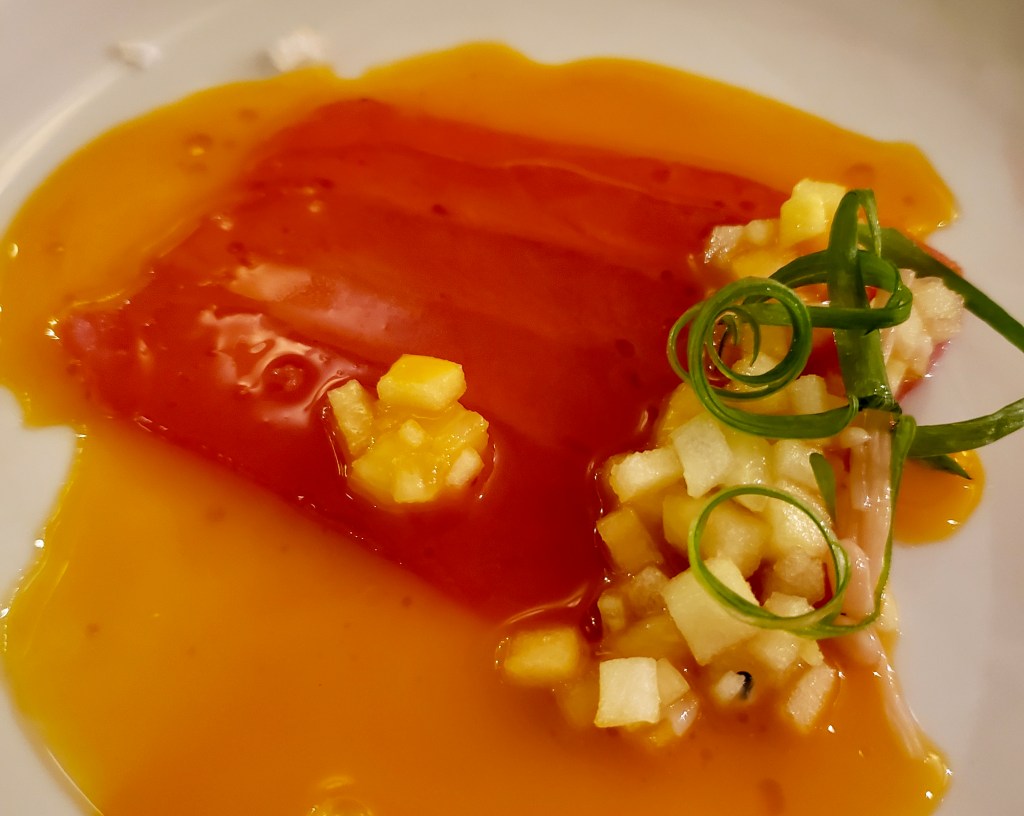
First course: Montauk Yellow Fin Tuna Cru, with sea buckthorn and pineapple ponzu. This was tender, bright, fresh, a menu highlight.
Second course: Seafood “Chowder,” with anisette, vermouth, black bass and clam. Probably our least-favorite course, it ate like a pudding and was cold by the time it was placed before us. Our server explained that we should dig into the bottom of the dish, where a single clam and a wedge of black sea bass awaited. The flavor surprisingly leaned to sweet rather than savory. Had it been served hot, it could’ve had the comforting effect of a congee or warm porridge.
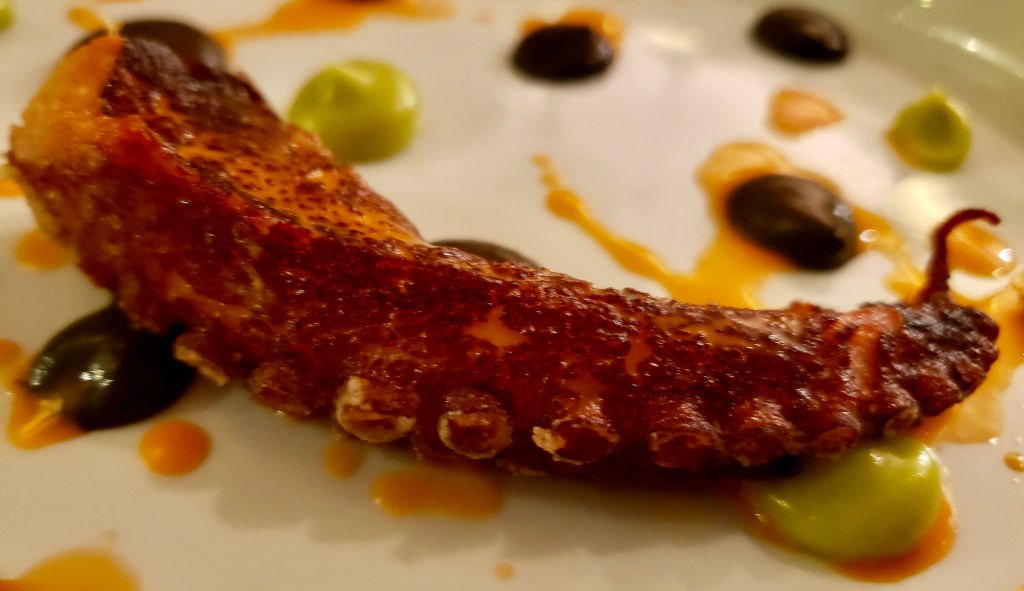
Third course: Charred Octopus a la Plancha, with dollops of black sesame, avocado and blood orange. Another menu highlight, the octopus was tender and paired well with the avocado, in particular.
Fourth course: Duck Tortellini in a beet, lemongrass and kaffir lime sauce. Delicate and delicious! The only criticism of this dish is that the sauce was so yummy, after the pasta was gone, there was nothing to soak it up.
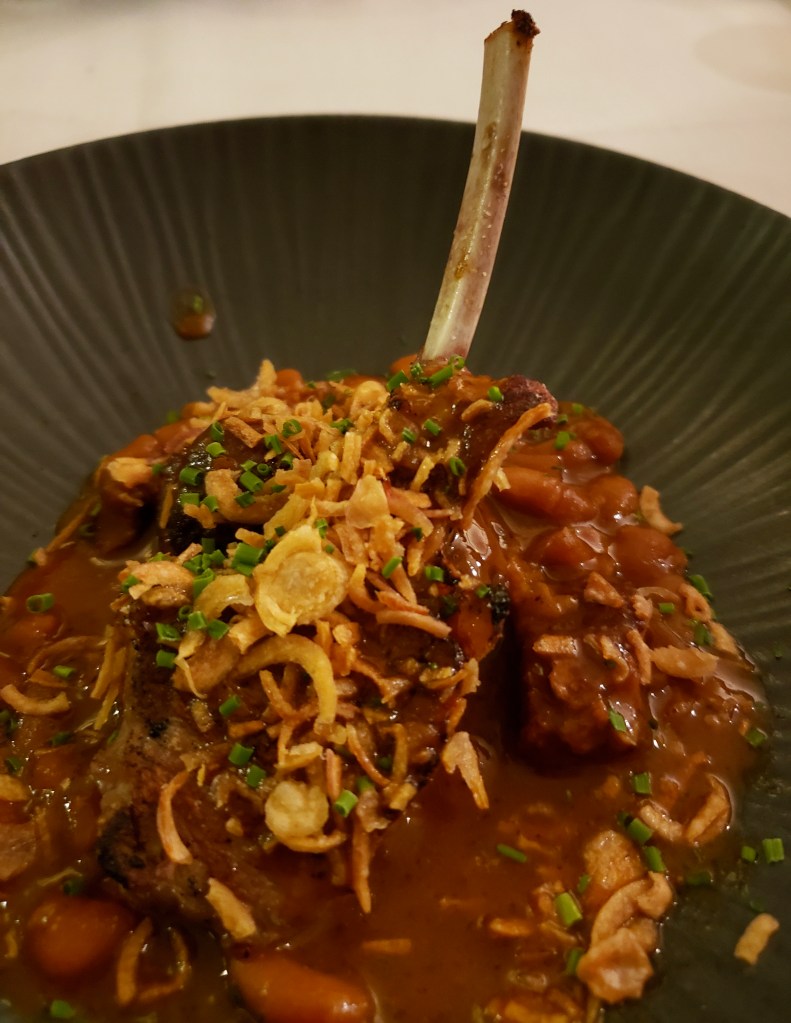
Fifth course: Lamb, with pork cassoulet, truffle and sauce périgourdine. I love a cassoulet — the very best version of “pork and beans,” in my book. This was a splendid version, with a tiny sausage, a melt-in-your-mouth chunk of pork, plus tender white beans slow-simmered in the sauce. It almost didn’t need the lollipop lamb chop, though the chop added to the dish’s height and texture for presentation.
Pre-dessert: Poached pear and sassafras sorbet.
Dessert: Flexi Ganache, with black cardamom and tarragon. This S-shaped chocolate ganache was served on a bed of chocolate sauce, with more powdered chocolate and white-chocolate (?) dots, sprinkled for color. Ours came with candles and a happy birthday song. We were the third table to celebrate December birthdays.
Post-dessert: We’d had plenty of sweets by then, but the server delivered four more bite-sized morsels to seal the meal, a sour patch-like tart fruit cube and a tiny take on toasted s’mores for each of us.
The standouts, we agreed, were the charred octopus, the tuna cru and the duck tortellini. In fact, I thought everything was delicious, if in teasingly small proportion. But my husband found the “seafood chowder” to be particularly distasteful — the flavor, consistency and cold serving temperature.
Though the chef came out from the kitchen and visited with other guests, he bypassed our table, so we didn’t have the pleasure of speaking with him about the menu or our experience. We would have expressed praises for our server, Peter, who was especially attentive and cheeky-fun.
As we finished our meal and drinks, we took notice of diners around us who’d ordered from the three-course menu. We coveted their simple green salads, warm bread and butter. The chef’s menu could’ve used one less wow dish (my husband would vote to nix the chowder) in favor of these simple pleasures. Overall, it was a pleasing experience. We didn’t leave feeling hungry nor stuffed, and we could name at least a few dishes that we relished and will remember.
The Essex is located at 247 Main Street in Old Saybrook, Connecticut.
In the latest installment of E&P’s “Reporting On” series, we look at the environment beat, with particular interest in reporting on communities impacted by pollution and contamination.
This was a particularly personal assignment for me, having grown up in a town with a notorious Superfund site not far from my childhood home. It was likely a contributor to lifelong health problems for our family and for so many others in our community. Today, nearly six decades after the malfeasance that contaminated the site — and despite EPA intervention and remediation efforts — the land remains contaminated by military-grade Vietnam-era defoliants (just one category of “forever chemicals.”). Not long ago, it was sold to a developer who built housing on it.
Reporting on these public health and safety dangers is critical journalism. At the link, I speak with two reporters — Halle Parker at NPR affiliate WWNO in New Orleans and Alex Rozier at Mississippi Today — about the importance and challenges of environmental storytelling.
In yet another installment of how the political press is silly, one right-leaning outlet leveraged FOIA to discover that the vice president—now candidate for the presidency—hadn’t included a teenage summer job at McDonald’s on job applications. The scandal! Stipulating that this is common practice in résumé tailoring, it nonetheless got me thinking about my first official summer job, for which I needed to get a work permit because I was just 15.
I wanted independence from my parents, to make my own money. I “applied” at a family-owned farm just down the road from our house. The owner, Denise, didn’t ask for any printed résumé. The interview went something like this:
Denise: Can you get up early in the morning?
Me: Yes. (But actually thinking, maybe.)
Denise: You don’t mind long hours? You’re not a complainer, are ya?
Me: I’m used to picking vegetables and being in the fields. (It was true. We’d lived in a rented brick ranch back then, which sat on farmland that was slowly being developed for housing. The landlord discounted the rent if we tended to the fields and he got his take of the harvest. We grew tomatoes, squash, corn, green beans, you name it. Here I am with one of my prize zucchinis.)
Denise: No back problems?
Me: No.
Denise: You’re hired. Can you start today?
My parents liked the idea of manual labor and how it kept me busy and out of trouble. And that it did. At dawn, I’d walk the half-mile to work, carrying a brown bag lunch. To beat the heat, Farmer Denise had us in the fields early. By us, I mean me and about a dozen or so farm hands who drove the flatbed trucks, and Spanish-speaking migrant workers who picked, like me.
Most of the season, we were tasked with picking tomatoes. You’d have to grab them off the vine at just the right time, when they were newly ripe and hadn’t yet split nor spoiled. We’d fill half-bushel baskets with tomatoes and then walk them back to the flatbed trucks parked at the end of our rows. We were paid a penny per tomato. Denise would inspect every single one at the end of the day, and toss aside any unsuited for market.
We picked rain or shine and in temperatures that soared into the 90s most days that summer. My skin browned; my muscles ached. The migrant workers laughed at me when I’d stand and stretch and moan from all the squatting and bending over. They were so much faster at picking those tomatoes. I always had the need to excel, but in this, I felt like an underachiever.
At lunchtime, we’d pile onto one of the trucks, to be carted back to the main barn, where we could eat our sack lunches in the shade. I sat alone and ate my white-bread sandwiches, coveting the homemade delicacies the others shared over spirited conversations.
At the end of the day, I’d walk back home, filthy and exhausted—and if it was a good-pickin’ day, $15 cash my pocket. I thought about my fellow workers and how for me, that money was to be spent on frivolity—a new pair of jeans, some lip gloss, the latest LP I had to have. For them, it was livelihood. I couldn’t help but wonder how they paid for housing, food, clothing and other necessities on those wages. And yet, they never seemed to complain.
Just when I thought I’d mastered the job, tomato season gave way to pumpkin season, and I got a dose of true backbreaking labor. Pumpkins don’t seem heavy individually, but when you pick about 150 of them and walk each of them down the long row to the truck, in crippling heat, you come to hate the sight of those orange gourds and relish smashing them.
Naturally, the job taught me a lot—the value of money, the feeling of hard labor, the determination and hardships of migrant workers, the relentless demands of a discerning boss, and so much more. Even still, when I went to apply for jobs post-college, farm worker wasn’t on my résumé.
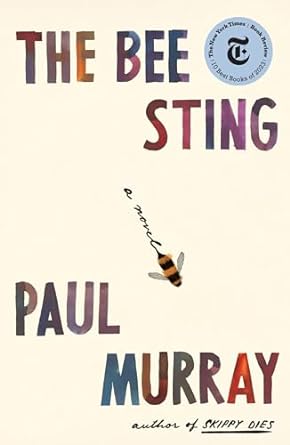
Paul Murray’s The Bee Sting is the most compelling work of fiction I’ve read in years. It’s a tale about a contemporary Irish family, told through each of its four members’ perspectives—father, mother, daughter and son. Murray’s use of first-person narrative, sentence structure and punctuation (or lack thereof) ensures each voice is distinctive.
Though the story unfolds over more than 600 pages, for the reader, there’s never a sense that even a paragraph is ancillary or unnecessary. It’s a story that conveys raw human emotions: grief, fear, disappointment, yearning, joy, duty and desire.
Murray cleverly, almost stealthily, explores some grand themes, such as one’s desire to be purely authentic, while the forces of life and societal conventions push back. He expertly captures how the past imprints on a person. Hardship, envy, violence, poverty, happiness, fleeting moments of awe, passion—memories that bind to us like DNA strands.
The author keenly explores the friction of a life that doesn’t follow the path you’ve plotted. Does it ever?
If you’re looking for a book that sucks you in and holds you captive until the final sentencee, this is that book.
Block Island is just off the coast of Rhode Island, accessible by ferries that leave from New London, Connecticut and Point Judith, Rhode Island.
The island only has approximately 1,400 residents, but it’s a popular day-trip, weekend or vacation destination for visitors.
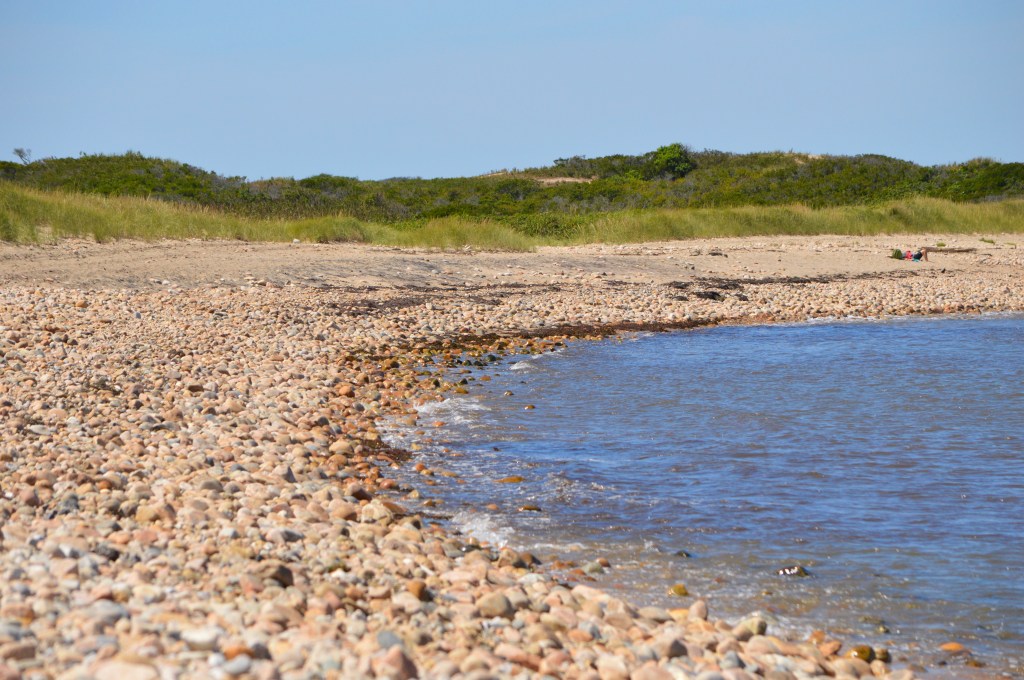
The island has both sandy and pebble beaches, accessible and free.
Beginner surfers catch waves on the main public beach.
There are two lighthouses — one you can tour and another that’s popular with photographers.
The island can be quite crowded during the summer season. But it’s also a wonderfully romantic destination for off-season visitors. One of my favorite trips to the island was New Year’s Eve one year. There were only a handful of tourists. Locals all descended on a local bar, Yellow Kittens, to ring in the New Year, and the next morning, they all gathered on the beach for an annual Polar Bear Plunge and bonfire.
Block Island homes derive nearly 100% of their energy from offshore wind. There are five windmills off its coast, which have become another popular tourist attraction. Chartered boats take you up close and personal with the wind turbines. It’s a great way to get a feel for their massive scale.
The ferries are the most popular way to get to the island, but if you’d like a special voyage, take a small-craft plane out of Westerly, Rhode Island’s airport. It’s a 12-minute flight on a plane that holds about eight passengers and their luggage.
The plane is no frills. There are no drink carts, no extra leg-room seats, and no air conditioning. On this flight, during a particularly hot day, our pilot asked, “Would you like me to turn on the air conditioning?” The passengers all chimed in together with a resounding, “Yes.” Little did we know that the “AC” meant she put her cockpit window down and used the palm of her hand to direct a breeze back into the cabin.
As with many other states today, Vermont is contending with a new cannabis economy. It has opened up a wellspring of opportunity for new businesses (dispensaries, growers and other cannabis-focused commercial organizations), associations, and for the state government to allocate and invest new tax revenue.
Building on a legacy news brand that dates back a century, Vermont News & Media saw its own opportunity to create a cannabis title, “Green Mountain Vermont Cannabis News,” to inform the public about cannabis laws and regulations, new businesses and jobs, and how to enjoy wider access to locally grown products. They’ve taken a different approach to the publication than other cannabis titles, choosing to reflect the state’s craft-cannabis culture.
The host of NPR’s TED Radio Hour speaks about audio storytelling and a recent partnership with Columbia University Irving Medical Center
Often when I speak with people around the news world, I learn something new. Each interview offers me a fresh professional perspective on journalism, storytelling, audience and business models. My conversation with NPR’s Manoush Zomorodi did that and more.
Zomorodi is the esteemed and well-sourced host of NPR’s TED Radio Hour. She recently found a new way to “engage audience” by enlisting listeners in a cooperative study with Columbia University’s Irving Medical Center. The project began with Zomorodi’s personal reflection on how technology—a topic she often covers on her show—was impacting her energy level, her focus, and overall health.
She learned of a study that indicated that our sedentary lifestyles, exacerbated by the time we spend on digital devices, was profoundly harmful. But there was also good news. A little bit of “gentle movement” every 30 minutes could potentially offset the harm. She wanted to test the theory, and so the partnership with Columbia’s scientists did just that.
At the link, read about my conversation with Zomorodi for Editor & Publisher. Professionally, she taught me a new way to “engage audience,” quite literally, but her work also changed the way I approach my own health. In news speak, it was impactful.