Gretchen A. Peck's writing has been featured in more than 50 domestic and international publications, including translations to Spanish, Portuguese, German, and French. She has written about communications, media, and advertising; politics and public policy; rhetoric, writing, and journalism; sustainability and food-chain matters; travel and culture; dance and fine arts; legal, and other consumer-interest topics.
Her decades-long reporting on journalism and news, publishing, printing, and graphic arts has appeared in dozens of industry trade periodicals and journals, including Editor & Publisher magazine; BookTech/Book Business magazine; Publishing Executive magazine; Business Tech Edge; Dealer Communicator; Digital Output and Digital Publishing Solutions magazines; In-Plant Graphics magazine; WhatTheyThink.com, Newspapers & Technology; CREATE Magazine; Internet Publishing; Catalog Success; Artes Graficas; HOW Magazine; The Seybold Report; IPA Bulletin; Graph Expo Show Guide; American Printer; Layers Magazine; Xerox's realbusiness magazine, Broad Street Magazine, Business Ledger, and more. She "tweets" about news and publishing @GretchenAPeck.
“This is an area where more boards of directors than ever are looking for continued updates, not just on the state of the law and the state of enforcement policy, but what it all means in terms of their own companies’ practices. … This is complicated stuff.” — Camille Olson, partner, Seyfarth Shaw LLP
E&P’s August 2025 Cover Story: Experts weigh in on how DEI can survive and evolve in today’s volatile media and legal landscape
Quick Read: The Houston Chronicle investigative team—double the size it was just a year ago—digs deep into the questions that matter most to Houstonians
E&P started a series a couple of years ago, which we call “J-school profiles.” To create a bridge between the next-generation of aspiring journalists and E&P’s readers — many of whom hail from C-suite offices at news organizations small to massive — we began to write about journalism schools across the country. We wanted to know how curricula is changing as technology and journalism itself evolve, and how young people coming into the profession see their future roles.
Often, during those conversations with faculty and students, the topic of journalism’s “impact” came up. Many of those young people spoke about being compelled to pursue journalism because they wanted to do work that is meaningful, that inspires change, that has real, measurable value. In speaking with deans and professors, they often echoed hearing this from their students — the desire to be impactful. And yet, some of those educators also spoke from a place of concern, noting the important distinction between pursuing stories that may ultimately have impact and being an advocate for a particular community or cause.
It left me wondering: At what point does creating impactful journalism cross over into the realm of advocacy? And what are the ethical implications? The answer, it would seem, isn’t clear-cut, but I’d argue it’s still a discussion worth having. So, I asked three experts about their takes on advocacy versus journalism. Here’s what they had to say:
Looking back over four decades I’ve spent in publishing, I have found that the most successful newsrooms I’ve worked in or consulted for have had a cooperative organizational culture. It’s typical for editors to lead daily or weekly newsroom staff meetings to discuss reporting projects in the works, accomplishments and obstacles to work around. But what I’ve observed is the benefit of broader team cooperation, too.
In one newsroom where I served as the editor, I regularly brought together not only the newsroom team, but also periodically welcomed the publisher and members of the staff representing production, marketing, IT, audience, data and art/creative to join us. While traditionally these roles are distinguished and separate, it became apparent to me early in my career that they are each a critical gear in the publishing machine. They literally have to work in tandem to make the engine run. Routine interaction allowed for every member of the team to have a voice and an opportunity to express their observations, challenges and ideas. They felt valued and empowered.
That’s not just a feel-good byproduct, it had practical benefits, too. Together, we created great things—compelling brand messaging, newsletter and special supplements, interactive storytelling, fresh design for our covers and pages, powerful impact reports, and live events, including three conferences that brought together thousands of attendees. It strengthened our magazine’s brand and galvanized our team.
If you are operating as silos, you’re missing opportunities for innovation—and, in this climate, growth and the potential for long-term sustainability.
My husband and I celebrate our birthdays each year not with the exchange of gifts but with a special dinner out — typically at a restaurant we otherwise wouldn’t frequent on the daily. If the place has a chef’s tasting menu, we tend to gravitate to that.
Over the years, we’ve had some truly exceptional tasting experiences, and some that were so disappointing they ventured toward the realm of absurd. In Philadelphia many years ago, we chose Eric Ripert’s 10 Arts, where Top Chef-famous Jennifer Carroll was the executive chef at the time. It was a frou-frou place, in a beautiful old Philadelphia building, with high ceilings, thick moldings, heavy velvet draperies. Here, nouveau cuisine — coded language for tiny portions — reigned. There were perhaps six courses in all, all about a bite or two in size, none of which were particularly enticing or memorable. In fact, the only course I remember to this day was dessert — two tiny homemade marshmallows. Granted, this was before craft marshmallows became de rigueur, so credit to Chef Carroll, who was ahead of trend.
The server would present each plate with such flourish, but each time she’d leave, we’d lean in and whisper to one another. “Are we being punked?”
“Are there hidden cameras here? Is Allen Funt going to jump out from behind one of these beautiful curtains and say, ‘Smile! You’re on Candid Camera!’”
You could’ve dined using tweezers rather than forks.
We paid the comically expensive tab and resisted complaining to the server. After all, it wasn’t her fault. On the way home, we stopped at a takeout place on North Broad Street and got dinner to go.
Conversely, we’ve had some incredible tasting menu experiences — at Chef Jose Garces’ Amada in Atlantic City and his now-shuttered Tinto in Philadelphia. You can never go wrong with the tasting menu at one of Chef Morimoto’s restaurants.
For a milestone anniversary we spent in Paris, we dined at a restaurant then called Vivant. The man who’d rented us an apartment for the week recommended it, proclaiming it to be one of Paris’ best-kept secrets, especially from the throngs of tourists. This locals-favorite spot delivered perhaps the best meal I’ve ever had in my life. Each plate was delicious, gratifying and paired with a different wine. We left sated, fat and a little drunk.
Not long ago, I dined with a colleague at Boqueria in New York City, a tapas chain with a generous tasting menu option. There were so many courses, we almost needed a second two-top table to hold all the dishes placed before us. We each had no trouble choosing a favorite — the brussels sprouts salad for her, the albondigas meatballs for me.
A successful tasting menu should strike a balance between variety and, frankly, volume. The diner should leave the table feeling exposed to new culinary adventures while also feeling comfortably full from the experience.
This year, my husband and I chose The Essex in Old Saybrook, Connecticut for our co-birthday celebration. It’s a French-inspired, seafood-forward restaurant and bar, with an impossibly small, open kitchen. If you dine at the chef’s table (we didn’t), you’re treated to personal interaction with Chef Colt Taylor, who describes each course. Sit anywhere in the restaurant, and you can hear and see the kitchen team work, like a live episode of The Bear, without the cursing.
“Fire two filets, table 3,” the chef barks at the cooks on proteins. “I need runners now,” he calls out to servers when dishes are expedited and presentable. You get a sense of the hustle it takes to run a fine-dining establishment.
At The Essex, there are two main dining options — a prix fixe three-course meal, plus an amuse, salad and oven-fresh bread. Diners can choose from a list of starters, about five entrées and several desserts. We opted for the chef’s tasting menu, with nine courses, starting with an amuse-bouche and concluding with a dessert. The restaurant also has an excellent selection of craft cocktails. We settled on an oak barrel-aged Manhattan and an Apricot by Surprise (a vodka-based martini).
On this occasion, the tasting menu featured:
Amuse course:
A tiny teacup of Rosemary & Bergamot Apple Tea: A warm and comforting greeting as we came in from the cold, rainy night.
Four canapes:
1. Two pickled mussels with vichysoisse chile oil. These were intriguing, but also a bit of a tease. There were only two on a bed of empty mussel shells.
Pickled mussels and a taste of The Essex Clam Chowder
2. Parsnip & Apple “Flan”, a bite-sized cube that ate like an eggy custard, despite there being no egg in the dish, our server explained.
Octopus fritters and Parsnip-and-apple “flan”
3. Crispy Octopus fritters, on a bed of subtly sweet plum sauce.
4. A half-thimble of “The Essex Clam Chowder.” Almost enough to give us an actual taste.
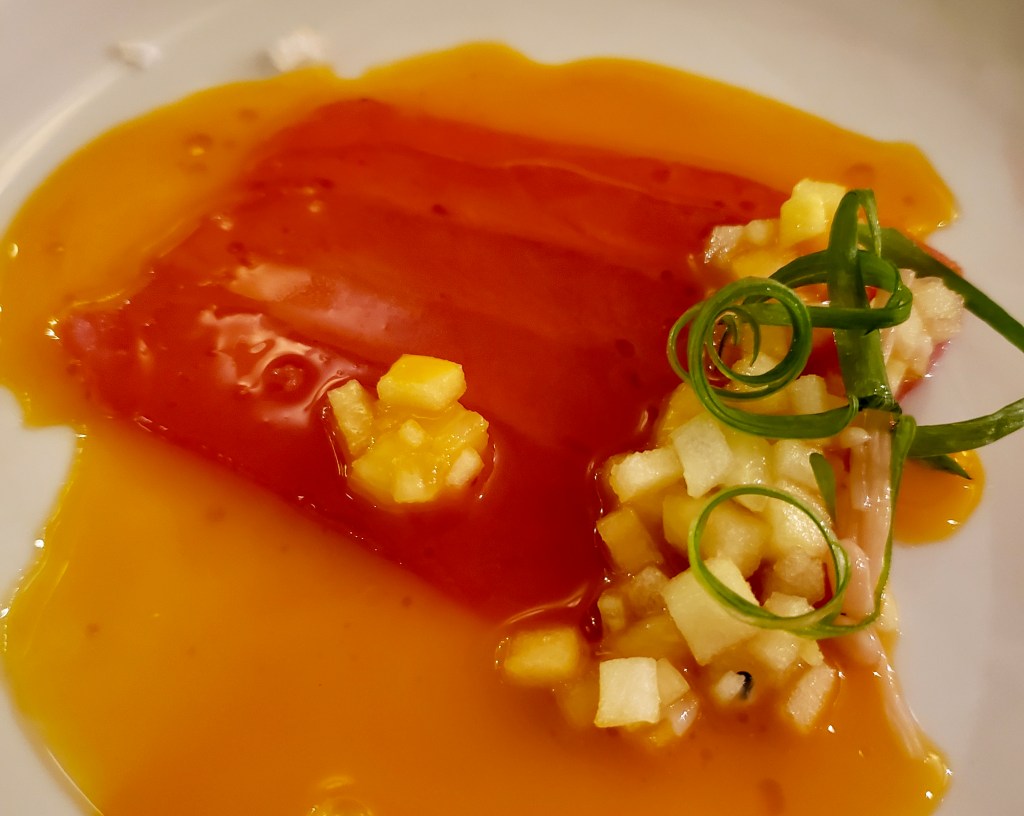
First course: Montauk Yellow Fin Tuna Cru, with sea buckthorn and pineapple ponzu. This was tender, bright, fresh, a menu highlight.
Second course: Seafood “Chowder,” with anisette, vermouth, black bass and clam. Probably our least-favorite course, it ate like a pudding and was cold by the time it was placed before us. Our server explained that we should dig into the bottom of the dish, where a single clam and a wedge of black sea bass awaited. The flavor surprisingly leaned to sweet rather than savory. Had it been served hot, it could’ve had the comforting effect of a congee or warm porridge.
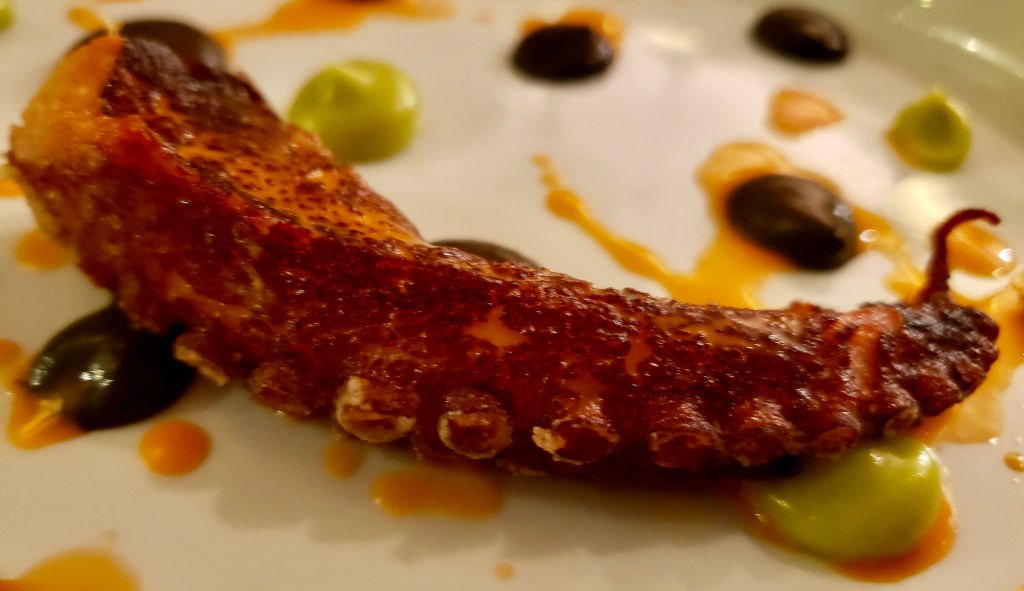
Third course: Charred Octopus a la Plancha, with dollops of black sesame, avocado and blood orange. Another menu highlight, the octopus was tender and paired well with the avocado, in particular.
Fourth course: Duck Tortellini in a beet, lemongrass and kaffir lime sauce. Delicate and delicious! The only criticism of this dish is that the sauce was so yummy, after the pasta was gone, there was nothing to soak it up.
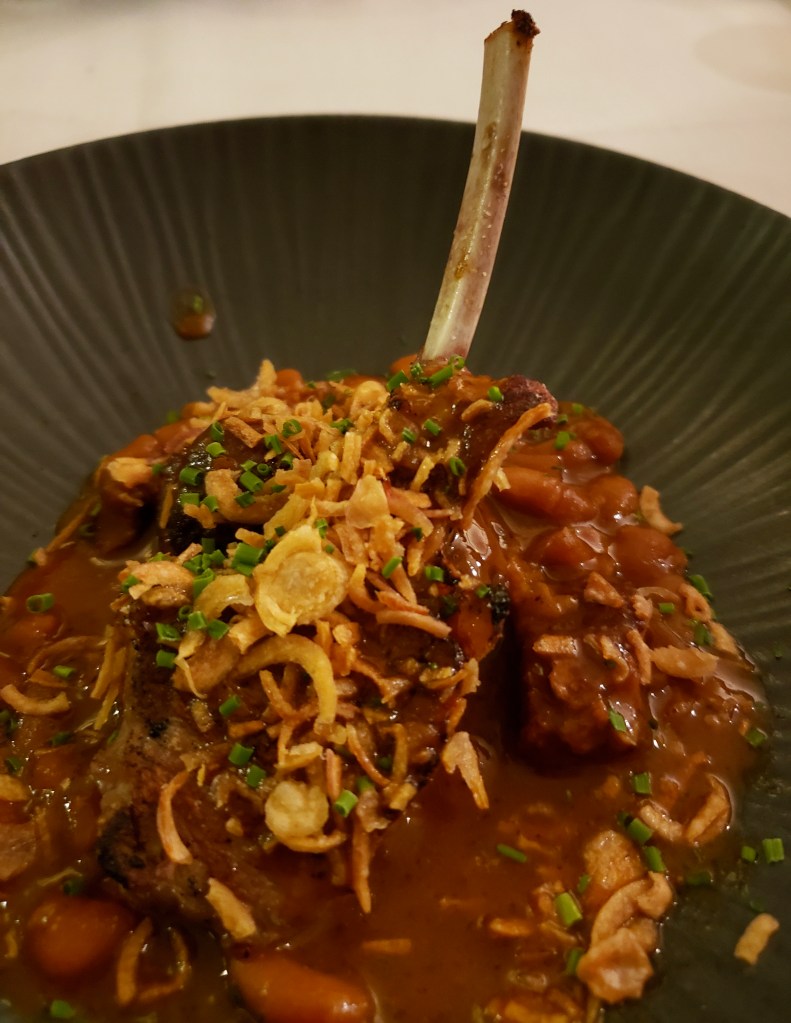
Fifth course: Lamb, with pork cassoulet, truffle and sauce périgourdine. I love a cassoulet — the very best version of “pork and beans,” in my book. This was a splendid version, with a tiny sausage, a melt-in-your-mouth chunk of pork, plus tender white beans slow-simmered in the sauce. It almost didn’t need the lollipop lamb chop, though the chop added to the dish’s height and texture for presentation.
Pre-dessert: Poached pear and sassafras sorbet.
Dessert: Flexi Ganache, with black cardamom and tarragon. This S-shaped chocolate ganache was served on a bed of chocolate sauce, with more powdered chocolate and white-chocolate (?) dots, sprinkled for color. Ours came with candles and a happy birthday song. We were the third table to celebrate December birthdays.
Post-dessert: We’d had plenty of sweets by then, but the server delivered four more bite-sized morsels to seal the meal, a sour patch-like tart fruit cube and a tiny take on toasted s’mores for each of us.
The standouts, we agreed, were the charred octopus, the tuna cru and the duck tortellini. In fact, I thought everything was delicious, if in teasingly small proportion. But my husband found the “seafood chowder” to be particularly distasteful — the flavor, consistency and cold serving temperature.
Though the chef came out from the kitchen and visited with other guests, he bypassed our table, so we didn’t have the pleasure of speaking with him about the menu or our experience. We would have expressed praises for our server, Peter, who was especially attentive and cheeky-fun.
As we finished our meal and drinks, we took notice of diners around us who’d ordered from the three-course menu. We coveted their simple green salads, warm bread and butter. The chef’s menu could’ve used one less wow dish (my husband would vote to nix the chowder) in favor of these simple pleasures. Overall, it was a pleasing experience. We didn’t leave feeling hungry nor stuffed, and we could name at least a few dishes that we relished and will remember.
The Essex is located at 247 Main Street in Old Saybrook, Connecticut.
In the latest installment of E&P’s “Reporting On” series, we look at the environment beat, with particular interest in reporting on communities impacted by pollution and contamination.
This was a particularly personal assignment for me, having grown up in a town with a notorious Superfund site not far from my childhood home. It was likely a contributor to lifelong health problems for our family and for so many others in our community. Today, nearly six decades after the malfeasance that contaminated the site — and despite EPA intervention and remediation efforts — the land remains contaminated by military-grade Vietnam-era defoliants (just one category of “forever chemicals.”). Not long ago, it was sold to a developer who built housing on it.
Reporting on these public health and safety dangers is critical journalism. At the link, I speak with two reporters — Halle Parker at NPR affiliate WWNO in New Orleans and Alex Rozier at Mississippi Today — about the importance and challenges of environmental storytelling.
I spend many of my days telling the stories of local newsrooms around the country doing exemplary work, serving their communities with practical information, uplifting perspectives — building community, as we say. Over the decades I’ve been on this “beat,” it’s been thoroughly rewarding work. Not only do I enjoy turning the spotlight on these storytellers, it’s fortified my long-standing belief that journalism is foundational to democracy. Without the First Amendment, nothing that becomes before or after it in the U.S. Constitution really matters. Without it, a nation spirals into autocracy, theocracy, despotism. Without it, corruption runs unbridled.
And I still believe this with every cell and synapse of my being.
But I’ve grown weary. The constant onslaught of anti-press rhetoric, endorsed by the highest offices in the land has admittedly weakened my resolve in recent years. The nation’s slide toward authoritarianism — our inability to even argue from a baseline of facts — is such a profound disappointment. At times, it makes me wonder if all the hard work of my colleagues in the media is worth it when it increasingly feels like screaming into a void.
I felt at the lowest point when I read the news that ABC News had settled a lawsuit brought by the President elect for comments made by anchor George Stephanopoulos during a “This Week” interview with Rep. Nancy Mace (R-SC). During the interview, the news anchor pressed Mace on her endorsement of the then candidate, considering Mace herself has spoken openly about being raped when she was a teenager. During his query, the anchor said that Donald J. Trump had been found liable for rape in the civil defamation suit E. Jean Carroll brought and won — with the jury awarding her $83.3 million.
Trump took issue with the word “rape” and filed suit against the network. Keep in mind that even the judge in the case described the initiating offense in this way: “The jury’s finding of sexual abuse therefore necessarily implies that it found that Mr. Trump forcibly penetrated her vagina.”
If forcibly penetrating a woman’s vagina – whether with a penis, an object or a hand — isn’t “rape,” then once again, it feels as if we’re not operating from a baseline of facts. It feels like arguing semantics in Atwood’s Gilead.
Before the case could advance further to the discovery phase, ABC News and George Stephanopoulos agreed to a settlement that required an escrowed $15 million to fund a future Donald J. Trump Presidential museum, another $1 million for Trump’s legal fees, and a public apology by the journalist – in other words, an admission of defamation.
Tim Miller and William Kristol — notably former Republicans — had a conversation about the perils of criticizing Trump. They wrote on thebulwark.com, “ABC News and George Stephanopoulos have joined the preemptive capitulation parade by settling Trump’s defamation suit—and by conspicuously paying out protection money ahead of the inauguration. The potential chilling effect on a key First Amendment issue is breathtaking.”
Northeastern Professor Dan Kennedy opined in his newsletter: “What Stephanopoulos said arguably wasn’t even false, and surely it didn’t amount to actual malice. A deep-pockets defendant like Disney ought to stand up for the First Amendment lest its cowardly capitulation to Trump harm other media outlets without the wherewithal to fight back.”
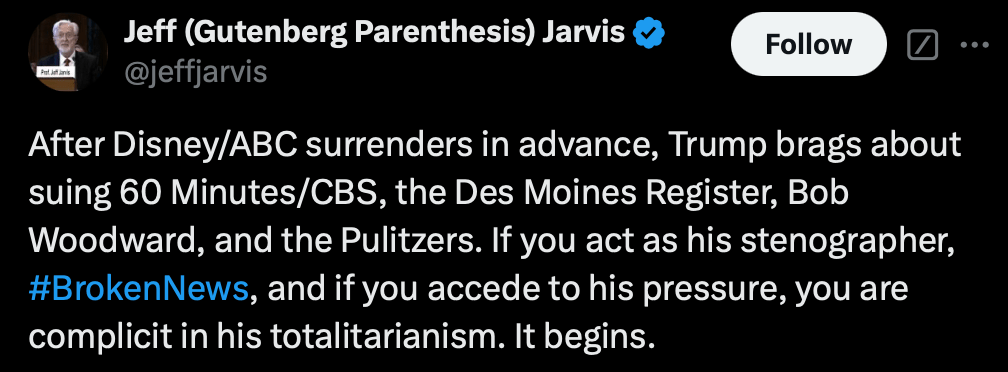
On Twitter/X, Jeff Jarvis, author and journalist, issued a warning:
Of course, none of us had a seat at the conference table surrounded by high-hourly-rate lawyers, so it’s purely speculation as to why the news media publisher agreed to settle. Some say the legal definition of rape in New York is a higher benchmark than this form of sexual assault. Others said the network didn’t want to be forced into protracted and expensive discovery, during which the President’s legal team could request all sorts of documentation, from producers’ correspondence to business strategy, personal calendars and diaries, footage from every show that mentioned Trump, social media posts, you name it.
Discovery is long and hard fought, typically with the Plaintiff asking for everything under the sun, and the Defendant having to go to court to argue against each non-related or protected journalist-source item.
Still others speculated that the $15 million settlement was such an insignificant amount for the parent organization, the Walt Disney Company, that it just made sense to pay it and get it over and done with. After all, an ongoing legal battle would’ve further impeded the network’s ability to gain access or fairly report on the incoming Administration. All of these reasons could simultaneously be true, too.
But the impact of the settlement has ripples — no, asphyxiating currents — that will reach far beyond the parties. It’s ammunition for a President and party that has continued to portray the press as “the enemy of the people.” It may not further embolden Trump himself to bring lawsuits against news outlets — he’s done that, usually unsuccessfully, for decades and long before he fatefully descended down the Trump Tower escalator to declare his first candidacy. And there’s no sign that he plans to slow down. Last week, he filed suit against the Gannett-owned Des Moines Register and pollster Ann Selzer over an unfavorable poll they published prior to election, alleging the poll — a poll, for goodness sakes — was akin to “election interference.”
But it will embolden others, particularly the political and powerful classes, to wield lawfare as a weapon to intimidate the press, to send a chill through the media, and in some cases, to kill off news outlets entirely — destroyed by the weight of defending protracted legal battles. Death by billable hour.
Atlanta Journal-Constitution Cartoonist Mike Luckovich so perfectly memorialized the settlement, shared on Twitter/X:
In E&P’s January issue, Columnist Rob Tornoe shares a conversation with Luckovich about being a political cartoonist in the era of Trump. You’ll want to read it.
And let’s be clear, lawfare is not just a threat to large media conglomerates. It oozes down to regional and local newsrooms, as well.
“I fear the federal attack on the press will trickle down locally, and it will be harder to get information through normal channels and freedom of the press requests,” Katie Honan, reporter for THE CITY, observed in Nieman Lab’s “Predictions for Journalism, 2025” series.
The other way it corrodes our profession is by signaling to journalists that your company, your superiors, may not have your back. They may, in fact, sell you out, make you pay, make you grovel. As a journalist there is little that’s more demoralizing than feeling as though your superiors would throw you under the bus rather than stand in solidarity with you.
Jonathan V. Last at The Bulwark wrote that “Disney has cut off ABC News at the knees and put everyone in its news division on notice that they will not be supported by corporate if they make enemies with Trump world.”
But I’m feeling a little better, a little stronger, more resolved for a couple of reasons. This Des Moines Register case is so petty, so meritless, it’ll surely be tossed out, right?
Right?
And I spent the past few weeks learning about the journalism program at the University of Oregon, where the curricula, the practical experiences and skills the students learn, and the remarkable faculty who guide them have sent some welcome breezes from the west to lift my wings. Asked about the aspirations and temperament of the new class of journalists coming into the profession, one member of the faculty described them generally as motivated, inspired, idealistic, energetic.
Elinor R. Tatum, publisher and editor-in-chief of New York Amsterdam News, exemplifies what it means to be E&P’s Publisher of the Year. For 30 years, she’s thoughtfully led the news organization through formidable challenges—the advent of the internet and digital media, greater competition for audience, uncertainty related to revenue, and most recently, the COVID pandemic era.
Tatum’s contribution far exceeds her work for the newspaper. She’s devoted her time and expertise to elevating other news media outlets and creating a sense of camaraderie so needed throughout the news media today. She’s a strategic risk taker and innovator—a change agent for the local news community, and especially the Black press.
And one of the many things I found to be so inspirational about Tatum as I wrote this month’s cover story was her long history of motivating, encouraging, empowering and challenging her staff, peers, all of us.
In late summer, I spoke with two journalists — Julian Borger, world affairs editor for The Guardian, and Nabih Bulos, who is the Los Angeles Times’ Middle East bureau chief — tasked with telling the story of the broadening war in Gaza. We spoke about the challenges of war coverage — about safety, working with local fixers and other journalists on the ground, about reporting on a region that it was nearly impossible to gain access to, and about the unpredictable nature of the work itself. For foreign correspondents, war means perpetual motion, a never-ending chase for anecdotes and atrocities, and meaningful context in sea of gray.
The only certainty, it seemed to me, was the volatility and the potential for the war to entrap or entice other nations and other terrorist groups to join the fight. And that’s precisely how it’s playing out. With just a few days of my discussions with Bulos and Borger, Hezbollah fired rockets into northern Israel.
Since, Israel retaliated by detonating pagers and mobile devices they believed to be in the hands of Hezbollah operatives. Iran-launched missiles rained down on Israel, and now the world holds its collective breath for Israel’s inevitable response to Iran’s assault. The one-year anniversary of the war passed.
The statistics I cited in the story are already obsolete. Since October 7, 2023, the war has now claimed the lives of 1,706 Israelis, 42,409 Palestinians, and 2,448 in Lebanon.
It is also one of the deadliest wars in the modern era for journalists. 128 have died. 40 have been wounded. At least 2 remain missing, according to the Committee to Protect Journalists. Please consider their sacrifices as you read this latest installment in our “Reporting On” series:















 Gretchen A. Peck