
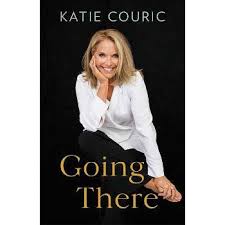
Katie Couric’s 2021 memoir is perfectly titled: Going There
It’s clever, because it relates to so many facets of her story—the places she went (physically and emotionally) over the course of her decades-long career in news; the torment of recalling profound loss and grief; or how she took a chance at love again.
Whether you’ve been a fan or a casual observer, Couric’s familiar voice comes through in the text.
Full disclosure, I once felt full-on fangirl when Couric retweeted me during the pandemic—both of us grateful for journalists who were covering “the front lines” of COVID.

As far as women in news go, Couric is legendary. And her memoir could’ve easily gone down a chest-thumping path, boasting of her myriad hard-news features and epic longevity on TV screens. Instead, there’s a raw, earnest quality to her retelling of the story that’s genuine and approachable, like Couric herself, as we come to see.
She shares with us what it was like to grieve her husband, her sister, her parents. She speaks honestly about loss, motherhood, exhaustion, but also about love, redemption and gratitude.
I’ve always felt the most effective memoirs are those that demonstrate a change and a maturation of the autobiographer: what you learn, who you come, what you overcome.
Life isn’t Instagram.
Going There is deeply introspective, particularly when Couric recounts her regrets and miscalculations along the way—missing signs that her beloved first-husband Jay was ill; unwisely choosing partners after his death; anecdotally putting career ahead of family; and a slew of professional missteps that make her (and us) cringe today.
Most of all, it’s a tome about journalism and TV news, from a woman’s point of view during a transformative time, spanning the age of overt misogyny and sexual misconduct to the post-#MeToo modern day.
Couric peels back the curtain on what it was like to navigate network politics, sexism and fierce competition, not just between the TV networks, but sometimes among your own network team. I’ll think about “60 Minutes”—a staple Sunday-night show in our home growing up—a little differently after learning how Couric was treated by the producers and fellow journalists.
Recently, in conversation with someone else in news, I used the term “working sources,” and I was met with silence on the other end of the line; then, a question: What do you mean by ‘working sources?’ More condemnation than question. And I explained what I feel it’s like to land an important interview, particularly with someone who may be initially reluctant to go on record, let alone on camera. I spoke of building trust, of having conversations, perhaps meeting in person, explaining my process, being fully transparent and honest—but, in effect, working to get the interview.
Couric gives us a no-holds-barred account of “working sources,” crediting her bookers and producers for contortionist-like moves to woo them. In the print world that I know, there are clearly defined ethics on such matters, and one of them is that we don’t accept gifts from them, and they shouldn’t expect from us in return. It seems TV news is a bit more cut-throat competitive, and that there are gray areas on such matters.
I (and I’m sure a lot of women readers) also appreciated how Couric spoke about trying to balance the two sides of her professional personality—serious, right-toned journalist versus the quirkier, fun, silly, sometimes smart-ass side of her personality. The TODAY Show gave her the perfect platform for that balancing act.
“Katherine or Katie, the serious journalist or the smiley cutup … the tension between those two sides of my nature would run like a fault line through my career,” she reflects.
Couric writes about Jeff Zucker and Matt Lauer, men with whom she’d had as close a professional relationship as you might have; both proved grave disappointments in the end.
Couric took a lot of heat when Going There first came out, particularly about her recounting of an interview with SCOTUS Justice Ruth Bader Ginsburg. Couric asked Justice Ginsburg about Colin Kaepernick’s protests. The Justice expressed how she found it disgraceful—not what you might expect from a liberal-leaning, First Amendment-affirming judge. Couric revealed how she wrestled with the editorial decision about whether to keep the exchange in the interview, or to cut it out. Critics decried that it was Couric’s duty to broadcast her remarks, that it was journalistic malpractice not to. She’s not objective, they said, citing Couric’s admission that she greatly admired Ginsburg.
But that’s journalism. You bring personal perspective to your reporting. How can you not? You are a person, a citizen, with lived experiences like anyone else. You learn things, and those things inform you as you move through life and, professionally, into others’ lives. These editorial dilemmas come up in nearly every interview or reporting assignment, especially in hard news and investigative journalism.
“I know I’m being fair when everybody’s mad at me,” Walter Kronkite once told Couric.
If all this sounds intriguing, I hope you’ll read the book, and check out Couric’s Instagram for more of her “smiley cutup” side.
 Gretchen A. Peck