News & Publishing, Politics & Public Policy, TV, Radio, Audio, Uncategorized

Nuzzi is not all of us

I cringed when I saw Jeremy Fassler’s headline for his Medium column this week, “The Olivia Nuzzi Scandal Is an Indictment of Journalism.” 

Nuzzi was placed on leave this week — and should lose her job — at “New York” magazine for an undisclosed personal relationship with presidential candidate Robert F. Kennedy, Jr., a controversial public figure she was assigned to report on. People have speculated about the degree of ethical breach, which Nuzzi contends did not veer into a physical relationship. She has been castigated and slut-shamed online, while Kennedy’s behavior has largely been brushed aside as de rigueur for the serial-philandering, vaccine-denying, dog-eating, dead-bear staging, whale head-sawing, brain worm-addled oddball he is. 

Make no mistake, Nuzzi’s behavior is a gross — and I mean that in every sense of the word — ethical breach. It reflects poorly on her, certainly, but it also stains the “New York” magazine brand. Nuzzi is just 31 years old and entitled to make journalistic mistakes that we all made in our young careers, but this one is beyond the pale. She should be fired, and she should have to rebuild her career and earn the trust of the public before given another megaphone — print, broadcast or otherwise. 

But this is hardly a condemnation of journalism, as Fassler claims in his headline. The public and especially the news media itself needs to get away from these broad, sweeping condemnations. Look at the sins of David Pecker’s tabloid empire and its “catch and kill” practices. Imagine if every reporter at local papers and nonprofit news outlets around the country had to carry the weight of that on their shoulders. It’s patently out of context and unfair. 

If you read past the headline, what Fassler is getting at is Nuzzi’s case is — and should be — an indictment of access journalism. Access journalism is when journalists favorably report on their subjects and sources in order to be granted access to them, to gain insider insight, and to get scoops that elude other news outlets. 

wrote about access journalism in a 2021 “Editor & Publisher” magazine. 

Nuzzi is certainly a glaring example of a journalist who’s traded on access — and, I dare say, on her beauty. Across news media, we’ve had some of the most popular, visible and broadly followed journalists who can be accused of the same, even at the nation’s most prolific legacy institutions. It is a bane, no question, yet not a reflection of the whole. 

Nuzzi’s recent work has been “sus,” as the kids say, and Fassler gives a number of examples of that. Yet, controversy attracts eyeballs and audience — still the most coveted currency in today’s news business. And she (and others) have been rewarded for it. 

Still, to lump all journalists and media companies in with Nuzzi and those who enabled her along the way — even in a headline — does disservice to all the earnest, dedicated and toe-the-line reporters around the country. 

And it emboldens the “dishonest press” and “enemies of the people” rhetoric. Let’s stop that. 

News & Publishing, photography, Politics & Public Policy, TV, Radio, Audio

Watch “Print It Black” on Hulu

In the week that followed the horrific mass shooting at Robb Elementary in Uvalde, Texas, I was one of thousands of calls into the local newspaper, the Uvalde Leader-News. I was working on a story for E&P—part of the magazine’s “Reporting On” series—about journalists who have the daunting task of reporting mass shootings. 

On a few occasions that week, a member of the newsroom there would answer—audibly exhausted and grief-stricken, yet polite and professional—and take down my message for the owner-publisher Craig Garnett. I, of course, wanted to speak with him about my assignment, to learn in those still-raw moments what it takes for a newsroom to cover a story of this magnitude and tragedy. But so much more importantly, I wanted to express my sorrow, to let him and his entire newsroom know that we shared in their grief. After all, a member of our news community had been personally and profoundly impacted by this crime. ULN’s Crime Reporter Kimberly Mata-Rubio’s 10-year-old daughter, Lexi, was among the victims.

Despite an enormous weight on his shoulders, Garnett called me back a few days later, and generously, thoughtfully spoke about what his newsroom was going through. Through tears that seemed never-ending, I wrote the story

I’ve thought about that local paper—Garnett and the small, tight-knit staff—the Rubio family, and the community of Uvalde every day since.

I had the great honor to reconnect with Garnett last week, to talk about the ABC News documentary, “Print It Black,” now streaming on Hulu. It’s a difficult-to-watch yet important film that I implore everyone to see—a complex, nuanced and honest look at mass shootings in America, about life in a small town, about racism, poverty and classicism, and about a local newsroom rising to an occasion for which it never could prepare.

#Uvalde #LocalNews #RobbElementary #UvaldeLeaderNews #ABCNews #documentary

News & Publishing, Politics & Public Policy, TV, Radio, Audio

Producing a step-by-step FOIA guide

As FOIA director at @washingtonpost, Nate Jones is a government records specialist — expertise he gladly shares with other journalists and the public

#newsmedia #FOIA #illustration #journalism

https://www.editorandpublisher.com/stories/producing-a-step-by-step-guide-to-foia,250976

News & Publishing, Politics & Public Policy

Two of ProPublica’s Editors Talk About the Past, Present and Future for the Nonprofit News Leader

It’s hard for me to believe that nearly 20 years have passed since ProPublica first came on the news media scene. I immediately followed their work, because I believed in their mission and the void they were filling. Yet, I worried that the then-fledgling news outlet and the nonprofit model wouldn’t pan out. 

Thankfully, they flourished. 

We wanted to write about ProPublica now, in a year when its journalists earned a 7th Pulitzer Prize (added to a considerably long list of other awards) and has become an unquestionable leader in the industry — not just for the impactful journalism their newsroom produces, but for the way in which they’re enabling other newsrooms around the country to excel in their own accountability work through partnerships. 

I spoke with two of the editors who’ve been there since the beginning — about what it was like to stake their careers on the new nonprofit; how the newsroom has evolved; and what keeps them motivated all these years in. At the link, hear from Charles Ornstein, ProPublica’s managing editor, local, and Editor-in-Chief Stephen Engelberg. 

https://www.editorandpublisher.com/stories/ethical-exposs-and-pulitzer-prizes-propublicas-impactful-journey-in-investigative-journalism,250361

News & Publishing, TV, Radio, Audio

TV and Radio Broadcasters Launch Hyperlocal Digital and Streaming News Services

I’ve long appreciated the concept of hyperlocal news. What better way to make communities and neighborhoods feel seen and heard than to cover the news expressly for them and about them? We’ve seen news outlets like Block Club Chicago and Trib Total Media have rousing success taking a street-level neighborhood approach to news. 

I was pleasantly surprised when E&P’s Robin Blinder and Mike Blinder returned from Borrell Miami this spring with a new story in hand about hyperlocal news—TV and radio broadcasters leveraging their brands and trustful audiences to launch hyperlocal digital sites and streaming services. So, I followed up with Gordon Borrell to get his take on why hyperlocal news was seeing a renaissance of sorts and followed up with three media executives in the throes of starting up new hyperlocal media properties. Here are their stories: 

#communitynews #hyperlocalnews #TV #Radio #Streaming #digitalmedia

https://www.editorandpublisher.com/stories/from-news-deserts-to-digital-havens-the-rise-of-hyperlocal-journalism,250359

News & Publishing, Politics & Public Policy, Printing and Imaging

Talking newspapers with Kelsey Russell

This ranks as one of the most fun and fascinating conversations I’ve had this year about the power of the printed newspaper and media literacy.

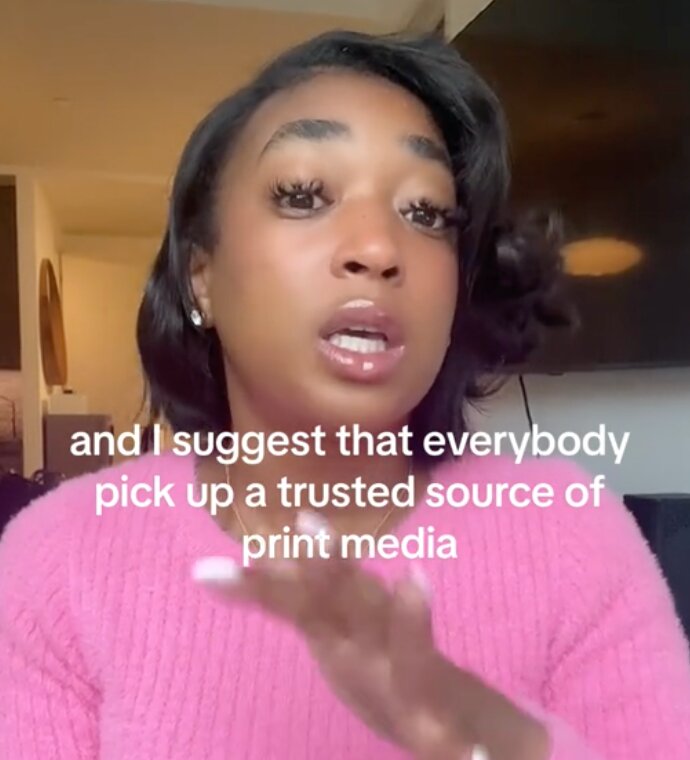
Meet TikTok’s “Print Princess,” Kelsey Russell, who leverages the platform to introduce her audience to news of the day; how to be critical about what they read; and how print can give us a break from screen time, as well as help us more meaningfully consider and retain information.

https://www.editorandpublisher.com/stories/meet-the-print-princess-tiktok-personality-kelsey-russell-uses-social-media-to-spark-critical,250283

News & Publishing, Politics & Public Policy

The New York Times assembles a trust team

Among our news community, we frequently talk about “trust in news” and how it has eroded to dangerous levels. I’d suggest there are myriad reasons for that, including some that date back centuries. The press has always been a convenient punching bag. When people don’t like what they read, they naturally want to discount the information. 

Some of the phenomenon is patently new, as we’ve seen with the increase in “lawfare” suits designed to chill journalists and shutter news organizations outright. There’s also the toxic political rhetoric, even shouted from the highest offices in the land, expressly to make people doubt watchdog and accountability reporting. 

Now, we’re contending with Artificial Intelligence (AI), too, which is training people to doubt what they read and view.

Some of it is well-deserved. The press doesn’t always get the story right, especially in the rush to report first. Quality journalists among the American media are contrite when it happens, acknowledging their mistakes and offering corrections or retractions. Far too many outlets masquerading as trusted sources of news peddle misinformation and never acknowledge their failures to report accurately. That’s harmful, industry-wide.

I’d suggest the public also has a cynical view of how news is gathered and produced when they hear about strategic misdeeds, such as tabloid-style “catch and kill” stories — for example, when an adult film actress’ story about an affair with a politician never sees the light of day because the publisher and the porn star are paid to suppress it. It’s easy for the public to conflate that kind of “news” with what earnest, professional journalists produce day-in, day-out. 

Indeed, there are many reasons — deserved and not — for the lack of trust in news today, but the important thing is that we’re thinking about it as an existential threat and doing our best to counter it. That’s why I’m bullish on The New York Times decision to convene a “trust team” that’s keenly focused on this issue. 

At the link, read about my conversation with Edmund Lee, editor of The Times’ trust team and one of the ways they’ve built more transparency and familiarity into the display of news.

#newsmedia #journalism #TheNewYorkTimes

News & Publishing, Politics & Public Policy

Behind the scenes of Pulitzer-awarded reporting

Ever wonder what it takes to produce Pulitzer Prize-winning journalism? I spoke with reporters and editors at three newsrooms that were awarded Pulitzers earlier this month. They spoke about the inspiration behind their award-winning series; the labors and resources the projects required; the dilemmas they faced during the news gathering; and ultimately, the impact. 


Read the “stories behind the stories” at the link.  Congratulations to all of this year’s Pulitzer winners. https://www.editorandpublisher.com/stories/pulitzer-story,249969

News & Publishing

Artificial Intelligence is stealthily altering how news is made and how the public finds information

Artificial Intelligence (AI) shows a lot of productivity promise for news publishers, but in its early iterations, AI is also proving to be perilous. E&P has been covering AI developments frequently, and this month we look at how Generative AI is changing the way people search for and retrieve information from AI-enabled search engines.

For the user, a query to an AI-enabled search engine may provide a thorough responses that satisfies their question. The risk remains that those response summaries may be flawed with fallacies, depending on how the AI engine was trained. 

The other concern for news publishers is how users behave based on the search response. They may be satisfied with the result and sated, and resist scrolling down for additional search results and links to other sources, including news articles. That should trouble any news media business that relies on a healthy influx of web traffic and has for years invested in improving SEO performance. 

We invited no less than 30 publishers about how they’re preparing for AI-search disruption. Some spoke on background; others opted not to comment at all, citing an uncertainty about what to do. There’s no shame in that. AI is new and developing at lightning speed, and we’re all just trying to figure out where this path is leading. But a few publishers are ahead of the curve and implementing new ways to nurture more direct relationships with readers/viewers/listeners, thereby relying less on search traffic. We tell two of their stories at the link: 

https://www.editorandpublisher.com/stories/artificial-intelligence-is-stealthily-altering-how-news-is-made-and-how-the-public-finds,249473

Food, Travel, Culture, News & Publishing, Politics & Public Policy

Exploring Vermont’s new(ish) cannabis economy

As with many other states today, Vermont is contending with a new cannabis economy. It has opened up a wellspring of opportunity for new businesses (dispensaries, growers and other cannabis-focused commercial organizations), associations, and for the state government to allocate and invest new tax revenue. 

Building on a legacy news brand that dates back a century, Vermont News & Media saw its own opportunity to create a cannabis title, “Green Mountain Vermont Cannabis News,” to inform the public about cannabis laws and regulations, new businesses and jobs, and how to enjoy wider access to locally grown products. They’ve taken a different approach to the publication than other cannabis titles, choosing to reflect the state’s craft-cannabis culture. 

Read on at the link: