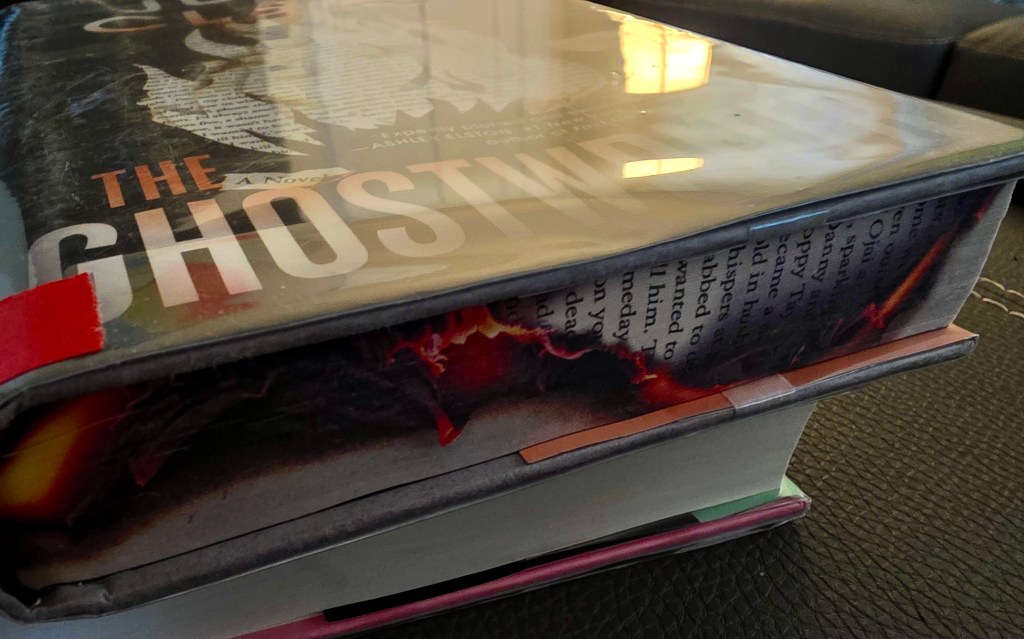
Love the printing on the book block’s trimmed edges. Grabbed my eye from the new-book shelves at the library. It’s “The Ghostwriter” by Julie Clark.


Writer. Editor. Photographer.
Love the printing on the book block’s trimmed edges. Grabbed my eye from the new-book shelves at the library. It’s “The Ghostwriter” by Julie Clark.
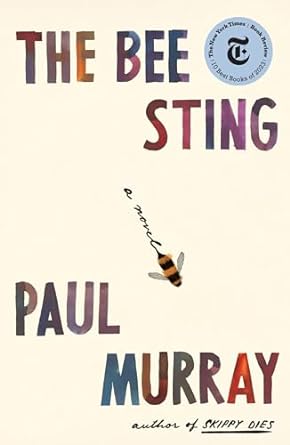
Paul Murray’s The Bee Sting is the most compelling work of fiction I’ve read in years. It’s a tale about a contemporary Irish family, told through each of its four members’ perspectives—father, mother, daughter and son. Murray’s use of first-person narrative, sentence structure and punctuation (or lack thereof) ensures each voice is distinctive.
Though the story unfolds over more than 600 pages, for the reader, there’s never a sense that even a paragraph is ancillary or unnecessary. It’s a story that conveys raw human emotions: grief, fear, disappointment, yearning, joy, duty and desire.
Murray cleverly, almost stealthily, explores some grand themes, such as one’s desire to be purely authentic, while the forces of life and societal conventions push back. He expertly captures how the past imprints on a person. Hardship, envy, violence, poverty, happiness, fleeting moments of awe, passion—memories that bind to us like DNA strands.
The author keenly explores the friction of a life that doesn’t follow the path you’ve plotted. Does it ever?
If you’re looking for a book that sucks you in and holds you captive until the final sentencee, this is that book.

I preordered Rebel Girl: My Life as a Feminist Punk by Kathleen Hanna. I felt it mandatory reading. I’d listened to the band(s) back in the day. I was fascinated by the lore and that Kathleen married my second favorite Beastie Boy. I wanted the backstory on it all, especially what it was like to be a woman in a band in the midst of a nearly all-male punk moment. I certainly knew what it was like to be a woman in the clubs, basements and warehouse shows where women were relegated to the perimeters by virtue of slamming male bodies and fear of being trampled or groped.
What I didn’t know to expect was the constant struggle, the poverty, the family dysfunction, the sexual abuse, the rapes, the violence, the loneliness, despair, the anger and hatred (especially from other women), which Hanna reveals in bite-sized chapter chunks. Sometimes it’s all you can swallow before snapping the cover shut and trying to process it, wondering how the author ever did.
Did she?
Can you?
It’s a question I ask myself all the time. Do we actually heal? Or do we just learn to be temporarily okay in the moment and then string those moments together to make a day, a week, a year, a decade, a lifetime?

Hanna’s storytelling kept me captivated. I read the book in two days. After all, it’s what a memoir should be — raw, candid, honest and deeply introspective.
 Gretchen A. Peck