News & Publishing

Preparing for 2020: News Organizations Ramp Up for an Election Cycle Certain to be Dynamic, Fast-Paced and Combative

By Gretchen A. Peck

In the wake of the 2016 presidential election, the press received some rather harsh criticism about its national coverage. Type in “press failures of 2016,” and Google will unkindly deliver a long list of critical analysis about the media and how it handled the Trump vs. Clinton battle for the White House.

Disillusioned voters blamed the press for a failure to present Trump as a viable nominee, let alone as their likely future president. Some declared that journalists missed the story of the Trump voter entirely.

That type of criticism—that the press had missed the Trump story—wasn’t entirely fair, according to Peter Wallsten, senior politics editor at the Washington Post.

Read more at:

https://www.editorandpublisher.com/feature/preparing-for-2020-news-organizations-ramp-up-for-an-election-cycle-certain-to-be-dynamic-fast-paced-and-combative/


News & Publishing

In Turbulent Media Climate, National and State Press Associations Continue to Serve as Advocates and Educators for Their Members

By Gretchen A. Peck

The business of newspapers is no longer competitive. While most towns may still have a local community newspaper, very few have two. Now, the culture is more collaborative, with publishers willing to work together, and share both their challenges and successes with one another.

Bringing them together are national and state press associations. They’ve felt the same struggles as their members, but they are proving to be invaluable allies in the quest to overcome them.

Read more at Editor & Publisher magazine:

https://www.editorandpublisher.com/feature/in-turbulent-media-climate-national-and-state-press-associations-continue-to-serve-as-advocates-and-educators-for-their-members/


News & Publishing, Politics & Public Policy

Thank you, Jason Rezaian

Will you read Jason Rezaian’s new book, Prisoner?

I really enjoyed this presentation — the chat with Ignatius, but also the beautifully produced documentary that introduced the Q&A. It is a must-watch if you’re at all interested in journalism, yes, but also diplomacy, negotiation, culture, international chess play.

The graphic showing all the moving parts of a three-hour window of opportunity perfectly illustrates a diplomatic nail biter.

To see again the photo of Jason kissing the tarmac, free after 544 of “detention,” is like a gut punch we all need — a reminder of how special our nation is, and how precious and fundamentally critical the First Amendment is. It’s both law and moral guidepost.

Watching the backstory told in the intro, you’ll see the remarkable cooperation between State and 4th Estate. It’s not just an example of logistical coordination; it demonstrated a resolve at the highest Office that our nation wouldn’t “leave one of its own behind.” The Administration and State Department fought for its son, while also waging a cultural (internationally watched) battle against the oppression of free speech in Iran.

This is in stark contrast to the current Administration’s reaction to and abject dismissal of Saudi Arabia’s assassination of Washington Post columnist Jamal Khashoggi.

Anyway, check it out.


News & Publishing

How Encrypted Mobile Messaging Apps Are Helping Journalists Protect and Guard Sources and Their Information

By Gretchen A. Peck

For many of their users, mobile messaging apps are just expedient little tools for texting and sharing photos or videos with friends who use the same app. The fact that those messages and content are encrypted is just an added a perk. But for journalists and their sources—especially sensitive sources like whistleblowers—encrypted messaging apps are an increasingly valuable means of communication, which provide a modicum of assurance that the information being exchanged is private and protected from anyone outside of that conversational relationship.

Read on at Editor & Publisher:

http://www.editorandpublisher.com/feature/how-encrypted-mobile-messaging-apps-are-helping-journalists-protect-and-guard-sources-and-their-information/

Photo: Devlin Barrett. Barrett covers national security and law enforcement for The Washington Post.


News & Publishing

Three News Outlets Form Oregon Capital Bureau to Expand Coverage

By Gretchen A. Peck

In Oregon, newspaper publishers have recognized the need to provide their communities with better and deeper coverage of state government and politics. Their answer was the creation of the Oregon Capital Bureau.

Under the editorial leadership of veteran investigative reporter Les Zaitz, the Bureau leverages the newsroom talent of three local news organizations: the Pamplin Media Group, publisher of the Portland Tribune and 24 other weekly, twice-weekly and monthly titles; EO Media Group, publisher of the East Oregonian, Daily Astorian and nine other titles; and the Salem Reporter, a digital news service that Zaitz heads up as editor. The Salem Reporter—co-founded by Zaitz and real estate developer Larry Tokarski—recently launched in September.

Read further at Editor & Publisher magazine: https://www.editorandpublisher.com/a-section/three-news-outlets-form-oregon-capital-bureau-to-expand-coverage/?fbclid=IwAR1Gov8Bsc1FeuifrhjZweTxysIGODwPkixEskcNoEVMuulyEjwXHZGGn8k

Photo courtesy of Les Zaitz

News & Publishing

Using Venture Philanthropy, American Journalism Project Seeks to Sustain Vital News Coverage

By Gretchen A. Peck

It was 2015 when an idea first began to germinate for Elizabeth Green, the co-founder, CEO and editor-in-chief of Chalkbeat, a nonprofit news organization devoted to American education.

“I’d been thinking that the way philanthropy organizes in the education sector had lessons that could be applied to journalism philanthropy sector that was emerging slowly at the time—too slowly, I thought,” she said.

In the education sector, Green and her colleagues at Chalkbeat had begun to talk about how enriching it could be to create a network by which educational-publishing leaders might share and learn from one another. Green began speaking with philanthropists known to invest in journalism and suggested that they “steal from that playbook.”

Read more at Editor & Publisher magazine: https://www.editorandpublisher.com/a-section/using-venture-philanthropy-american-journalism-project-seeks-to-sustain-vital-news-coverage/

Photo: AJP’s Elizabeth Green


News & Publishing

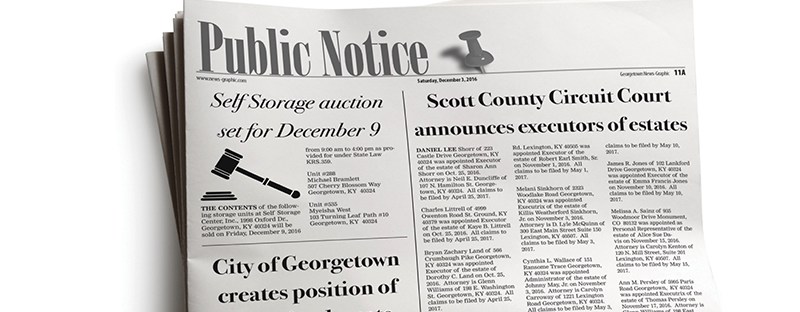
Ongoing legislative battles put Public Notices in peril

By Gretchen A. Peck

Author’s Note: The relationship between newspapers and Public Notice authors is being challenged across the U.S. What does this mean for newspapers and the public? I took a look at the issue in the October 2018 issue of Editor & Publisher magazine.

If you look closely at the fine print just below the banner logo for PublicNoticeAds.com, a single-source searchable database for legal ads published by “participating newspapers” across the country, it reads: “The public notice database on this site is not a substitute for the official publication that is required by law. You will still find those notices in your local newspaper.”

On the site’s homepage are links to each to state with “participating newspapers,” though most simply redirect the browser to other websites of a similar design. For example, clicking on the link to Connecticut redirects the user to Connecticut public notices, which is “powered by MyPublicNotices.com.” From there, users can click on individual links to public notices on individual websites for each newspaper title, or search notices published in any of the state’s local and regional titles.

In fact, legally mandated public notices are already prevalently available online and digitally redundant to what’s published in printed newspapers. In addition to these sites, they are also found on government-maintained sites, legal sites and on many newspaper-branded websites.

Yet, in several states just this year, legislators have proposed bills that would allow for public notices to bypass print altogether, possibly narrowing access to information and starving newspapers of the revenue derived from publishing information of this kind.

Given the legislative effort that feels coordinated and party-centric, E&P went in search of who and what was behind the lobby for this legislation and answers to what it would mean to newspapers if printed public notices become obsolete.

Read more at:
http://www.editorandpublisher.com/feature/ongoing-legislative-battles-put-public-notices-in-peril/ 
 

News & Publishing

The Side Hustle: What Do Newspapers Gain by Having Their Journalists Appear on TV and Radio?

By Gretchen A. Peck

For the penultimate segment on “Hardball with Chris Matthews” each weeknight, Matthews queries his panel of journalists and pundits—often with at least one reporter representing a major-market newspaper—challenging them, “Tell me something I don’t know.”

His branded phrase not only introduces the segment, it exemplifies one of the benefits of having journalists appear as guests on broadcast news programs. Reporters remain excellent sources themselves of researched, vetted and well-sourced information. Their appearances and expertise on the topics of discussion lend both content and credibility to broadcast news programs.

And there are obvious professional gains for the journalist—who has a brand and a byline to protect—and to the newspaper’s brand, which benefits from audience reach and an opportunity to evangelize its reporting.

Still, as some newspaper journalists have learned, appearing on broadcast news programs can occasionally come with some unwanted attention too.

Read more at: http://www.editorandpublisher.com/feature/the-side-hustle-what-do-newspapers-gain-by-having-their-journalists-appear-on-tv-and-radio/

Editor & Publisher magazine, October 2018 issue


News & Publishing

The Journalist and the President: I’ve Called with Bad News

I just listened to the phone call between Bob Woodward and President Donald J. Trump.
A few takeaways:
Woodward cites meeting with WH personnel outside of their offices, on the low down. He has tapes of those conversations (though protects source identities). This is the most whistle-blowy staff I’ve ever seen.
How quickly the President throws his team (including K. Conway, and Raj Shah) under the bus — in real time — and then how effortlessly she passes blame to official WH comms team. Also: Conway had lunch with Woodward to discuss book! Who would sign off on that?
Final thought. Woodward’s not perfect. He can sometimes err on the side of doubt-benefit when intention is otherwise obvious. But he’s pretty close to textbook on sourcing and supporting documentation. My guess is that the book’s narrative will feel like a tabloid read, because it’s a tabloid Presidency.
Here’s the audio, thanks to the Washington Post:
https://www.washingtonpost.com/politics/2018/09/04/transcript-phone-call-between-president-trump-journalist-bob-woodward/?utm_term=.865bfb1b0cef
News & Publishing

Newspapers 2020: How are newsrooms preparing for the next decade of publishing?

By Gretchen A. Peck

More than a year has passed since the New York Times’ newsroom published “Journalism That Stands Apart: The Report of the 2020 Group.” The report was intended to define “the newsroom’s strategies and aspirations” and laid out arguments for initiatives like nurturing more reader participation; creating more visually stimulating, multimedia journalism; and committing to greater collaboration between the newsroom and the publisher’s product teams.

Overall, the report provided interesting insight on what the Times was planning for its future, so we couldn’t help but wonder what other newspapers had on their agenda for 2020. E&P reached out to several newspapers across the country and asked them to share.

What variables do you think will have the most influence on how well your newspaper performs—in both revenue and audience—in the coming two years?

Read more at: http://www.editorandpublisher.com/feature/newspapers-2020-how-are-newsrooms-preparing-for-the-next-decade-of-publishing/