News & Publishing, Politics & Public Policy, TV, Radio, Audio

Weary, but resolved at year’s end

I spend many of my days telling the stories of local newsrooms around the country doing exemplary work, serving their communities with practical information, uplifting perspectives — building community, as we say. Over the decades I’ve been on this “beat,” it’s been thoroughly rewarding work. Not only do I enjoy turning the spotlight on these storytellers, it’s fortified my long-standing belief that journalism is foundational to democracy. Without the First Amendment, nothing that becomes before or after it in the U.S. Constitution really matters. Without it, a nation spirals into autocracy, theocracy, despotism. Without it, corruption runs unbridled. 

And I still believe this with every cell and synapse of my being. 

But I’ve grown weary. The constant onslaught of anti-press rhetoric, endorsed by the highest offices in the land has admittedly weakened my resolve in recent years. The nation’s slide toward authoritarianism — our inability to even argue from a baseline of facts — is such a profound disappointment. At times, it makes me wonder if all the hard work of my colleagues in the media is worth it when it increasingly feels like screaming into a void. 

I felt at the lowest point when I read the news that ABC News had settled a lawsuit brought by the President elect for comments made by anchor George Stephanopoulos during a “This Week” interview with Rep. Nancy Mace (R-SC). During the interview, the news anchor pressed Mace on her endorsement of the then candidate, considering Mace herself has spoken openly about being raped when she was a teenager. During his query, the anchor said that Donald J. Trump had been found liable for rape in the civil defamation suit E. Jean Carroll brought and won — with the jury awarding her $83.3 million. 

Trump took issue with the word “rape” and filed suit against the network. Keep in mind that even the judge in the case described the initiating offense in this way: “The jury’s finding of sexual abuse therefore necessarily implies that it found that Mr. Trump forcibly penetrated her vagina.” 

If forcibly penetrating a woman’s vagina – whether with a penis, an object or a hand — isn’t “rape,” then once again, it feels as if we’re not operating from a baseline of facts. It feels like arguing semantics in Atwood’s Gilead.

Before the case could advance further to the discovery phase, ABC News and George Stephanopoulos agreed to a settlement that required an escrowed $15 million to fund a future Donald J. Trump Presidential museum, another $1 million for Trump’s legal fees, and a public apology by the journalist – in other words, an admission of defamation. 

Tim Miller and William Kristol — notably former Republicans — had a conversation about the perils of criticizing Trump. They wrote on thebulwark.com, “ABC News and George Stephanopoulos have joined the preemptive capitulation parade by settling Trump’s defamation suit—and by conspicuously paying out protection money ahead of the inauguration. The potential chilling effect on a key First Amendment issue is breathtaking.”

Northeastern Professor Dan Kennedy opined in his newsletter: “What Stephanopoulos said arguably wasn’t even false, and surely it didn’t amount to actual malice. A deep-pockets defendant like Disney ought to stand up for the First Amendment lest its cowardly capitulation to Trump harm other media outlets without the wherewithal to fight back.”

On Twitter/X, Jeff Jarvis, author and journalist, issued a warning: 
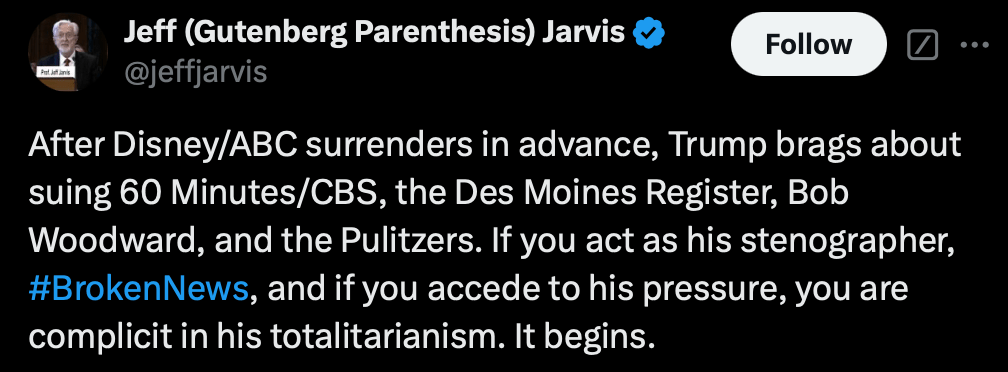
Of course, none of us had a seat at the conference table surrounded by high-hourly-rate lawyers, so it’s purely speculation as to why the news media publisher agreed to settle. Some say the legal definition of rape in New York is a higher benchmark than this form of sexual assault. Others said the network didn’t want to be forced into protracted and expensive discovery, during which the President’s legal team could request all sorts of documentation, from producers’ correspondence to business strategy, personal calendars and diaries, footage from every show that mentioned Trump, social media posts, you name it. 

Discovery is long and hard fought, typically with the Plaintiff asking for everything under the sun, and the Defendant having to go to court to argue against each non-related or protected journalist-source item. 

Still others speculated that the $15 million settlement was such an insignificant amount for the parent organization, the Walt Disney Company, that it just made sense to pay it and get it over and done with. After all, an ongoing legal battle would’ve further impeded the network’s ability to gain access or fairly report on the incoming Administration. All of these reasons could simultaneously be true, too. 

But the impact of the settlement has ripples — no, asphyxiating currents — that will reach far beyond the parties. It’s ammunition for a President and party that has continued to portray the press as “the enemy of the people.” It may not further embolden Trump himself to bring lawsuits against news outlets — he’s done that, usually unsuccessfully, for decades and long before he fatefully descended down the Trump Tower escalator to declare his first candidacy. And there’s no sign that he plans to slow down. Last week, he filed suit against the Gannett-owned Des Moines Register and pollster Ann Selzer over an unfavorable poll they published prior to election, alleging the poll — a poll, for goodness sakes — was akin to “election interference.” 

But it will embolden others, particularly the political and powerful classes, to wield lawfare as a weapon to intimidate the press, to send a chill through the media, and in some cases, to kill off news outlets entirely — destroyed by the weight of defending protracted legal battles. Death by billable hour. 

Atlanta Journal-Constitution Cartoonist Mike Luckovich so perfectly memorialized the settlement, shared on Twitter/X: 
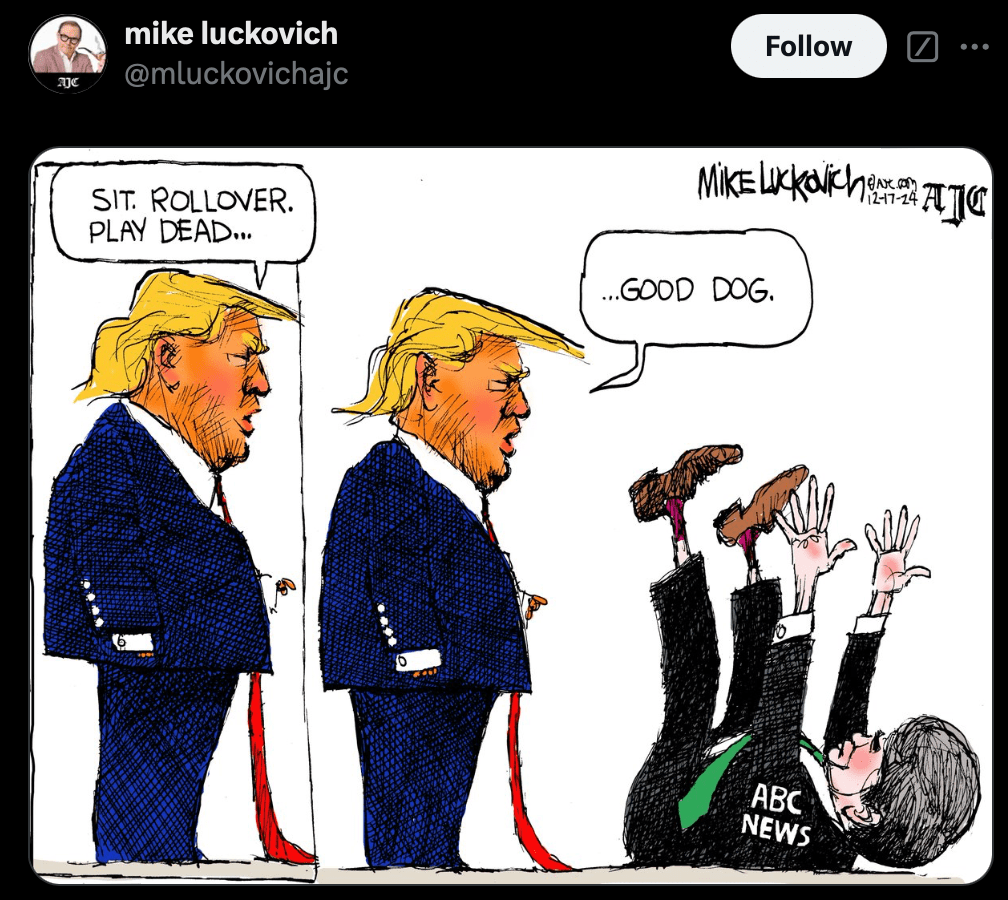
In E&P’s January issue, Columnist Rob Tornoe shares a conversation with Luckovich about being a political cartoonist in the era of Trump. You’ll want to read it. 

And let’s be clear, lawfare is not just a threat to large media conglomerates. It oozes down to regional and local newsrooms, as well. 

“I fear the federal attack on the press will trickle down locally, and it will be harder to get information through normal channels and freedom of the press requests,” Katie Honan, reporter for THE CITY, observed in Nieman Lab’s “Predictions for Journalism, 2025” series.

The other way it corrodes our profession is by signaling to journalists that your company, your superiors, may not have your back. They may, in fact, sell you out, make you pay, make you grovel. As a journalist there is little that’s more demoralizing than feeling as though your superiors would throw you under the bus rather than stand in solidarity with you. 

Jonathan V. Last at The Bulwark wrote that “Disney has cut off ABC News at the knees and put everyone in its news division on notice that they will not be supported by corporate if they make enemies with Trump world.”

But I’m feeling a little better, a little stronger, more resolved for a couple of reasons. This Des Moines Register case is so petty, so meritless, it’ll surely be tossed out, right? 

Right? 

And I spent the past few weeks learning about the journalism program at the University of Oregon, where the curricula, the practical experiences and skills the students learn, and the remarkable faculty who guide them have sent some welcome breezes from the west to lift my wings. Asked about the aspirations and temperament of the new class of journalists coming into the profession, one member of the faculty described them generally as motivated, inspired, idealistic, energetic. 

I figure, if they can be, I can muster, too. 

News & Publishing, Politics & Public Policy

The shifting balances of press powers: While First Amendment champions work to affirm the free press, others seek to undermine it

By Gretchen A. Peck, Contributing Editor, Editor & Publisher

The past few years have been remarkable for news media publishers, which have enjoyed some particularly public and powerful support. In the U.S. Congress, representatives and senators from both sides of the aisle sponsored legislative proposals that would secure press protections (the PRESS Act), get news agencies a seat at the table in negotiations with Big Tech (Journalism Competition & Preservation Act, the JCPA), and a proposal that would provide financial relief to local news businesses (the Local Journalism Sustainability Act, or LJSA).

Under Founder Steve Waldman’s direction, Rebuild Local News has been lobbying statehouse legislators to adopt bills that would provide tax credits to small businesses that advertise in local news media, to newsrooms that retain or hire more journalists and to individuals who subscribe or donate to a local news outlet.

While these champions for local news have been hard at work, powerful forces have been running a counteroffensive — undermining the press, impeding access and making it easier for members of the public and political class to sue news organizations.

Read on at: https://www.editorandpublisher.com/stories/the-shifting-balances-of-press-powers,243446

News & Publishing, Politics & Public Policy

What’s “Section 230,” and why should you care?

Yesterday, the Giants of Social Media stomped their feet down on the President of the United States, who’d abused their platforms all along, leveraging them to spread disinformation, launch attacks, paint targets, fire people, lament TV ratings, race bait, and – his most egregious offenses – to discredit the 2020 election, grift people of their hard-earned cash with promises of an overturn, inciting the most gullible among them to disrupt governance, trash and pillage the U.S. Capitol, plant bombs in the nation’s capital, murder a Capitol Police officer, and attempt to install Donald J. Trump as a second-term President via violent insurrection against their own country.

Whew.

Indeed, social media had tolerated much from the digitally prolific President, but as conversations of an armed terrorist attack on the nation’s capital began to simmer, they’d had enough. 

Immediately came the decries of a “First Amendment infringement” (it’s not), and Trump’s most loyal lawmaker friends calling for a repeal of “Section 230” – a pet peeve for the outgoing Commander in Chief.

What is Section 230?

“Section 230” – more formally known as Section 230 of the Communications Act of 1934 at 47 U.S.C. § 230, and colloquially as “the 26 words that created the Internet” – was born out of two 1990s lawsuits against ISPs and challenged in the Courts several times since. Each time, it was upheld. 

It is fair to say that Section 230 is perhaps the single most important legislation applicable to social media. It is what enabled platforms like MySpace, Facebook, Twitter, and others to grow, flourish, and become a huge, integral part of the American economy and culture.

President Trump’s interest in Section 230 appears to coincide with Twitter’s first fact-checking of the President’s potentially harmful tweets, back in the spring of 2020. At the time, he was undermining his own taskforce with COVID-19 disinformation, and already sowing the seeds of election chaos. 

Twitter justified the tags it placed on the President’s tweets by suggesting that virus disinformation could kill people – and it has – and that his election discrediting jeopardized democracy itself. The rest of the President’s political gamesmanship was all fair game, Twitter and Facebook concluded. 

From then on, the President became hyper-focused on a Section 230 repeal. He would like to be able to sue the tech companies for denying him a platform and megaphone. He wants to criminalize fact-checking. He has been so intent on this goal, that he was willing to tank two major pieces of legislation – the NDAA and a second sweeping COVID relief Bill – if he couldn’t get his way on Section 230. 

For Democrats, this repeal is a non-negotiable dealbreaker, perhaps because they have a better grasp of what’s at stake. 

In Congress, some of President Trump’s most lock-step Republicans now champion the repeal in his stead. 

Rep. Louie Gohmert (R-TX) sponsored a 2020 bill, known as H.R. 8896 – the AOC Act, which conveniently shares the acronym with a certain Congresswoman perpetually under the skins of her Republican colleagues and its actual title, “the Abandoning Online Censorship Act.” Gohmert was able to get seven co-sponsors to sign on, all Republicans.

It was “dead in the [swamp] water.”

In 2021, and in the wake of the de-platforming of an American President who would not follow the rules, Republicans will make this case: When the platforms began to fact-check, censor, and now ban content from the President and others, they have ceased to be a platform and are instead a publisher, with an editorial due diligence and subjective control over what users see or don’t see. 

The tech platforms will argue: As private companies, with clear terms of service (that users agree to when they open their accounts and create their avatars), they should be able to enforce those rules and codes of conduct, which clearly state that users are prohibited from sharing content that will harm or threaten people (other users or otherwise). 

It’s worth mentioning that the federal government already has some control over platforms and their users. For example, it is criminal act to distribute certain types of content across the Internet or any platform. Section 230 does not give social media platforms blanket immunity from all forms of civil or criminal prosecutions. 

If Section 230 goes away, what happens?

Without Section 230, the platforms, like publishers, would be subjected to defamation and libel laws. The distinction, however, is that publishers own their content. Publishers create, edit, verify and challenge, run it by lawyers, decide what and what not to publish, and then take whatever fallout there is from those choices; they wholly own the content they share. 

Conversely, platforms are just that – a technological foundation for users to share the content they and others produce. Without Section 230 shields, platforms could then be held liable for content they do not create and merely host. 

President Trump and his Congressional allies vow this repeal will force the tech companies to take an apolitical hands-off approach to users; that it will force them to enable more free expression; and force the platforms to be tolerant of a broader spectrum of ideas and alt-facts. 

They feel social media has been unfair to conservative voices and ideas. A simple glance at what trends on Facebook defies this assertion. On any given day, the top 10 trending posts on Facebook are often from Right-leaning media and personalities, or topics deemed of import to conservative-minded users.

I know you’re surprised that politicians would sell you poppycock, right?

Instead, a repeal would likely have a chilling, constricting effect on users most of all. 

Now, liable for content they do not create, platforms will be forced to more protective and less likely to tolerate content that could be controversial, debatable or have merit in a Court of law. 

Users would have less opportunity for free expression, not more

It’s a bottomless pit of liability for the social media platforms, which could be named as a Party in every single lawsuit in which a social media comment somehow plays a role – big-dollar cases to petty ones. 

The only real winners will be lawyers. 

Ultimately, it would hobble the tech companies, just as one notoriously vindictive President hopes. The tech market would be destabilized, fractured. Users would find themselves with fewer options and tighter restrictions on what they can post and share. Online communities will be more insular and more echo-chamber like. 

Businesses – especially small businesses that rely heavily on the mostly free marketing perks of platforms like Twitter and Facebook – would be hobbled, too. It doesn’t seem the Republicans like Lindsay Graham and Louie Gohmert have really thought this through. 

None of this is to say that social media execs don’t have plenty of atoning to do. There is no shortage of Silicon Valley sin, but repealing Section 230 will not address those in a surgical, effective way. 

News & Publishing, Politics & Public Policy

Consider the source

The Hunter Biden laptop story was so full of holes it’s hard to imagine why the NY Post — a tabloid — made an editorial decision to pick it up. This NY Times column explores why other outlets didn’t buy into it, including another Murdoch-owned paper, the non-tabloid WSJ.

It’s interesting to look at this from a 40,000-foot level and to study how news perpetuates in an economically disparate way. If you get your news largely from free sources or social media — or if you only watch Fox News and listen to freely accessible radio pundits — you likely don’t know the problems with the story and the diligence media outlets must use to determine its veracity. But if you’re a bit more well off — enough to afford a relatively expensive subscription to The New York Times or The Wall Street Journal, for example — you get the bigger picture, the more complete story, the truer version of events, and access to information that has been put through a meat grinder of editorial challenges and adjudication.

News & Publishing, Politics & Public Policy, Uncategorized

The Roof, the Roof, the Roof Is On Fire

Unlike George Floyd, who literally choked out his last words …

“Don’t kill me.”

“Momma.”

“I can’t breathe.”

… I only figuratively choke on words to chronicle this moment in our nation’s history. I feel inadequate and inarticulate. Nothing I can put to paper is profound enough. What can I write that I haven’t said before, after each injustice I’ve paid witness to in my lifetime — this life of mine that tonight feels privileged and impossibly long?

What have I not already said about the racial disparities that plague our culture? How can I, an inept bystander really, somehow define and encapsulate the festering wounds of racism and our pathetic inability to destroy it, once and for all?

I think I choke on these words because it’s not my story to tell. I think on these matters, as a white person who knows that I can go about my days — somedays even myself breaking laws — without that omnipresent fear that others will inherently aim to target me, harass me, disparage me, or even kill me, I might be best to shut the fuck up and listen, or better yet, to act as a conduit, a megaphone for others who know these atrocities firsthand.

I need to do a better job at making sure those stories are told. That is my mission and vow.

I may be better equipped to speak about protests. A child of the 60s and 70s, I have been witness to Vietnam-era rebellions, Los Angeles, Ferguson, and all the modern-era injustices that have led people to the streets to speak to their rage, to show the world their anguish.

I have myself marched, when there seemed like no other way to break through. This is all too familiar to me.

Tragically, rather than acknowledging their numbers and hearing their cries – rather than listening to their plight and empathizing with their anger – too many in this country will look at anecdotal property destruction and discount these protesters’ voices, wholesale. They will criticize them, or worse, tsk-tsk them and just move on about their days.

I sat up all night again, watching live feeds of fires burning in businesses, a news network under siege, tear gas canisters flying, and I think back to a demonstration I took part in years ago. I found myself side-by-side with a perfectly mild-mannered and otherwise peaceful, law-abiding person, who was so caught up in the moment, so unable to tamp down his rage, that he screamed out, “Burn it all down!”

That’s what rage does to human beings. That’s what being unheard, for years, decades, centuries, does to us.

As the day breaks, American cities will awaken to carnage today. They will find their neighbors and friends nursing wounds, glass on the streets, fires still smoldering. Talking heads on TV and social-media commenters will ponder, “Why have they done this? What purpose does it serve?”

They don’t understand it, because they haven’t tried to understand it.

I think about erupting rage and wonder how this anger is any less valid than the grievances that inspired this nation to elect Donald J. Trump as our 45th President? So often I’ve heard from Trump voters who say they voted for him to “drain the swamp,” to “shake things up.”

What they really meant was, “Burn it all down.”

The thing is, when you have that level of power – as a member of Congress or as President – burning it down proves rather easy and clean. No muss, no fuss. You don’t need to take the streets. K Street comes to you. You meet in chambers at the Capitol and with pen strokes, you dismantle it. You exploit that rage that sent you there to undermine law enforcement, intelligence agencies, the very system of justice that governs our land. You quietly leverage the courts to take mere access to healthcare away from millions who desperately need it. You slickly undermine public education. You put a price tag on the environment and sell it to the highest bidder. You champion war criminals and demote military heroes. You strike down laws intended to protect workers and people from businesses that will harm them and make them sick. You enrich your friends and starve the rest.

You challenge long-established Constitutional laws, because you can, and because you feel it’s what you were elected and emboldened to do.

You see a plague coming and you shrug it off, knowing that it might kill millions, especially in the cities for which you have disdain, cities that didn’t vote for you.

You burn it all down while surrounding yourself with blue-suited middle-aged white men cheering you on, never getting any grime on your hands at all. It’s all disgustingly dignified.

But the People don’t have that power. They’ve got to get their hands dirty.

The People don’t have those commemorative Executive Order-signing pens. They only have the streets. They only have their rage. They have only year after year of screaming into a void. And, so, they want to burn it all down the only way they know how, until the powerful listen, until they command their attention, until the change they demand comes.

News & Publishing, Politics & Public Policy, Uncategorized

The President’s “Keyboard Warriors” Take to the Streets

I saw this clip when the reporter first posted it — taken at some of sort of a rally. I can’t be sure whether it was a gathering just to celebrate the President or to make some sort of statement about the state of affairs on Long Island, within reach of the COVID-19 hotbed zone, New York City.

I’ve come to expect this kind of vitriol. It’s not new. Some years ago when I was dispatched to photograph a protest/counter-protest of Trump’s speech at the Coast Guard Academy commencement, I took some of this kind of flack myself from several individuals who walked alongside the protest marchers and screamed at the group. To me, they yelled “fake news” and some misogynistic nonsense that I shrugged off at the time. It’s gotten much worse in the years since, with reporters harassed, doxxed, physically assaulted, their gear ripped from their hands and destroyed.

The Constitutionally protected Free Press no longer feels very free. It feels like targets have been painted on their backs.

When this clip first published on Twitter, I had a couple of thoughts: First, note how brave the local TV reporter is as he walks through the frothy-mouthed crowd. See his calm as he navigates individuals/superspreaders yelling in his face and refusing to respect any physical distancing.

I thought, look at how they scream at him, even in front of their young, impressionable children. Look at how they seem to have lost their damned minds, becoming people I doubt they are in everyday situations. I bet they don’t behave like this at family reunions, nor at the workplace, nor in their neighborhoods, nor in their PTA meetings.

I was also hyperaware of the irony of this. Here, we have a reporter dispatched by the local Long Island TV station, to report on their event. Had he and others not been there, they would have been accused of ignoring their plights, blackballing their voices. How many times have you heard from the President’s most ardent supporters, “You won’t hear this on the mainstream media …”

And yet, this is about as MSM as you can get, the guy I bet everyone in the crowd knew by name and face, because he’s on their TV screens every weeknight. Local TV news is about as close to the community as you can get outside of a small-town paper. It’s not just “mainstream,” it’s “Main Street.”

Here he was to capture their moment, to take their story to the airwaves, to interview them and get their perspectives.

And what do they do? They threaten him, scold him, verbally shit all over the guy. They terrorize him.

I shared the clip on social media, and I blamed the President for this vitriol and hate. After all, it’s his words, verbatim, that they practically spit at the TV newsman. Listen carefully, and you can hear them parrot our President.

Turns out, I was right to put the blame at the President’s feet, because in the middle of the night — when the President should either be sleeping, meeting with his entourage at Camp David, or thinking long and hard about how to save lives in the throes of pandemic — the President shared this clip, too. Not once, but twice. That tells me he’s quite proud of these people, this behavior, and his ability to manipulate masses of his “keyboard warriors,” to the point that they have become something other than themselves.

News & Publishing

Headlines always fall short

The New York Times published a bad headline.

In the newspaper’s defense, headline writing is sometimes problematic. At the 12th hour, before the presses roll, when you’re tasked with finite space, painfully few characters and a need to quote a President’s national address, this stuff happens.

The headline was misleading as it read, but there was a lack of space to lay out the “backgrounder” context that puritanical media critics wanted. They wanted a headline that called the President a “racist.”

They wanted the headline to scream: He said this stuff, but of course he doesn’t really mean it. 

They wanted the headline to tell the full story. Headlines never do.

And, of course, this particular headline was never going to meet that expectation. It was never going to say, “Today, the President spoke insincerely about racism and gun culture.”

It was never going to say that a.) Because that’s a full sentence. b.) It’s editorializing in what is intended to be a straight news piece.

Critics, you can’t have it both ways. You can’t say, “The media is biased!” And then, at the same time, expect us to be biased, to make a qualification or judgment — and blatantly, on the front page, above the fold.

Certain members of the media (looking at you, Joan Walsh) piled on and stoked the embers of a digital subscription revolt against the Times. Never mind that 2,000 newspapers have shuttered in just a few years. Never mind that 95% of the time, The New York Times masthead somehow, incredibly, produces important deep-diving work that smaller papers cannot, because they lack the resources.

Never mind all the other good work by staff not tasked with political coverage. Never mind that many of them are trying to decide tonight whether they should pay their rent or buy groceries this month.

Never mind that every day is a mental, physical and spiritual succubus on journalists trying to cover this Administration.

This anger against The New York Times is misplaced. It’s bubbling up because of a President, who is never held to account for his words, his policies, his opacity and gaslighting, his indecency, and his criminal conduct. Of course, the President was insincere when he read his scripted statement. His uncomfortable body language. The sniffing. The stumbling over the words. The legacy of racist, violent rhetoric, archived and freely searchable on the Internet. The predictable 180-degree spin on Twitter the very next day.

Does The New York Times need to spell it all out for the American people in a pithy 15-character headline?

Are we that daft? ~ G.A. Peck

Here’s what The New York Times had to say about it: