
In the 1990s, I worked at a law firm while getting my grad degree. My job wasn’t clearly defined. I answered phones, paid the bills, and drafted correspondence and pleadings for the senior partners. One of the partners worked in criminal law, and working with his team allowed me insight into some horrific crimes — not the least of which was a compelling case against the Archdiocese for the alleged sexual abuse and rapes now made famous by the Netflix documentary, “The Keepers.”
That same attorney introduced me to a convicted murderer, for whom he was mounting a death penalty appeal. The man had been sentenced to death, along with a buddy, for murdering a Baltimore woman in her home. She was a single gal, a professional who lived alone. According to the defendants’ testimony, they’d gone to her home one evening, thinking she wasn’t there. Once inside, they scouted the first floor, looking for items of value to grab. They came to the kitchen and felt hunger pangs. They opened the refrigerator, took out some ingredients and began cooking up a snack on her stove.
But she was home.
Upstairs, she was sleeping in an early bed. The clanging sound of pots and pans and cooking utensils woke her. She stirred, and the sound jolted the intruders down below. One of the men grabbed a 10-inch chef’s knife — at trial, they’d pointed fingers at each other, accusing the other of wielding the knife — and they went upstairs.
They forced her back to the bed. To silence her screams, they put a pillow over her face. Then, the man holding the knife stabbed her dozens of times, including a final blow that penetrated the pillow and impaled her through the breastplate.
As I tell you this story, the hair on your arms might stand at attention. You might feel revulsion at the brutality of it. You might for just a fleeting moment consider what it was like for her in those final horrific moments. But you’ll never really understand the violence unless you saw the crime scene photos.
I had to sift through them one day, stacks upon stacks of black-and-white glossies taken by law enforcement and shown to jurors as evidence during the trial. To this day, I can remember how she looked, frail and tiny and limp. The simple furnishings around her defied why anyone would want to rob her. She had so little, just starting out in life.
Blood was everywhere — pooling on the sheets, seeping through the soft, worn pillowcase, where the knife was embedded in her body. It was splattered on the walls, the carpet, the nightstand.
I’m sure my heart fell out of rhythm when I noticed in one of the photos that she was wearing a nightgown with Ziggy, a cartoon character, childlike. I had the same nightgown when I was a teenager. I have a photo of me in it from one Christmas morning.
I cried for hours in our little law library. I still cry when I think about those images — when I think of her — today. They were hard to look at, certainly for the jurors who were deciding the defendants’ fate. But they needed to see them, to fully understand, to grapple with the violence, to make informed decisions and to act accordingly.
Yesterday, The Washington Post published a controversial investigative piece, “American Icon: Terror on Repeat, a rare look at the devastation caused by AR-15 shootings.”
Please look at it: https://www.washingtonpost.com/nation/interactive/2023/ar-15-force-mass-shootings/
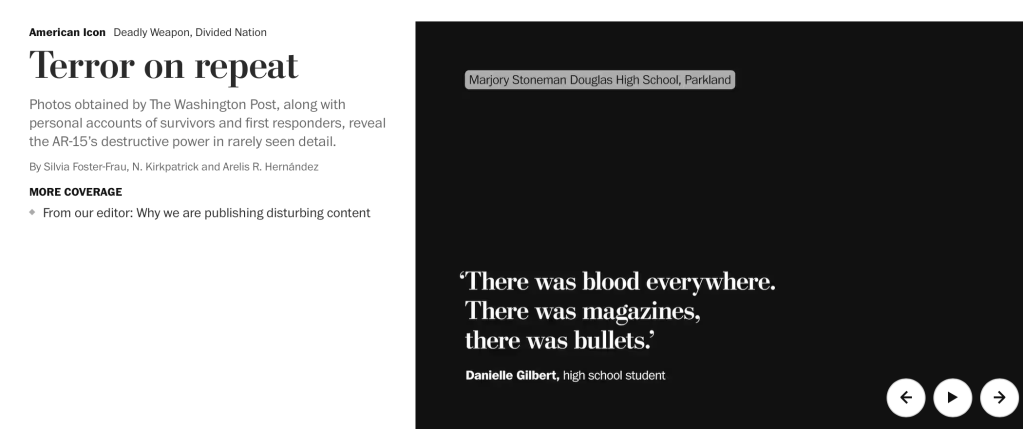
The piece is controversial for its graphic photos, showing the horror, carnage and death inflicted by people with access to a weapon of war — a gruesome tool designed expressly for hunting human beings.
As long as I have worked in news, there has been fervent debates among journalists about graphic images and what is beyond the pale for the viewing public. This is not an easy professional nor moral call. And it’s often the case that new outlets are accused of exploitation and shock value for publishing violent imagery.
I spoke with a Pulitzer-awarded photojournalist this week, for whom I have the utmost respect. She’s been covering war for more than 23 years, and has paid witness to the very worst of humanity, the very worst violence, the absolute worst gore. Over the course of her career, she’s faced this dilemma an untold number of times, weighing which images to submit for publication and which ones are simply too grotesque to inflict on others.
She spoke thoughtfully about her worry that if a photograph is too distasteful to a person, they’ll simply turn the page or switch the channel and move along, negating all of the work and danger it took to capture it, negating the story of the victims.
If they can’t stand to look at the photo, they can’t care about the people, she explained to me.
We talked a little about the skills a journalist acquires on the war beat, and how they translate here in America for local news reporters who find themselves covering crises, like mass shootings. If you’re intrigued, I’ve written more about our conversation in the December issue of Editor & Publisher.
I implore you to look at the photos in WaPo’s important piece of journalism.
Fit yourself in the cowboy boots of young people running from rapid gunfire, when moments before they were singing along to country music.
Stand over the body bags lining an elementary school hallway, with the corpses and parts of children zippered inside, and imagine what it’s like to be their parents, their friends, the adults who failed to protect them.
Fight the urge to turn away from the picture of pews, soaked in blood, the walls of the church pockmarked and splintered by an AR-15s spray.
No narrative, no amount of pontificating, no amount of wrestling with the right adjectives can communicate the story more honestly and accurately than these videos and photos.
Brett Cross, father of Uziyah “Uzi” Garcia, who was one of the children murdered at Robb Elementary, took to X/Twitter to comment on The Washington Post piece: https://twitter.com/BCross052422/status/1725139970518646866
He’s right: Why should these images only haunt him and the victims’ families? We’re all responsible for gun violence in this country, because we turn away, we move on, we conscientiously — by choice — build up our tolerance to it.
I get tangled up on the question of whether it’s the press’s duty to somehow soften the blow, to make violence and murder more palatable to the public? Or is it a newsroom’s duty to depict the crime and its aftermath with unobscured clarity?
I think WaPo made the right call.
 Gretchen A. Peck